2 ¿Cómo eres?
Your Chapter 2 task is to share more personal information about yourself and ask others about themselves.
Meet Jessica Milagros, from the American television show, Big Brother. Listen as Jessica introduces herself by sharing some personal information with you such as her profession and ethnicity.
Steps to take to achieve this task:
- ¿Yo, tú o elle?- introduce yourself with the verb ser and identify subject pronouns in Spanish
- ¿A qué te dedicas?– state your profession and nationality and ask others about theirs with the verb ser
- ¿Cómo eres?– describe your personality and physicality with the verb ser and ask others about theirs
- ¿Cómo estás?– express how you are feeling and where you are with the verb estar and ask others how they are
- ¿Qué te gusta?– describe what you like or dislike and how to identify favorite things with articles- ask others about their likes and dislikes
- Task 2 Assessment– share more personal information about yourself and ask others about themselves
I. ¿Yo, tú o elle?
In Chapter 2, you will go beyond introducing yourself with your name and saying where you’re from. You will learn how to share even more information about yourself with the verb ser such as what you do for a living, your physical and personality traits and nationality or ethnicity.
Jessica Milagros, who introduced herself to you at the beginning of the chapter, recently went live on Instagram for her Spanish-speaking followers. Watch as Jessica introduces herself to them.
What does Jessica reveal in her Instagram Live?
When Jessica states her profession and ethnicity in her Instagram Live, did you notice that in one sentence, she uses the subject pronoun yo, and in the other she does not?
Jessica says:
Yo soy puertorriqueña. Soy modelo y ex jugadora del programa, Big Brother.
Both Yo soy and Soy mean I am. Why does one sentence have a subject pronoun, but the other does not? Unlike in English, where a subject pronoun is required in a sentence to understand who or what is completing the action, in Spanish, the subject pronoun is optional.
Watch the following video by BaseLang as you get introduced to subject pronouns in Spanish and the rules related to when to include them in conversation and when to omit them.
¡Muy bien! 🙂 You just learned many new subject pronouns in Spanish. However, there are a few more subject pronouns you should be aware of.
Vos – This subject pronoun is similar to the informal tú, but it is specifically used in countries in Central and South America.
Elle, Elles, Nosotres, Vosotres – These are non-binary subject pronouns used in Spanish-speaking communities that celebrate inclusivity.
Play the audio to hear the explanation of the subject pronouns, including inclusive ones with the verb ser.
Actividad A
Now that you know about the different subject pronouns in Spanish, see if you could place them in their correct space based on the cues provided.
Carmen is related to Jessica Milagros, and she would like to share a photo of her friends with you. Listen as Carmen describes each person in the photo with subject pronouns.

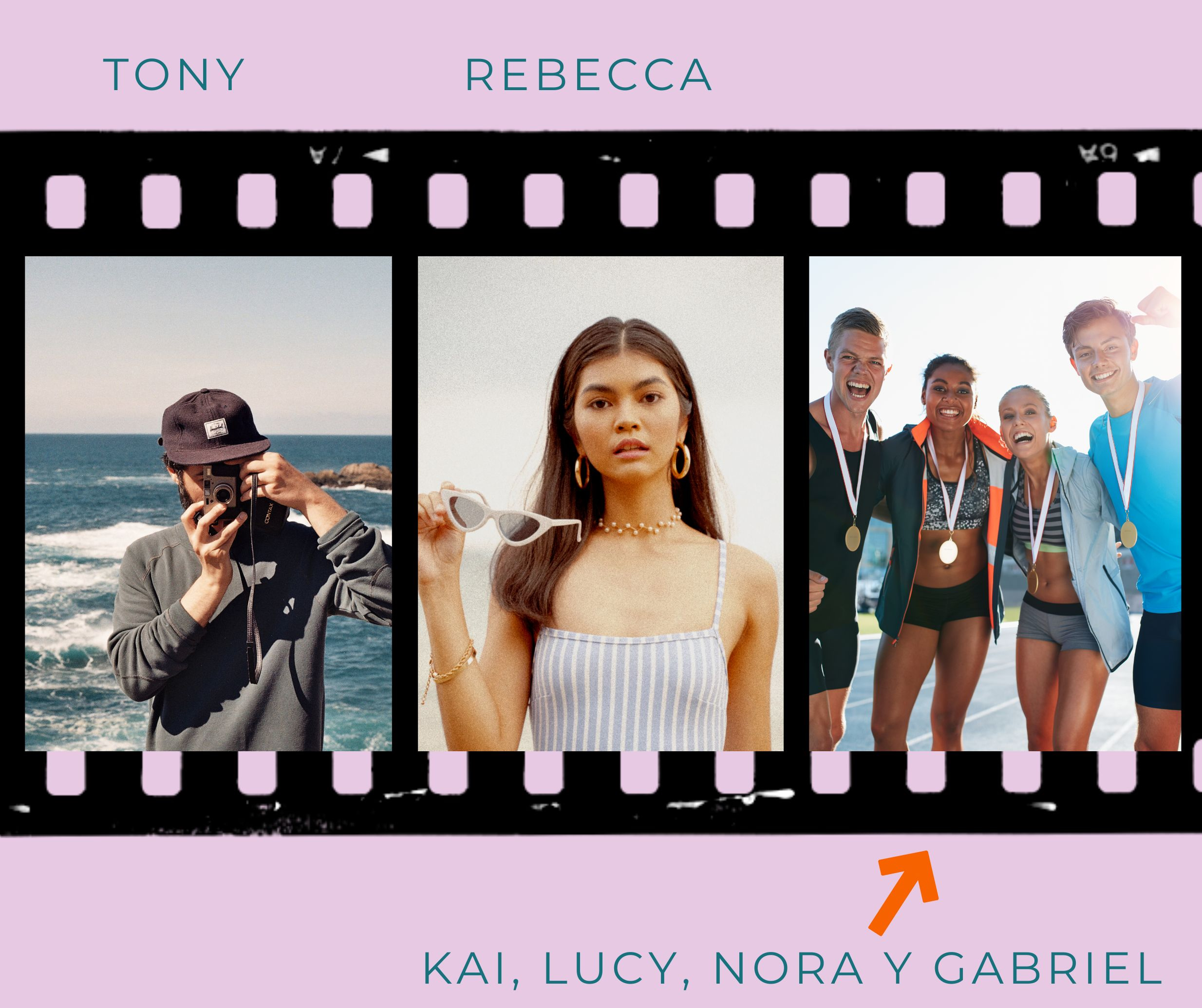
Actividad B
Select which subject pronouns Carmen uses for her friends.
¡Bravo! 🙂
In the following video, BurbujaDELEspañol reviews subject pronouns with the verb ser for you. Feel free to select captions or subtitles by pressing CC on the bottom portion of the video.
Actividad C
¡Muy bien! 🙂
Actividad D
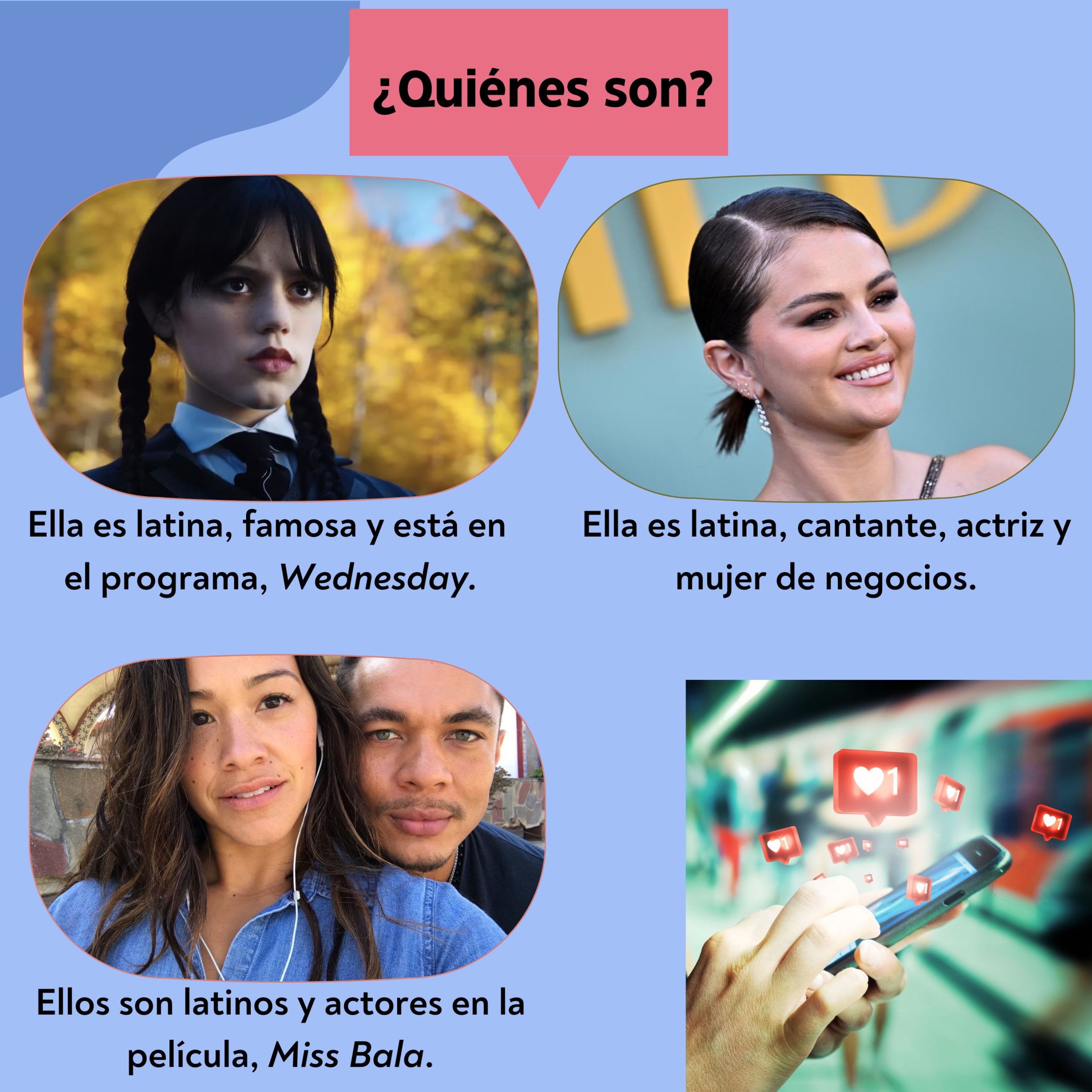
Paso 1. Jessica Milagros just followed new Latinx artists on Instagram. She admires their work. Based on the descriptions of each one, can you guess who they are?
Here are the Latinx celebrities, with links to their Instagram accounts:
Gina Rodriguez, Selena Gomez, Jenna Ortega, Ismael Cruz Córdova
Instructions:
With a partner, take turns reading descriptions of each Latinx celebrity in the following Instagram post. Once you’ve read a description, say either ¿Quién es? (if you are asking about one person) or ¿Quiénes son? (if you are asking about more than one person) If you know the answer, say it in the following format.
Es ____. (He or She is) OR Son ____ y ____. (They are)
Modelo-
Estudiante 1- Ella es latina, famosa y está en el programa, Wednesday. ¿Quién es?
Estudiante 2- Es __________. <~~ say the name
Paso 2. Are there any Latinx celebrities you follow on social media? Share them with your partner by taking out your cell phone and holding up their social media profile and say why you follow them.
Modelo-
Sigo (I follow) a Mario Lopez en Instagram porque él es muy cómico. OR Sigo a Rosalía en TikTok porque me gustan sus videos.
*If you don’t use social media or follow any Latinx celebrities, select a photo from your cell phone, or from another source, and introduce someone you admire with the Spanish you’ve learned thus far.
Modelo- (I admire) Admiro a _____ porque es _____ OR porque me gusta _____.
¡Excelente! 🙂
Did you know that there is a movement occurring within the Latinx community to identify and use inclusive subject and personal pronouns in the Spanish language? Read the following Intercultural reflection to learn more about the importance of inclusivity in the Spanish-speaking world.
Intercultural reflection 1
Do you have any friends or family members that use non-binary pronouns? Are these non-binary pronouns accepted in your community? In the Latinx world, the use of non-binary pronouns has become more present and embraced as part of the Spanish language. It is called inclusive language or lenguaje inclusivo.
Jiveworld Languages discusses the topic of languaje inclusivo in the Latinx community.
Explore more
- Do you feel language in general should be more gender neutral and more accepting of inclusive pronouns, adjectives or professions? Share your opinion.
- Why do you feel the Latinx community is now embracing the pronouns elle, elles, nosotres and vosotres?
- The RAE (Real Academia Española), the official institution in Spain responsible for regulating and maintaining the standards of the Spanish language, has not officially accepted inclusive pronouns as part of the Spanish language. Jiveworld Language explained why this is the case in her video. Do you feel this is just or unjust? Share your opinion.
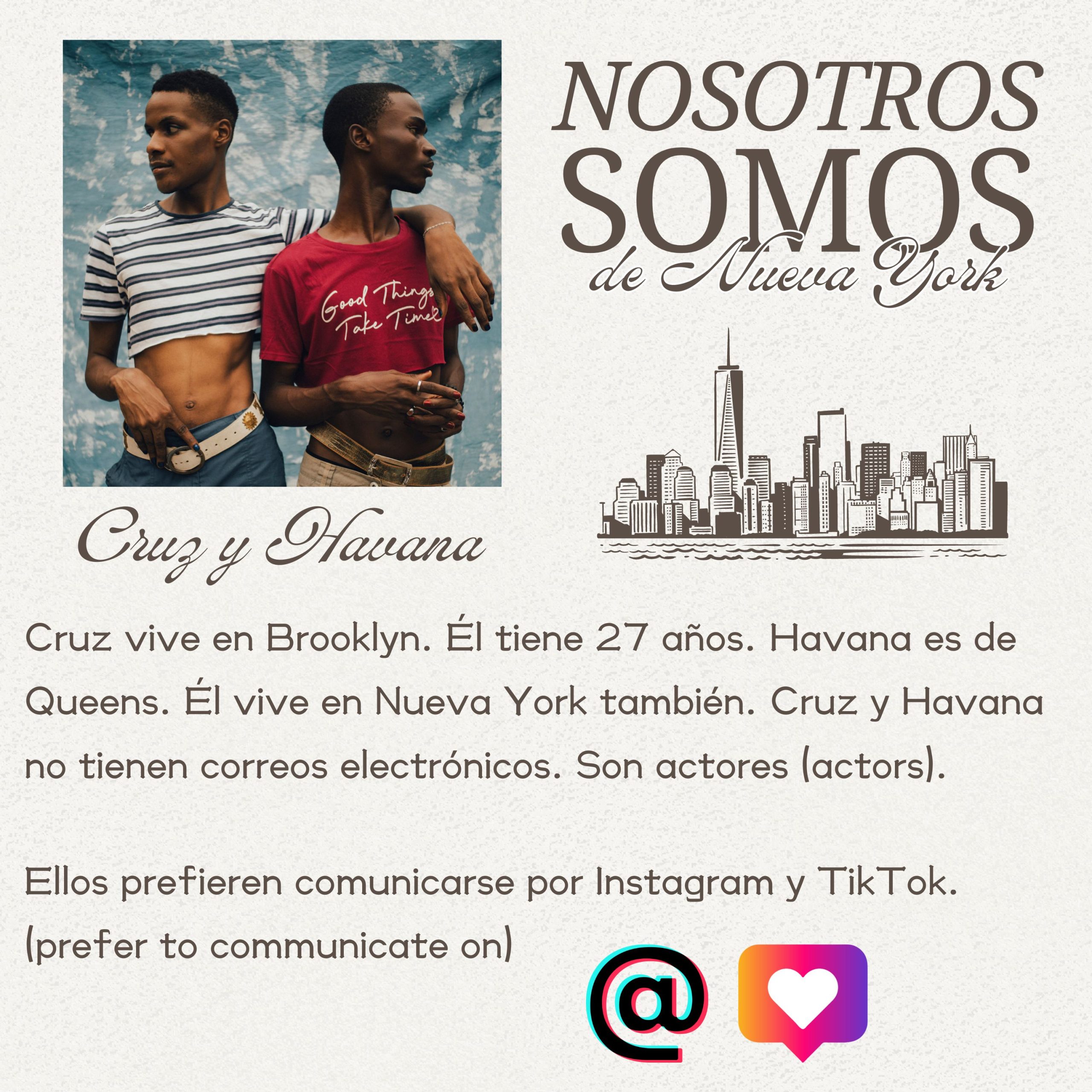
- Read the following online profile a promoter wrote for Cruz and Havana, two Latinx actors. They are part of the non-binary community in New York. What pronouns did the promoter get wrong? Find the subject pronoun errors in the following online profile, and fix them so that it reflects el lenguaje inclusivo for Cruz and Havana.
5. To understand the perspective of the Latinx non-binary community regarding gender inclusivity and language, watch the following video by Atlas Wylde.
6. After watching the video, do you have more empathy for the non-binary community and the importance of recognizing their identity in the Spanish language? Do you have more compassion for the non-binary community and the use of inclusive pronouns in your area? Share your opinion.
7. What was something that resonated with you from the video by Atlas Wylde?
II. ¿A qué te dedicas?
You’ve learned how to use the verb ser to identify yourself and others with subject pronouns. Do you know how to express what you do for a living or your nationality in Spanish? Do you know how to ask others about their profession and ethnicity?
Earlier, in Jessica’s Instagram Live, she shared her ethnicity and profession. Do you remember them?
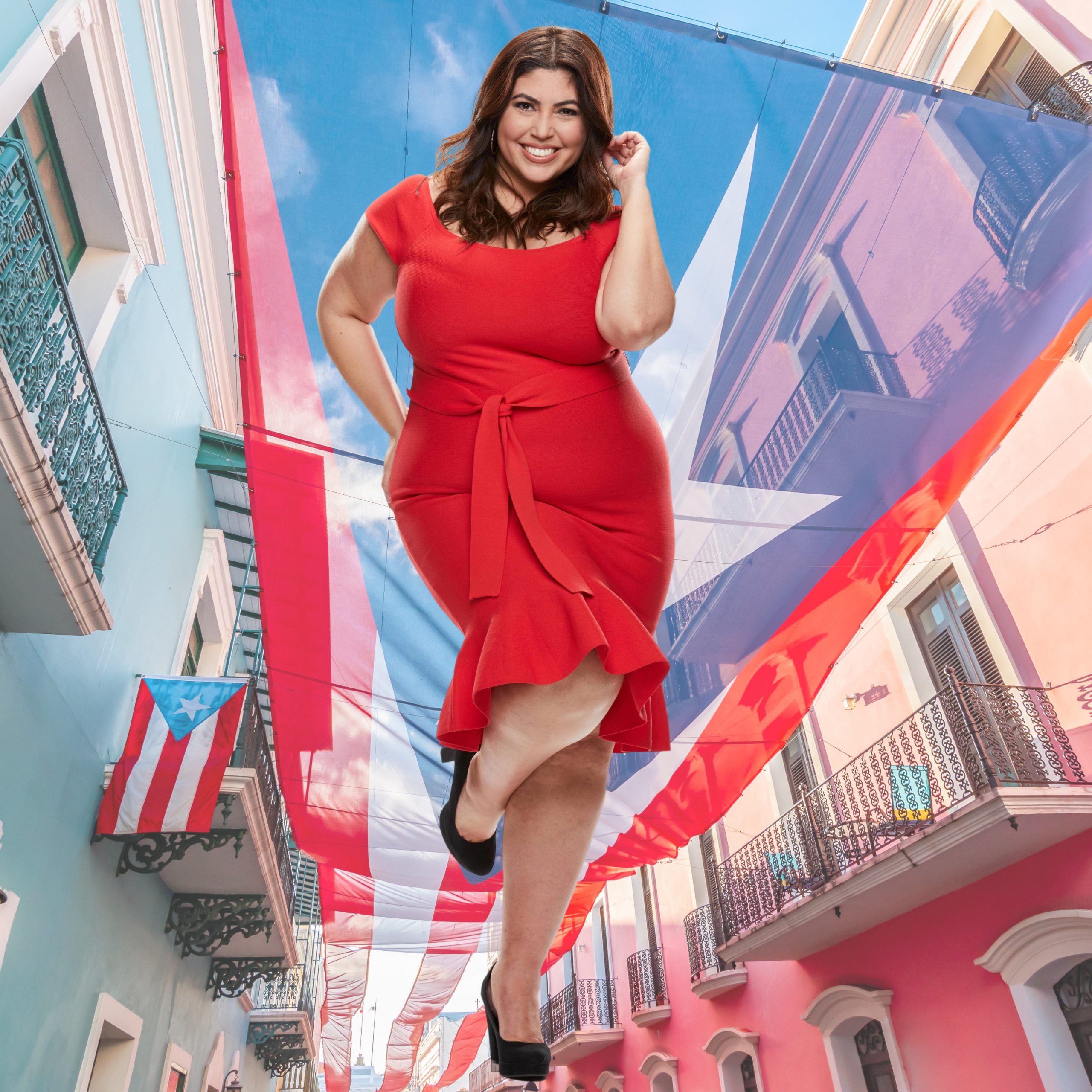
If you identified Jessica’s ethnicity as Puerto Rican, you would be correct! Muy bien. :). Most think that being Puerto Rican is a nationality. Because Puerto Rico is not an independent sovereign nation, Jessica’s nationality would not be Puerto Rican. That would be her ethnicity.
The country where you were born or hold citizenship would be considered your nationality. Jessica was born in the U.S., so her actual nationality is American, which in Spanish is estadounidense.
Whether Puerto Rico should be an independent nation is a topic worth discussing. What is your opinion on the matter?
When asking someone what their nationality is, you would say, ¿Cuál es tu nacionalidad? (What is your nationality?)
To learn more about nationalities, read the following slide.
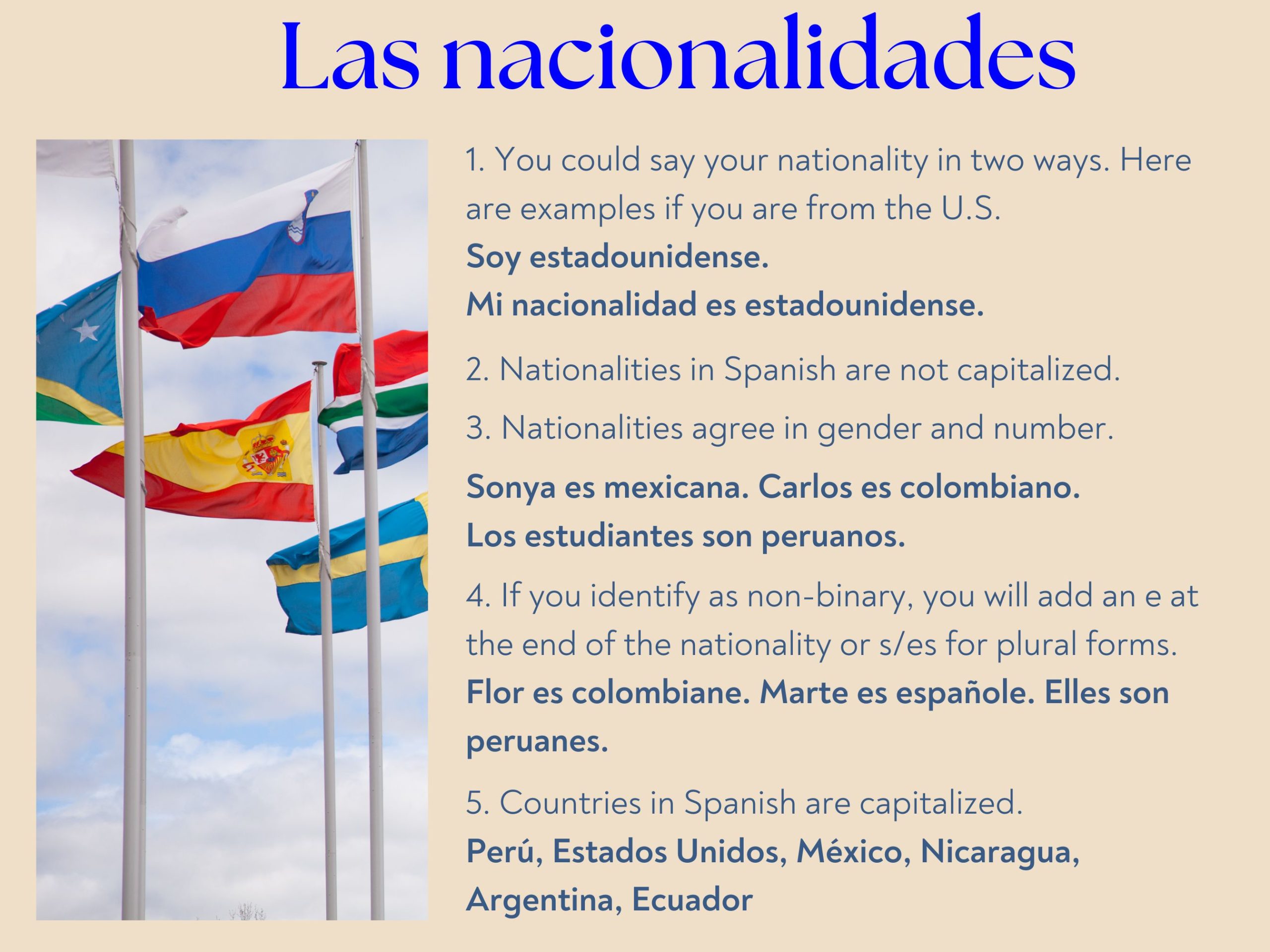
The following slide includes some nationalities where Spanish is spoken. Play the audio to hear how they are pronounced.
Actividad E
Paso 1. You will be taking part in a virtual conversation exchange program to help you develop your Spanish-speaking and intercultural competence skills. You will be selecting a Spanish-speaking partner to converse with.
Each speaker shares their brief biographies, and they include where they are from.

Write each conversation partner’s correct nationality in the following spaces. Be sure to include accents when necessary.
Paso 2. Watch the following video to see a Spanish language learner discuss nationality with her Latinx conversation partner.
Una conversación sobre la nacionalidad
For a transcript of the conversation, click here.
Una conversación entre Kristin y Yanina
Video by TalkAbroad
Paso 3. If your conversation partner would like to know your nationality, how will you answer?
Conversation partner- ¿Cuál es tu nacionalidad?
You answer: Soy _______________.
Another way you could express your nationality is by stating the country where you are from, as you just saw in the conversation exchange between Yanina and Kristin. Example- ¿De dónde eres? Answer- Soy de los Estados Unidos.
Remember, countries are capitalized in Spanish. If you would like to know how to say a particular country in Spanish, you could look it up at www.wordreference.com.
Listen as Lingo Mastery Spanish pronounces some countries in Spanish for you. Note- Los Estados Unidos should have capital letters on both words in the video.
Actividad F
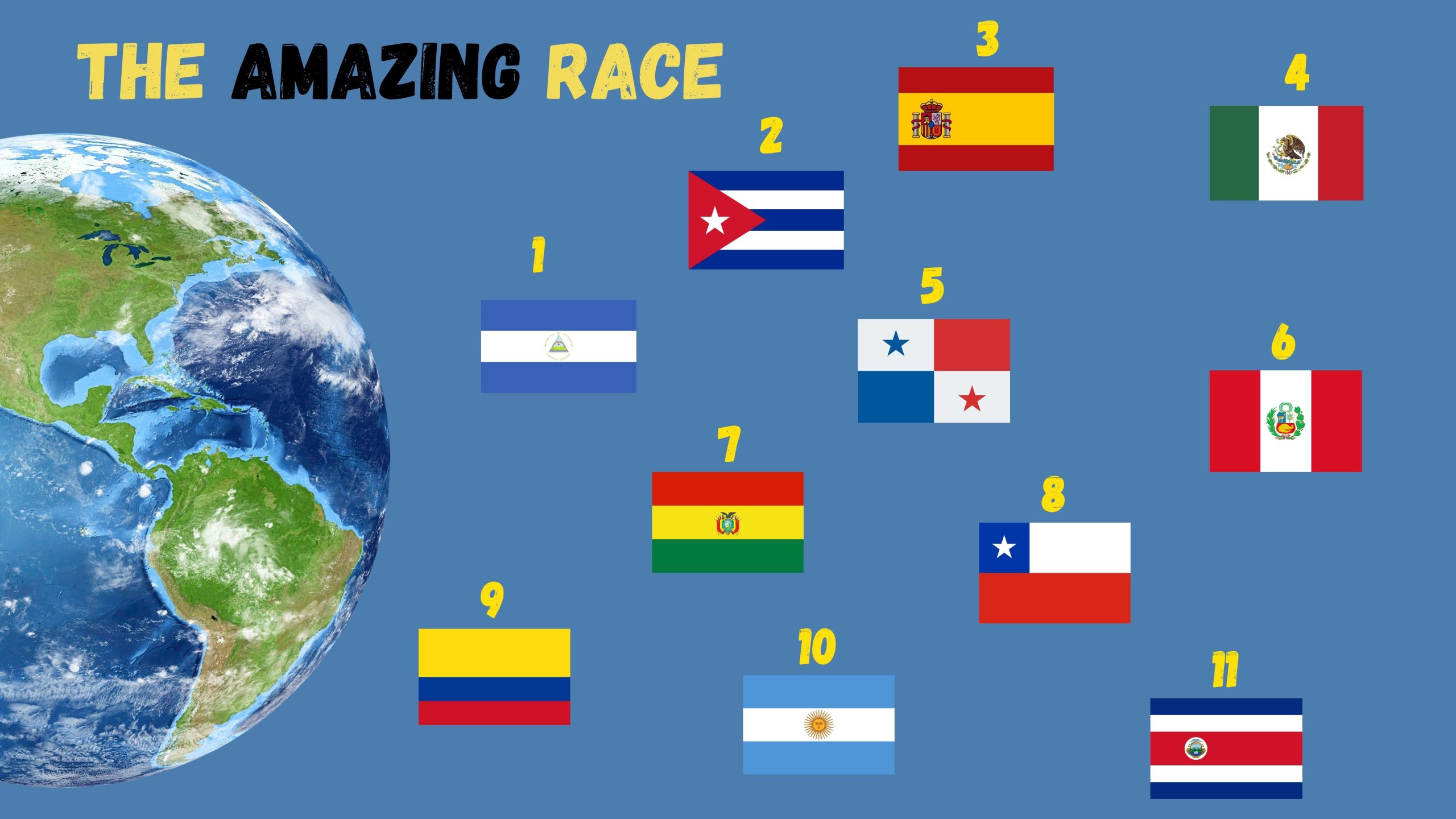
Have you seen the Amazing Race before? The contestants travel to different countries around the world to complete tasks. As a fun activity, in groups of 3-4, you will be traveling together to Spain and Latin America. In preparation for your travel, write down the countries you will be visiting and their nationalities based on each country’s flag and their corresponding number in the slide below the Amazing Race video.
The following link will help you with the names of Latin American countries in Spanish.
If you would like extra competition, see which group could correctly identify the most countries and nationalities via their flags within 5 minutes!
Actividad G
Paso 1. Get to know your classmates better. Ask 2-3 students the following questions about their nationality and origin.
- Hola. ¿Cuál es tu nacionalidad? You would answer: Soy _______. (nationality- do not capitalize)
- ¿De dónde son tus padres (parents)? You would answer: Son de _______. (country- capitalize)
- ¿De dónde eres? You would answer: Soy de ______. (city, state or country- capitalize)
- Muy bien. Gracias. 🙂
Paso 2. Report back. What did you learn?
Modelo- Charles es estadounidense. Sus padres son de China (His parents are from China.) Charles es de San Francisco, California.
The topic of nationality and ethnicity could be challenging for the Latinx community who suffer from prejudices and stereotypes from others. Have you ever experienced someone stereotyping you or someone in your community based on ethnicity or nationality?
Read the following Intercultural reflection to learn more about the Latinx experience with regards to overcoming stereotypes (los estereotipos).
Intercultural reflection 2
In popular culture, you may hear people refer to Latinos as Spanish. This is incorrect. Spanish is the language that the Latinx community speaks. There are people that are Spanish; however, they are from Spain.
Stereotypes about and within the Latinx community exist. For example, because people from the United States are so close to Mexico, there is a misconception that all Latinx people are Mexican. This is false. Each Spanish-speaking country has their own identity and nationality.
There is another stereotype that all Latinos look the same. This is also false. Latinos have very diverse backgrounds. For example, there are Latinos that have indigenous, African, Asian, and European roots.
Did you know that the following celebrities from BuzzFeedVideo were Latinx?
Explore more
1. What stereotypes have you heard regarding Latinos? How do you feel when you hear them? How do you think they make the Latinx community feel?
Watch the following video by NBC News as the Latinx community discusses the issue of stereotypes directed towards them.
2. What are your thoughts or reactions to the Defining Latino video you just viewed?
3. Do you resonate with the discussion about identity and stereotyping? How so?
4. Have there ever been stereotypes about your community, ethnicity or nationality? If so, what were they? How did those stereotypes make you feel? What do you think could be done to help avoid stereotyping? Share your ideas.
5. Do you feel more empathetic towards the Latinx community regarding the issue of stereotyping? Has your perspective changed on the matter? Will you do anything to raise awareness or support the Latinx community when you hear someone stereotyping them?
Earlier you learned that Jenna Ortega is an actress that Jessica Milagros follows on Instagram. Have you seen the popular Netflix program, Wednesday, starring Jenna Ortega? Watch a famous scene from the program, where Jenna dances as her character, Wednesday.
Recently, Jenna Ortega, Latina star of Beetlejuice and Wednesday, was interviewed by Carolina from Pero Like. The interview went viral because Carolina told Jenna that she was Latina enough. Jenna had received criticism for not being Latina enough because she didn’t speak fluent Spanish.
Watch the following segment.
6. Why do you think this video went viral among the Latinx community? Do you feel to be Latino/a/e enough, you need to speak Spanish?
7. The name of this Spanish language e-book is Nepantla, which is a Nahuatl word that means to be in the middle of or between two worlds, two languages or two cultures. How does Nepantla pertain to American born Jenna Ortega, whose ethnicity is Mexican and Puerto Rican, but her nationality is American? Have you ever felt Nepantla (in between two worlds) in your community, family or friendship circle? Share your experience. If not, do you know of anyone who has felt like they are in between two cultures o identities?
8. After completing this Intercultural reflection, what perspective have you gained from the Latinx community regarding stereotyping, Nepantla and being Latinx? Will this change your own perspective about the Latinx community or your own identity moving forward?
We now know Jenna Ortega is a famous actress. That is her profession.
Watch as spanishteacherlatef introduces more professions to you in Spanish in one of his TikTok videos. Did he mention your current or future profession? 🙂 Be sure to press the sound button on the bottom left.
@spanishteacherlatef Jobs in 🇪🇸 what do you do? 😁 @mosesgotterer #spanish #spanishteacher #espanol #learnspanish #jobs #vocabulary #foryou #usa #uk #nyc
♬ Monkeys Spinning Monkeys – Kevin MacLeod & Kevin The Monkey
Spanishteacherlatef ends his video with, ¿A qué te dedicas?. This is an informal way to ask someone what they do for a living. ¿A qué se dedica? is the formal way. When getting to know a Spanish-speaker, asking what they do for a living is a common question to get to know them better.
See the following post for ways to answer when someone asks you, ¿A qué te dedicas?
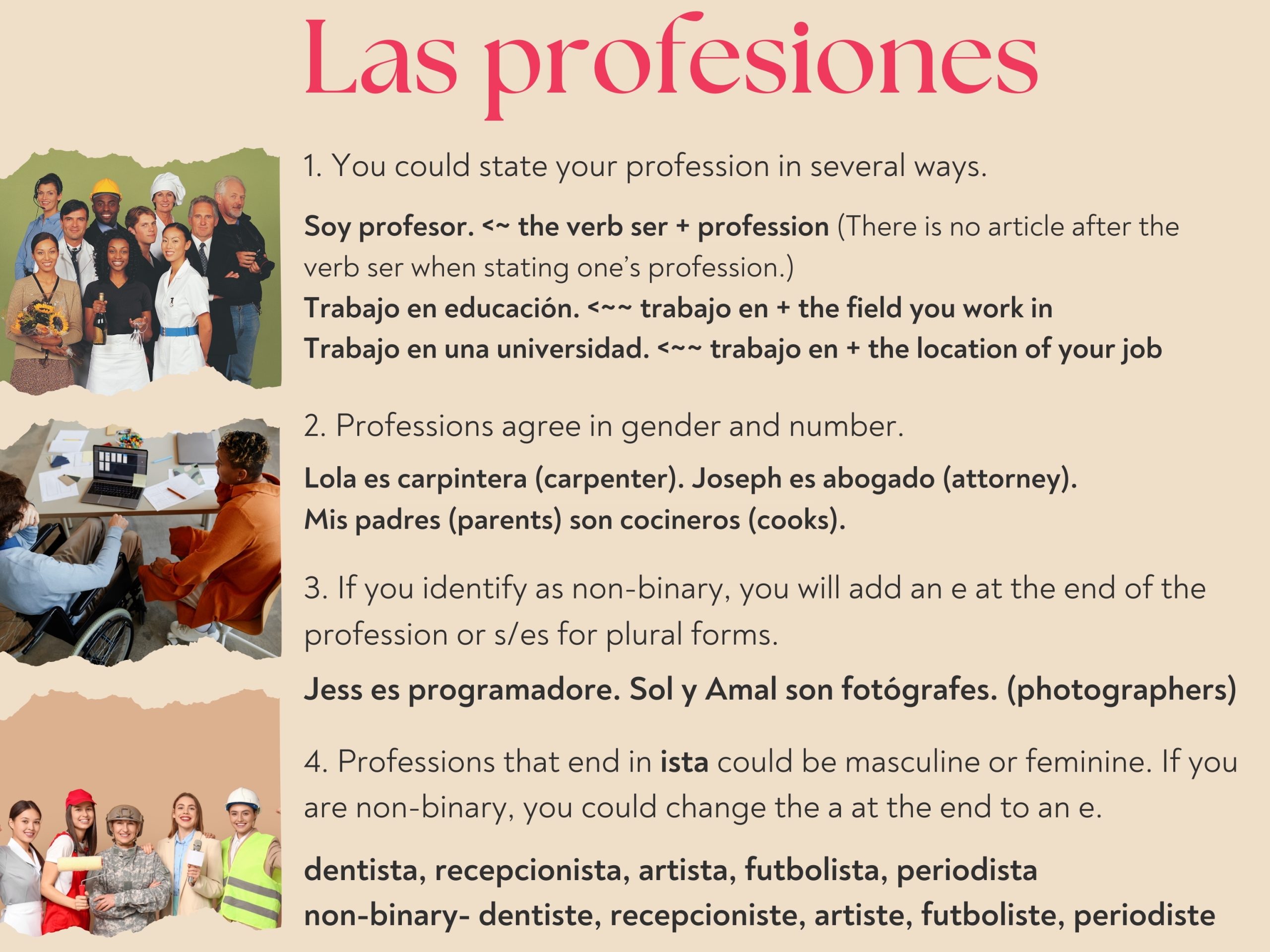
For a list of some professions in Spanish you may be pursuing, see the following slide. If yours is not on the list, you could go to www.wordreference.com to look it up.
The professions listed in the following slide are separated by a forward slash for the feminine and masculine forms. For example, a nurse in Spanish is enfermero/a. A female nurse would be enfermera. A male nurse would be enfermero. If you identify as non-binary, the profession would end in e, enfermere.
Actividad H
Complete the following crossword puzzle with the correct profession based on each cue provided. How many did you get right? 🙂 Did you pay close attention to the gender of each profession?
For a list of more professions in Spanish, follow this link by Livelingua.
If you would like to get to know what someone does for a living or where they work in formal and informal settings, review the following slide.
Actividad I
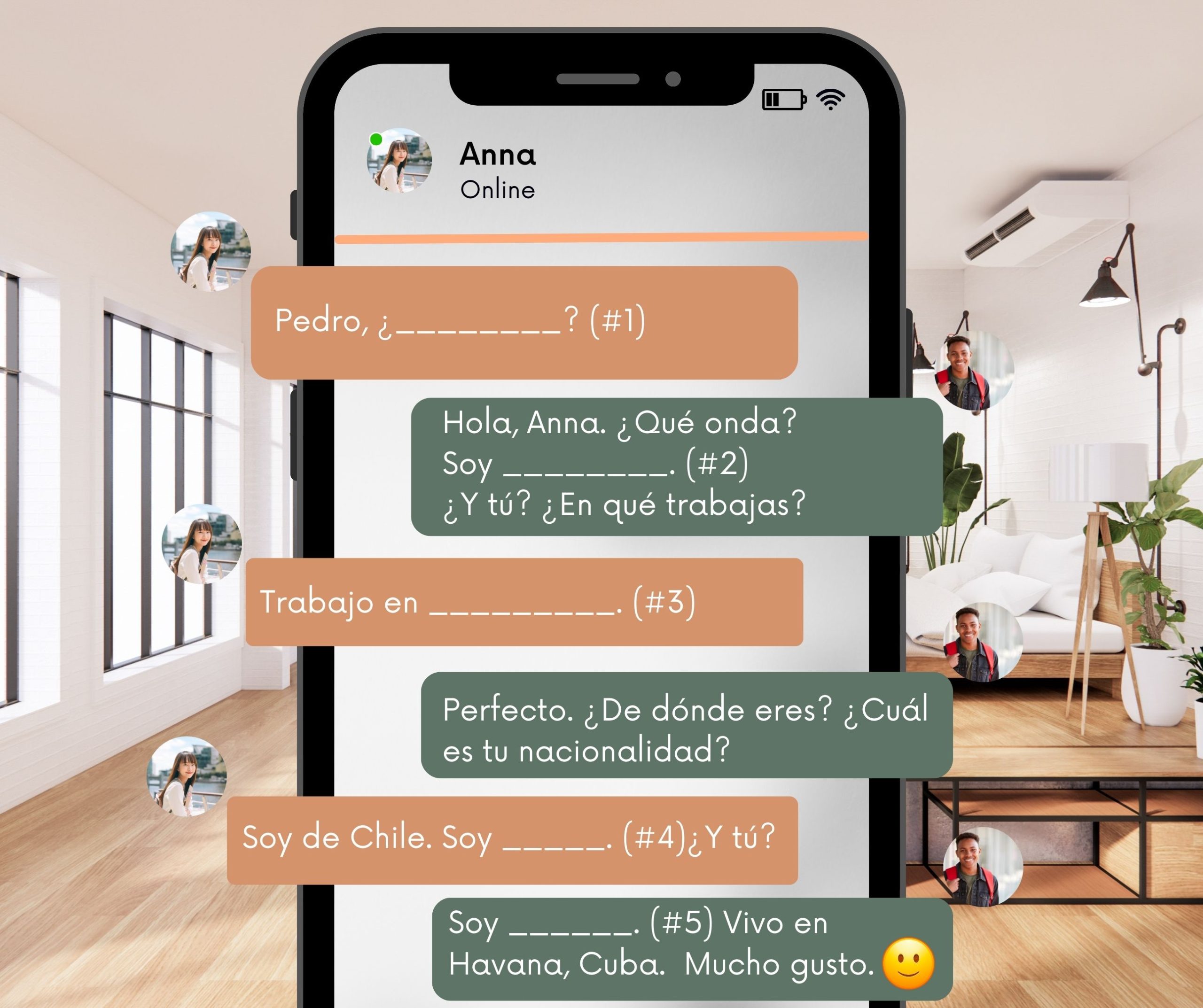
Anna and Pedro just met at a virtual seminar about volunteering in Central America. They would like to get to know each other more by asking about each other’s nationality and profession.
Based on their text exchange, what do you think they said in each blank? Select the most appropriate answer.
Valeria, a virtual conversation partner, would like to introduce herself and ask you some questions about your profession and nationality to get to know you better. Record your answers.
For a transcript of Valeria’s introduction, click here. Scroll to Valeria.
Regarding professions, did you know that there is a movement in the Spanish-speaking world to make professions more inclusive? Is this the case in your community as well? Is there equality in pay among men, women and the non-binary community?
Complete the following Intercultural reflection to learn more about professions and inclusivity (las profesiones y la inclusión) in Latin America and Spain.
Intercultural reflection 3
Earlier you learned how the Spanish language is evolving to be more inclusive. The same is true for professions in Spanish-speaking countries.
Did you know there are certain professions in Spanish that do not have a word for women who do that certain job?
For example, if you would like to say you are a pilot in Spanish, the word is piloto. There is no word for a female pilot. You would need to add “la” in front of the word piloto to identify the pilot as female. However, there is no feminine word, such as pilota for piloto.
How do you feel about that?
Another example is the word for mechanic. In the Spanish language dictionary, there is no feminine form of mecánico. Do you feel this is fair?
There are certain professions in Spanish that end in a vowel such as e or a for males and females that you’ve seen in previous slides.
For example- intérprete, dentista, ecografista, publicista, policía <~~ these professions are identified as female or male by the article (el or la).
However, there is a movement in the Latinx community to be more gender inclusive in professions. Similar to the non-binary community using the letter e to not have to distinguish between male or female, Latinas would like feminine forms to their respective professions to be identified as well.
Watch the following inspirational video of women adding the letter a to their professions in Spanish on their own.
Make sure to press CC and select translation into English from the settings wheel to read the subtitles.
Explore more
- Are there certain professions in your community that are dominated by males and not very inclusive towards women?
- Are there gender stereotypes associated with certain professions in your community? What are they?
- How do you feel about gender stereotypes in professions in general? Has your community taken any steps to address gender stereotypes in your community?
- Is there equality in pay between men and women in all professions in your country? Where do you see the most disparity in pay?
There is a group of women who are currently challenging gender stereotypes in the field of mountain climbing. They are called The Cholita Climbers.
Watch the following video to learn about them.
5. Discuss in what ways you feel the Cholita Climbers are challenging gender stereotypes in their community, nationally or internationally. List 3-5 examples.
6. Discuss who in your community reminds you of the Cholita Climbers or has the same mission of defying gender norms and stereotypes? What is their profession? What do they share in common with the Cholita Climbers?
III. ¿Cómo eres?
You now know how to introduce yourself, say where you’re from, and state your nationality and profession with the verb ser. ¡Muy bien! 🙂 You’ve learned so much!
The verb ser is also used to describe your personality and physical traits. To ask someone what they’re like, you would say Hola. ¿Cómo eres? in informal settings and ¿Cómo es? in formal ones.
This is different from ¿Cómo estás?, which you will learn how to use in conversation in the next section of this chapter. ¿Cómo estás? means How are you?
Listen as Jessica Milagros describes her personality in her Instagram Live.
Actividad J
What adjectives did Jessica use to describe herself? Play the video again, if necessary.
Jessica uses adjectives that have a feminine ending because she doesn’t identify herself as non-binary. What if Jessica asks what you are like, how would you describe your personality or physicality? What if you wanted to ask someone else what they were like? How would you do that?
Watch as Teacher Catalina reviews how to ask about someone’s personality and physicality and how to answer if the question were posed to you.
It is also important to know that adjectives agree in gender and number in Spanish. TeacherCatalina demonstrates how to correctly describe yourself or others with adjective agreement.
Actividad K
Based on the two videos you just viewed about adjective agreement by Teacher Catalina, select the correct adjective/s that describe the following students.
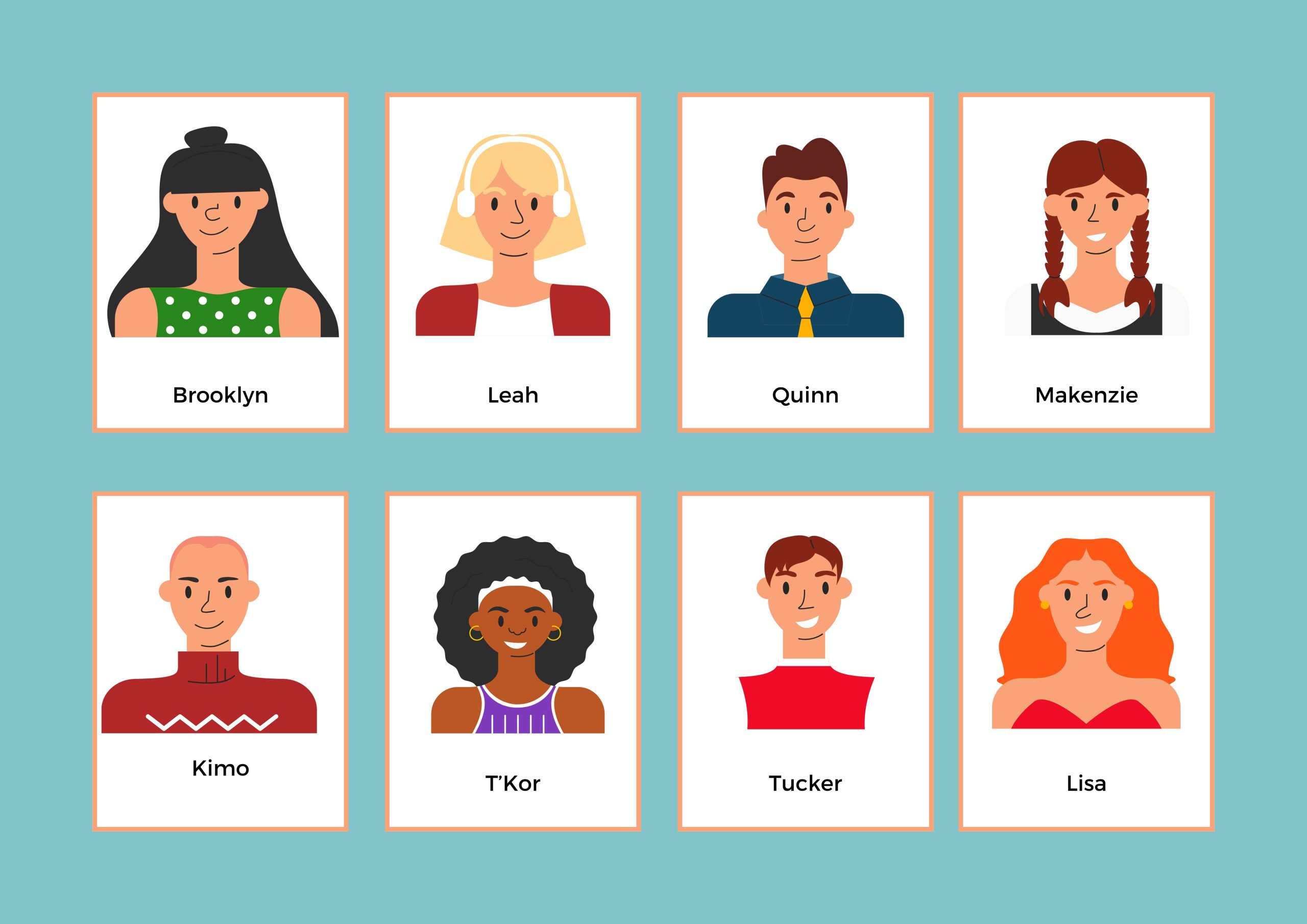
For a list of descriptive adjectives, review the following slides. Most of the slides are cognates. This means that the adjectives have similar spellings in English and Spanish.
The slides are separated with a forward slash to separate masculine and feminine forms of each adjective. For example, if Teacher Catalina wanted to say she was nice, you will see the adjective simpático/a for nice. Since Teacher Catalina identifies as female, she would use the feminine form of that adjective, which would be simpática. For someone who identifies as male, he would say: Soy simpático.
Play the audio to hear each adjective pronounced.
Descriptive Adjectives Slides 1-4
Descriptive Adjectives Slides 5-7
You could also access the slides via this link.
If you identify as non-binary, you would add an e to the adjective ending.
Please note:
In Spanish, when listing your personality or physical traits, if you have a y and I together in a sentence, the y changes to an e.
For example, if you say I am short and intelligent in Spanish, it would be: Soy baja e inteligente.
If there is not an I that follows the y, then the y remains.
For example- Soy inteligente, fuerte y atlética.
*In Spanish, you don’t put a comma before y in a sequence of descriptions.
Actividad L
Paso 1. Jessica Milagros loves her friends and uses wonderful adjectives to describe them. Can you identify all of the positive adjectives Jessica uses?

Paso 2. ¿Cómo son tus amigos? What are your friends like?
Jessica just described her friends. What about yours? Use 2-3 adjectives from the instructional slides on descriptive adjectives to describe your friends. Pay close attention to adjective agreement.
Modelo- Mis amigos son divertidos y atléticos.
Actividad M
Paso 1. Choose 4-5 of the adjectives from the slides you just viewed on personality and physicality to describe yourself. Write them down below.
Pay close attention to adjective agreement.
Soy ________, _________, ________ y _________. <~~ In Spanish, you do not need to put a comma before y.
Paso 2. Ask 2-3 people around you to describe themselves by following the model below.

Modelo-
Estudiante 1- Hola. ¿Cómo eres?
Estudiante 2 (female) – Buenas tardes. Soy trabajadora, innovadora, alta, activa y generosa. ¿Y tú? ¿Cómo eres?
Paso 3. Describe your classmates based on the most repeated adjectives you heard.
Modelo- Mis compañeros de clase son activos, inteligentes y simpáticos.
*Pay close attention to adjective agreement.
¡Fabuloso! 🙂
Actividad N
Have you ever taken a BuzzFeed survey? Did you know that they are popular in Latinx countries because they are fun and use popular culture?

Take the following BuzzFeed survey to determine what your personality is like. At the end, you will receive a personality summary in Spanish associated with your answers, which will include other adjectives to describe you as well.
Encuesta de BuzzFeed sobre tu personalidad
*You may not understand everything in the survey or summary, but try to focus on the images and key words to build your reading skills in Spanish and help you understand the context and message.
Do you think the survey is accurate? List the descriptive adjectives the survey got right.
Sí, la encuesta (survey) de Buzzfeed es correcta porque soy ____ y _____. (List the adjectives you agree with and pay close attention to adjective agreement.)
If the survey was wrong, list why.
La encuesta (survey) de BuzzFeed no es correcta porque no soy _____ y ____, pero sí soy ____.
(List the adjectives you don’t agree with.)
Who in the class had the most accurate survey results regarding their personality?
Actividad O
For a fun activity, your instructor will tape an index card with a famous person’s name on your back. You will not know who the famous person is. Once each student has an index card on their back, you will mingle and students will use descriptive adjectives to help you guess who you are.
Pay close attention to adjective agreement. 🙂 Follow the model below. Have fun! 🙂
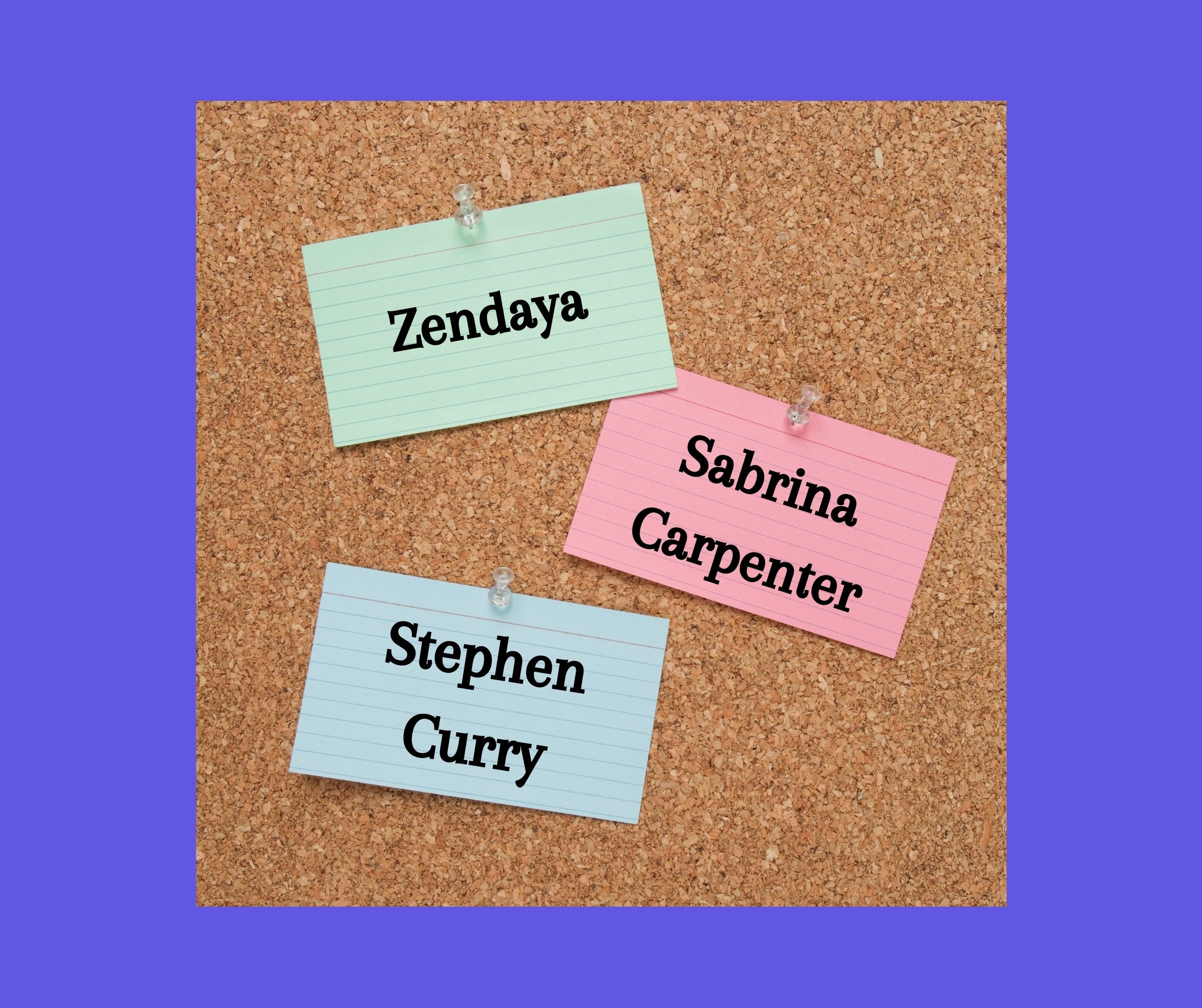
Modelo- The famous person written on the index card is Bad Bunny.
Estudiante 1- Hola. ¿Puedes describirme? (Can you describe me?)
Estudiante 2- Sí. Eres moreno, artístico y flaco. <~~ You must provide at least 3 descriptive adjectives before you give other clues in the tú form since you are talking to your classmate.
Estudiante 1- No sé. ¿Me puedes dar más pistas? (I don’t know. Can you give me more clues?)
Estudiante 2- Claro. Eres puertorriqueño, famoso y te gusta el reggaetón. <~~ You can provide the famous person’s nationality, other adjectives and maybe a fact or two to help the person guess.
Estudiante 1- ¿Soy Bad Bunny?
Estudiante 2- ¡Correcto! 🙂
*If you can’t guess, you can ask for more clues. After 3-4 rounds of still not knowing, you can say, ¿Quién soy? Yo no sé. (I don’t know.)
IV. ¿Cómo estás?
Earlier in the chapter, you learned how to ask someone to describe themself with ¿Cómo eres?, which uses the verb ser. Personality and physical traits are more permanent features of your persona.
Something more temporary are emotions, and this is why when you express how you feel, you would use the verb estar. If you would like to ask someone how they are doing or feeling, you would say, ¿Cómo estás?
To answer this question, you could answer in general terms as demonstrated in the following video by Babbel.
If you would like to be more specific and express how you are feeling, you could use an emotion such as happy, sad, nervous, and tired.
Watch as LingoMasterySpanish shares different emotions with you in Spanish.
Similar to descriptive adjectives, emotions agree in gender and number. For those that identify as non-binary, the emotions will end in e.
For example, Lola está cansada. 🥱 Jeremy está triste. 😔 Mis amigos están felices.😊 Sonny, mi amigue, está contente. 🤗
Actividad P
Soon, you will be conversing with your virtual conversation exchange partner. As a sign of respect, when you meet that person, and they are older than you, you should ask them if using the informal address is ok.
Modelo- Hola y buenas tardes. Antes de continuar con la conversación, ¿está bien si le puedo tutear?
If the speaker says yes, then you could go ahead with the conversation informally.
Modelo- Perfecto. Gracias. ¿Cómo estás hoy?
The speaker will then answer and continue the conversation.
See the following virtual conversation exchange through TalkAbroad between Zaira and Mirel as they meet one another for the first time and ask how each other is.
Conversación entre Zaira y Mirel
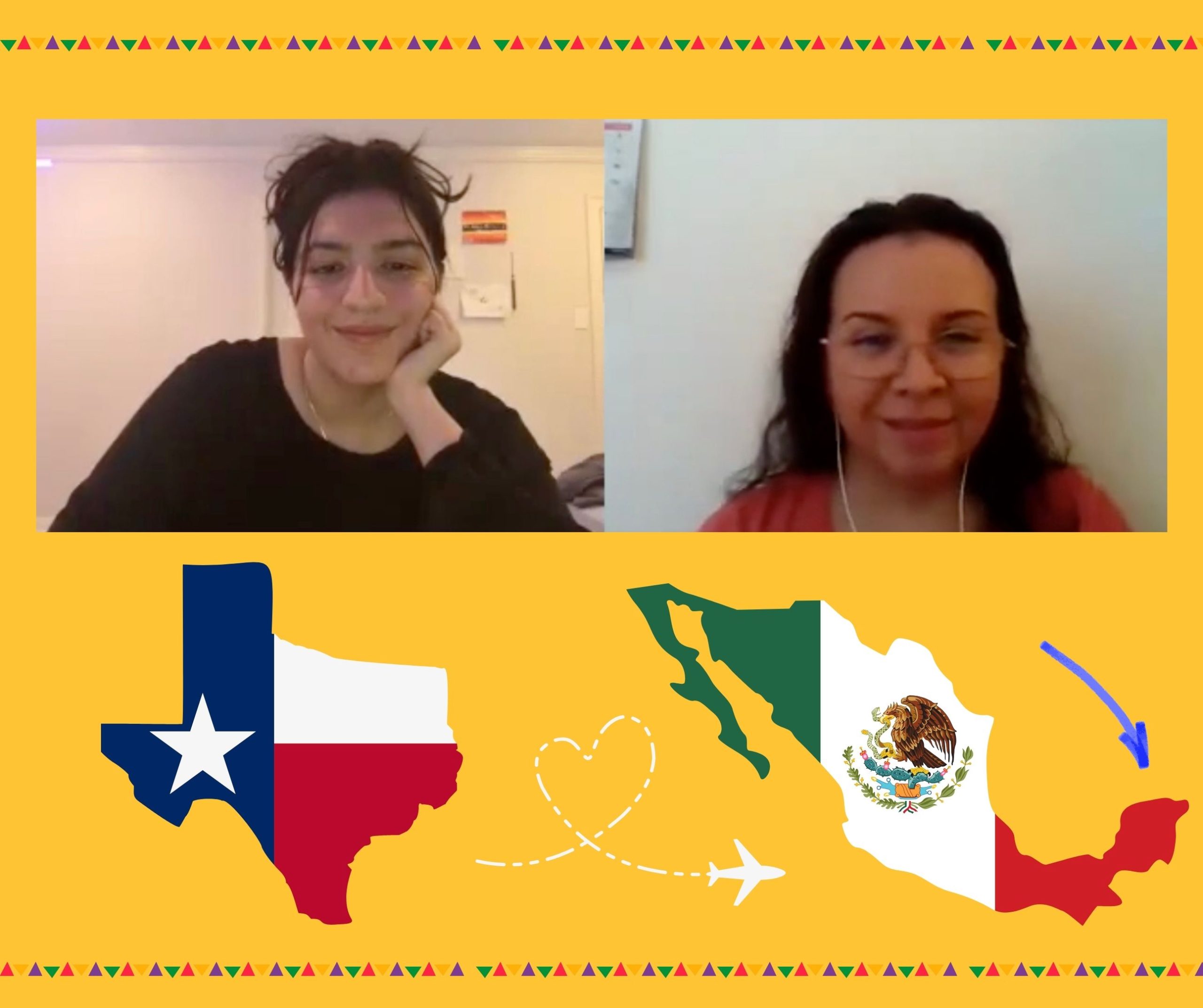
- How did Zaira answer Mirel’s question: ¿Cómo estás?
- How did Mirel answer when Zaira asked her, ¿Cómo estás?
- Did you notice that Zaira showed respect by asking Mirel if it was ok to ask her questions in the informal because Mirel was older than her?
- Did you also notice that Mirel shared where she is now with the verb estar? Mirel said: Estoy en el estado de Yucatán and showed her location with her cell phone.
The verb estar could also be used to specify one’s location.
To understand how to conjugate the verb estar and use it to express emotion or location, watch the following video by Teacher Catalina. You will learn about using prepositions with the verb estar in a later chapter.
Actividad Q
Based on Teacher Catalina’s video of the verb estar, answer the following questions.

For a list of popular emotions that you could use to express how you are feeling, see the following slide. Listen as Valeria explains her experience with her school using these emotions.
Actividad R
Valeria shared her feelings about school and her routine. What are logical emotions you would feel in the following situations regarding school?

Actividad S
Paso 1. With another person, take turns describing the emotion Isabela is feeling in the photos below with the verb estar.
Modelo- En la foto Y, Isabela está molesta.

- En la foto B, _____________________________.
- En la foto L, _____________________________.
- En la foto X, _____________________________.
- En la foto D, ______________________________.
- En la foto P, _____________________________.
Paso 2. Ask 2-3 people around you how they are today. If someone asks how you are, be sure to use 1-2 new adjectives of emotions to answer.
Modelo-
Estudiante 1- Buenos días. ¿Cómo estás?
Estudiante 2- Hola. Estoy feliz, gracias. ¿Y tú? ¿Cómo estás hoy?
You learned earlier from Teacher Catalina’s video that the verb estar could also be used to express location.
Listen as Marcos introduces himself and describes where he is with the verb estar.
For a transcript of Marcos’s introduction, click here. Scroll to Marcos.
Actividad T
Paso 1. What did you gather from Marcos’s introduction about where he is and where his family is located? Answer the following questions to test your listening comprehension skills.
Paso 2. Choose 4 different students, and ask them the following questions using estar + location.
- ¿Dónde estás ahora? To answer: Estoy en _______.
- ¿Dónde están tus padres? To answer: Mis padres están en ______. If you have one parent: Mi madre está en ______. Mi padre está en _____.
- ¿Dónde está tu universidad? To answer: Está en ______.
- ¿Dónde está tu casa? To answer: Mi casa está en ______.
Actividad U
Meet your online classmates. Record the following prompts.

- Greet your fellow classmates, say your name and nice to meet you.
- Say where you’re from and where you are now. (ahora)
- Ask them for their names, where they are from and where they are now in the Uds. form.
V. ¿Qué te gusta?
A fun way to get to know someone is by asking about their likes and dislikes. This way, you could see if you have anything in common. 🙂
Sonya Mendoza loves to scroll through photos of her favorite things on Instagram. Listen as Sonya shares her recent likes with you.
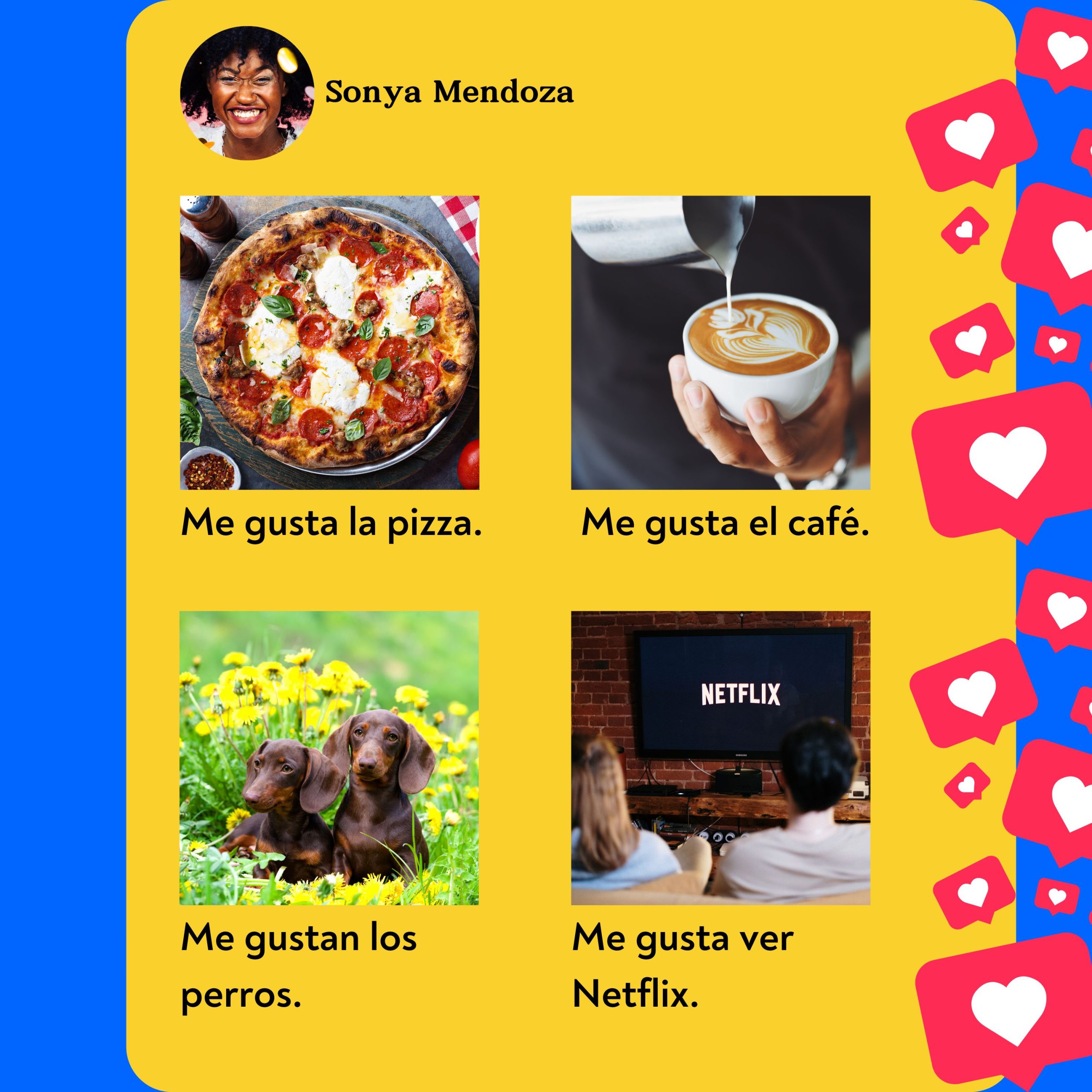
The verb Sonya uses to share her likes is the verb gustar (to like). Watch as My Daily Spanish discusses the verb gustar and how to use it in conversation.
The video ends with, Y a ti, ¿qué te gusta? How would you answer?
Put a check mark by all the items or activities you like in the following Facebook post.
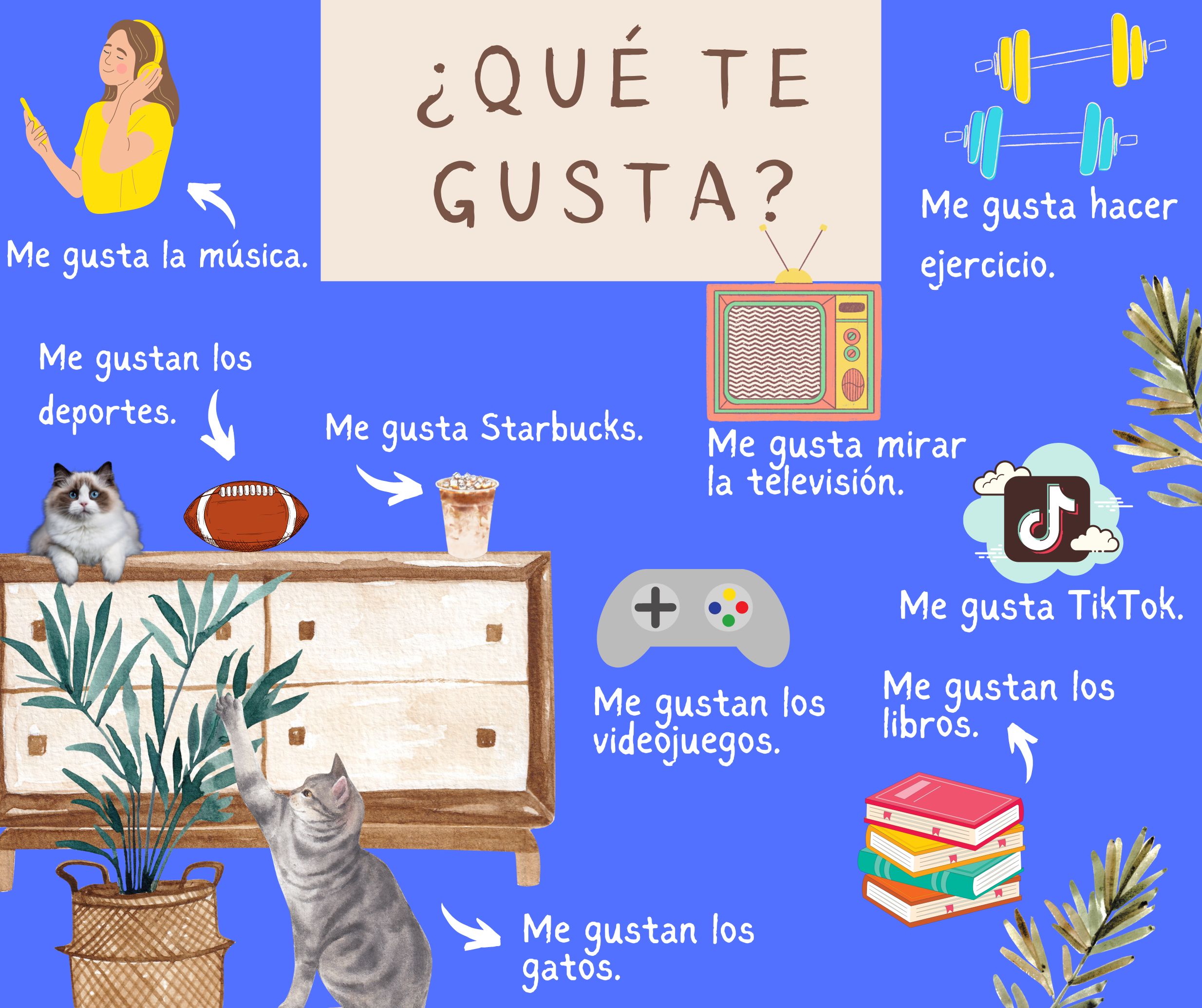
Share a few of your likes with someone else. Feel free to say what you don’t like, if it’s not in the Facebook post.
Modelo- Me gusta mirar la televisión y hacer ejercicio. También (also), me gusta Starbucks y TikTok. No me gustan los gatos. ¿Y a ti? ¿Qué te gusta?
When you express your likes or dislikes with the verb gustar, the verb gustar is conjugated in a very unique way.
Alicia, from espamundi, highlights some structural components of the verb gustar in her TikTok video. Be sure to press the sound button on the bottom left of the video.
How to conjugate the verb gustar
For a visual of the verb gustar with different subjects and examples in context, see the following slide.
Actividad V
Mark true or false for each of the following statements about personality types and their likes and dislikes.
When you use the verb gustar to express your likes or dislikes, the definite article is needed for nouns. You may ask, what is a definite article?
Watch the following videos to learn about definite articles in Spanish and how to make them plural by EO Español Online.
See the following examples of singular and plural nouns with definite articles.
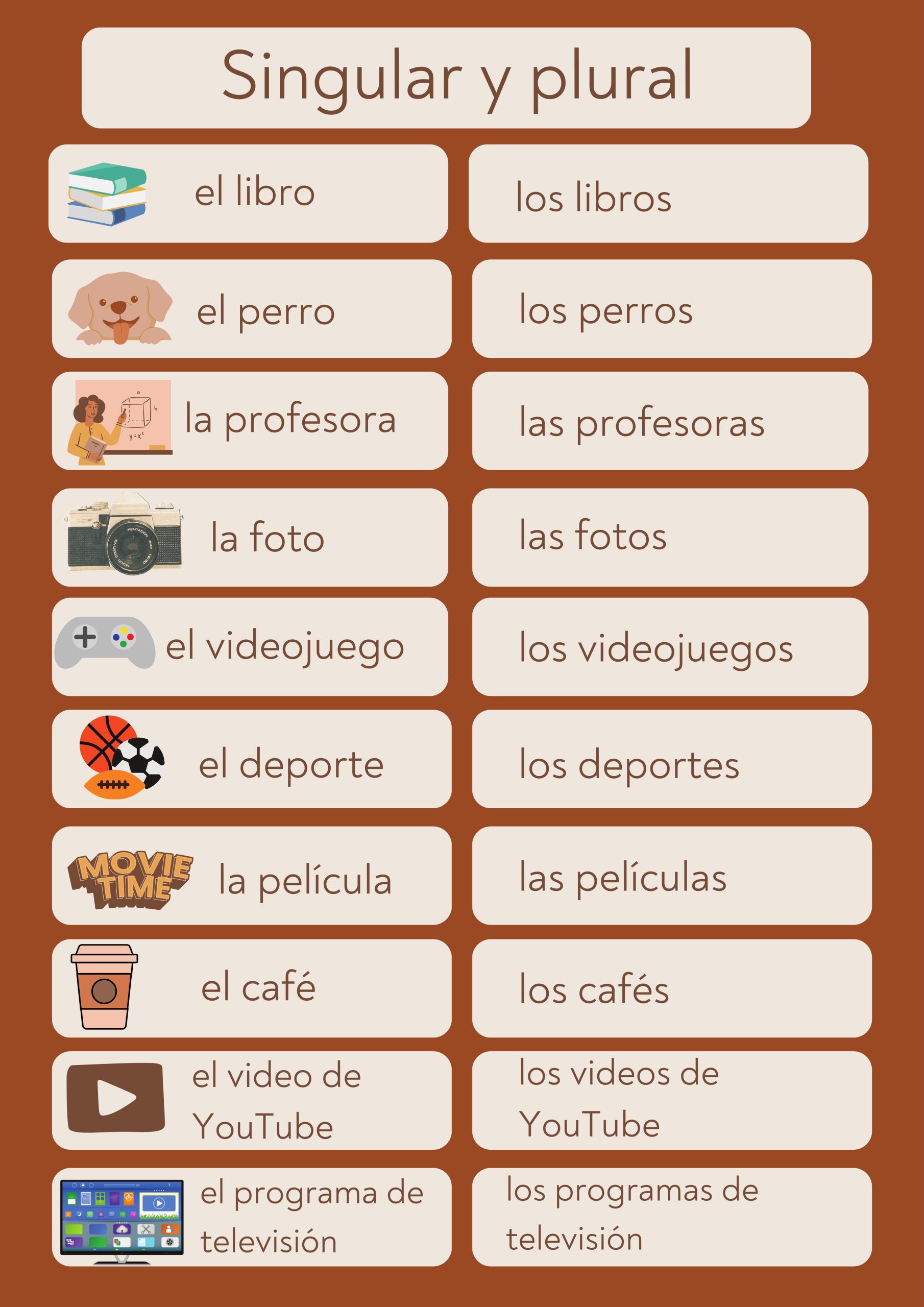
Actividad W
Paso 1. Based on what you learned in the two videos about definite articles, in groups of 2 or 3, fill in each blank with the correct definite article. Options are el, la, los or las.
Paso 2. Choose 2-3 questions from Paso 1, and ask someone else what they like or don’t like.
Modelo- ¿Te gusta el café de Starbucks? Answer- Sí, me gusta. OR No me gusta.
Paso 3. For reactions to your groups’ statements, you could use the following expressions.
¿De verdad?- Really?
¡Qué interesante!- How interesting!
Estoy de acuerdo.- I agree.
No estoy de acuerdo. – I don’t agree.
Muy bien.
Sale or Vale- Ok.
¿Por qué? OR ¿Por qué no?
You’ve met Jessica Milagros in this chapter. Jessica is known for challenging the social media stereotype that models should be one size only. Jessica believes in body inclusivity, and she is proud to represent the Latinx and plus-size community in her modeling career.
Learn more about Jessica Milagros on Big Brother.
It’s time to watch Jessica Milagro’s entire Instagram Live. You’ve seen Jessica introduce herself, share her personality traits, express how she is doing, where she is in the video, what she does for a living and what her ethnicity is. Listen as Jessica expresses what she likes and what her favorite music is as well.
Actividad X
Do you remember what Jessica likes and dislikes from her Instagram video? 🙂 Complete the following questions to test your listening comprehension skills.
In Jessica’s video, she expressed her favorite music with the word favorito/a/s. This is another way to express your preferences in Spanish. Like the verb gustar, using the word favorito/a/s requires a definite article for nouns since you are highlighting something you love. However, you do not need a definite article for proper nouns.
See the following examples.
Expressing your favorites with favorito/a.
Mi deporte favorito es el tenis.
Mis clases favoritas son el español y la biología.
Mi programa favorito es Stranger Things.
Expressing your favorite things with gustar.
Me gusta el tenis.
Me gustan las clases de español y biología.
Me gusta el programa Stranger Things.
Actividad Y
Select the correct way to express what you like with the word favorito/a/s.
Actividad Z
Paso 1. In small groups, take turns asking each other the following questions about likes and dislikes to get to know each other better. Do you have anything in common? 🙂
Paso 2. Write something you have in common or something you don’t have in common after conversing with your group.
*If you have something in common that you like or dislike, you would use the nosotros form of gustar.
Example- A Michael y yo nos gusta la música country. Or A Michael y yo no nos gusta la música pop.
*If you cannot find something in common, follow the example below.
Example- A Taylor le gusta leer, pero a mí me gusta escuchar música en mi tiempo libre.
*A mí is used for emphasis and is included since you are comparing and emphasizing what you like versus the other person.
VI. Chapter 2 Final Assessment
In this chapter, you learned how to share how you are feeling and where you are with the verb estar, state your profession, nationality and describe yourself with the verb ser and express your likes and dislikes with the verb gustar. ¡Muy bien! You’ve learned so much! 🙂
As a review for your Chapter 2 Final Assessment, answer Jessica’s questions! Watch the following video Jessica recorded for you. Then record your answers.
For your Chapter 2 Final Assessment, you will call into Jessica’s Live, introduce yourself and share more personal information about yourself.
Follow the prompts below.