6 Repaso de Español 1
Your Chapter 6 task is to review and converse about the topics covered in Elementary Spanish I to get to know someone.
Steps to take to achieve this task:
- ¿Cómo te llamas?– introduce yourself and get to know others by asking basic personal questions
- ¿Cómo eres?– share more personal information about yourself using the verb ser and ask others about themselves
- ¿Cómo es tu rutina diaria?– describe your daily routine with regular, irregular and reflexive verbs and ask others about theirs
- ¿Cómo es tu familia?– share details about your family members such as their age, where they live and how they are and ask others about theirs
- ¿Cómo son tus hábitos de comer?– discuss what you eat in a day and your favorite foods and restaurants with the verb gustar
- Task 6 Assessment– answer questions about yourself, your daily routine, family and eating habits and ask a classmate questions about those topics to get to know them better
I. ¿Cómo te llamas?
Meet Gabby as she introduces herself to you and asks questions to get to know you.
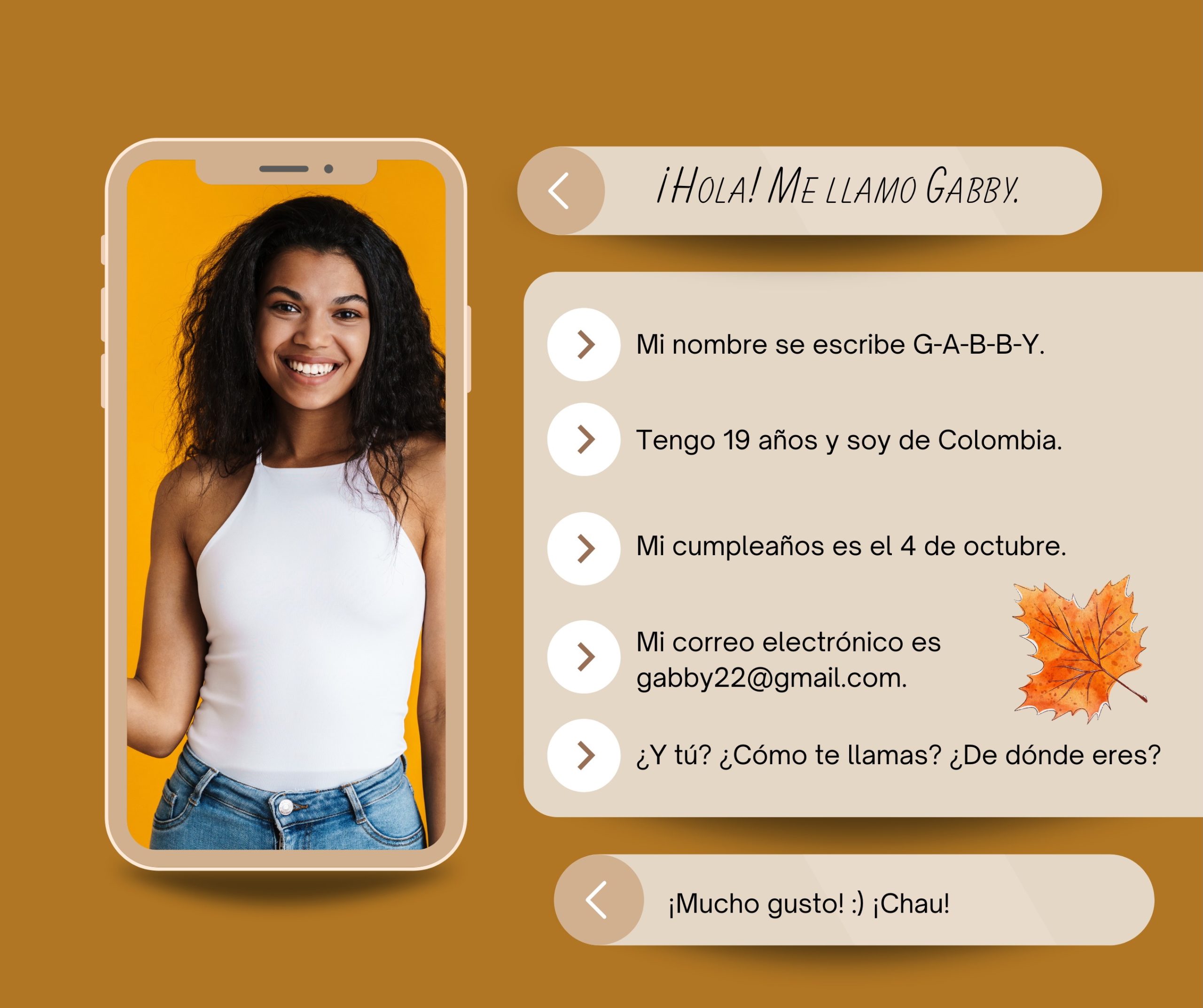
¡Hola! 🙂 You just met Gabby. Did you notice she spelled her name for you? Many confuse the spelling.
Do you know how to spell your name in Spanish? Do you remember the Spanish alphabet?
Watch the following video by Sesame Street with Gina Rodriguez and Elmo to help you remember how to say your letters in Spanish. 🙂
¡Muy bien! If someone asks you to spell your name in Spanish, you are now able to.
Here is the formula: Hola. Me llamo Antonio. Mi nombre se escribe A, N, T, O, N, I, O.
Gabby also greeted you in her introduction. Greetings in Spanish vary by region, culture and context or setting. Greetings among Latinos often include a hug and kiss on the cheek.
Have you ever greeted someone from Latin America or Spain? What was the greeting like? Was it different from how you greet friends, family or someone you met for the first time in your culture?
Watch as Nas Daily Español shares his experience greetings people from Spain and Latin America.
Did you know that in Spain and Latinx countries, informal greetings are generally used for family, friends or someone that is your age or younger, and formal greetings demonstrate a level of respect and are reserved for professional settings or when greeting someone older than you?
A common greeting in Spanish used in both informal and formal settings is ¡Hola! (Hello!).
Actividad A
Use ¡Hola! to greet your classmates as you play Lotería to get to know their background with the Spanish language.
Instructions: You will greet each student following the model below. Ask them one of the questions from the following Lotería sheet, and when they answer, write their name in the corresponding box. Say thank you, and go to the next student. Once you obtain a different name for an entire row, you win! You will say ¡Lotería! 🙂
Modelo-
Student 1- ¡Hola! Me llamo (My name is) ______. <~~ fill in the blank with your name
Student 2- Mucho gusto. 🙂 (Nice to meet you) Soy (I am) _____. <~~ fill in the blank with your name
Then ask your question in English. When the student answers, say ¡Gracias!
*If you are learning Spanish on your own, feel free to answer the questions individually.
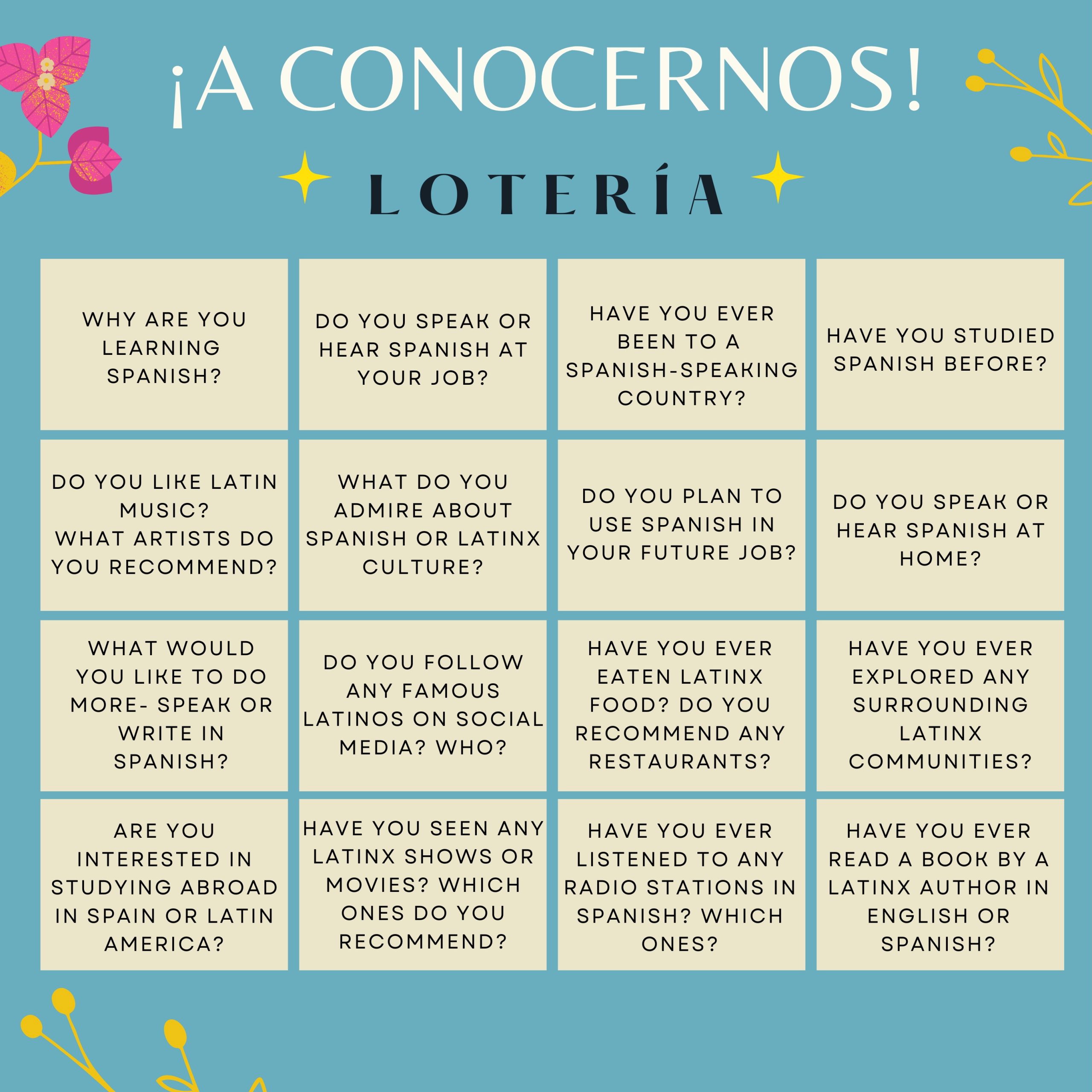
What did you learn about your classmates and their experience with the Spanish language? What did they learn about you and your motivation to learn Spanish? You will get to know your classmates and the Spanish language more throughout the term. 🙂
To go beyond saying ¡Hola!, read the following slide to review other ways to greet someone and introduce yourself.
Listen as Gabby pronounces the greetings and other expressions for you.
If you need to review your numbers to provide your age in Spanish, MyDailySpanish pronounces numbers 1-100 in Spanish for you. Take a listen.
Feel free to scroll to the number or numbers you would like to know with the scroll bar at the bottom of the video.
You could also review the following slide for your reference with corresponding audio.
Actividad B
Get to know 2-3 of your classmates by asking them the following questions. Don’t forget to start with a greeting and say Mucho gusto at the end of your brief conversation. 🙂
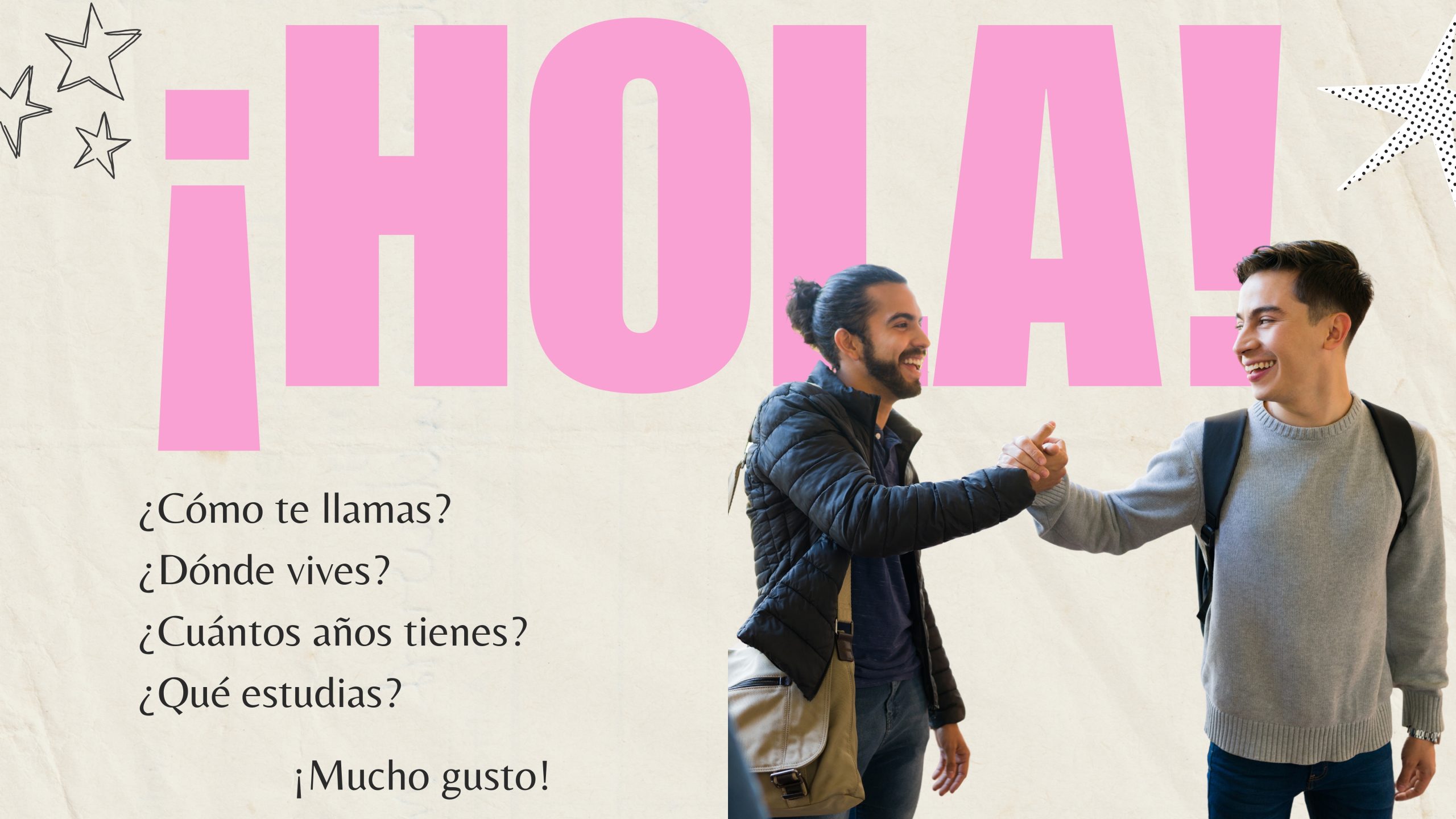
If you reviewed your numbers by Daily Spanish, they will come in handy if someone were to ask you for the date, your birthday, your cell phone number or other personal details involving numbers in conversation.
Renato is a new study abroad student from Ecuador. He would like to do conversation exchanges with students studying Spanish. Listen as Renato introduces himself to you on WhatsApp and shares the date of his video message, his age, birthday and WhatsApp phone number with you.
For a transcript of Renato’s video, click here.
Actividad C
Based on Renato’s video, select the correct answer for each question. For the numbers, you could use numerals.
¡Excelente trabajo! 🙂
Intercultural reflection 1
India and Mexico are two countries very far from one other on a world map, separated by different religions, cultural practices and language. However, Indian culture has become very popular in Mexico recently through music, dance and art. This could be attributed to the famous Asoka trend that has spread worldwide through TikTok.
Doris Jocelyn is a content creator from Veracruz, Mexico. She is famous for having the most likes on her TikTok video for paying homage to the Asoka trend, but adapting it to her Mexican heritage and culture. As of January 2025, it has over 360 million views.
*Be sure to press the sound on the bottom left of the video.
@dorisjocelyn 🇲🇽MÉXICO, HAZ LO TUYO! Y que todo el mundo te vea ✨❤️🔥 #TRENDMEXA #transiciones #princesaazteca
Watch as social media influencer, Fernanda Cortes, known for creating videos that celebrate Latinx culture, details more information about Doris Jocelyn and her most watched TikTok video in Latin America.
*Be sure to press the sound on the bottom left of the video.
@fernandacortesx She did such an amazing job!! ❤️🇲🇽 #mexico #mexican #veracruz #mexicana #mexicano #asoka #trendmexa
Explore more
- Did you enjoy Doris Jocelyn’s Asoka trend video? Did you recognize any of the Mexican cultural references Doris included in her video? (national flag, colors, history, pastimes)
- Are you familiar with the Asoka trend? Do you admire how Doris Jocelyn honored her Mexican heritage in her video with this popular TikTok trend?
- If you made your own video celebrating your culture through the Asoka trend, what aspects of your heritage would you include and why?
- Music unifies people from different countries and cultures. What else could unify and connect cultures from across the world?
- Doris Jocelyn incorporated the Mexican flag in her Asoka video, which is displayed proudly in her country on Mexican Independence Day. Mexicans celebrate their independence on September 16. How would you say the date now that you know your numbers and months in Spanish?
Modelo- El Día de la Independencia de México es el _____ de ______. (include numeral and month)
6. Did you know that in Spain and Latin America, the dates in numeral format include the day first and then the month?
Example- Mexican Independence Day would be written as 16/9 versus 9/16.
7. When is your birthday? First, answer the question, and then write it out on your own in numeral format as if you were in Mexico.
Modelo- Mi cumpleaños es el 22 de noviembre. 22/11
8. To learn more about Doris Jocelyn’s famous Asoka TikTok, watch her YouTube video detailing the experience.
*Be sure to press CC for captions in the language you prefer.
You’ve learned how to introduce yourself in this chapter and ask others about themselves. You are now ready to conclude your conversation. Do you know ways to say goodbye in Spanish?
Listen as StoryLearningSpanish shares common ways to say farewell in Spanish. Which is your favorite? 🙂
Gabby concludes this chapter by sharing ways to say goodbye in Spanish. She also shares days of the week with you, in case you would like to say- See you on Monday or See you on Friday.
Actividad D

List a way to say goodbye in the following scenarios.
Be sure to use a new way to say goodbye in your next conversation with a Spanish speaker. 🙂
Actividad E
II. ¿Cómo eres?
In this section of the chapter, you will go beyond introducing yourself with your name and saying where you’re from. You will share even more personal information about yourself with the verb ser such as what you do for a living, your physical and personality traits and nationality or ethnicity.
Meet Jessica Milagros, from the American television show, Big Brother. Jessica recently went live on Instagram to meet her new Spanish-speaking followers. Watch as Jessica introduces herself by sharing some personal information about herself.
What personal details does Jessica include in her Instagram Live?
When Jessica states her profession and ethnicity in her Instagram Live, did you notice that in one sentence, she uses the subject pronoun yo, and in the other she does not?
Jessica says:
Yo soy puertorriqueña. Soy modelo y ex jugadora del programa, Big Brother.
Both Yo soy and Soy mean I am. Why does one sentence have a subject pronoun, but the other does not? Unlike in English, where a subject pronoun is required in a sentence to understand who or what is completing the action, in Spanish, the subject pronoun is optional.
Watch the following video by BaseLang as you get introduced to subject pronouns in Spanish and the rules related to when to include them in conversation and when to omit them.
The verb ser is a powerful one because you could use it to describe your identity, profession, nationality or ethnicity, physical or personality description, and other details about yourself or others.
You just learned many new subject pronouns in Spanish. However, there are a few more subject pronouns you should be aware of.
Vos- This subject pronoun is similar to the informal tú, but it is specifically used in countries in Central and South America.
Elle, Elles, Nosotres, Vosotres.- These are non-binary subject pronouns used in Spanish-speaking communities that celebrate inclusivity.
Listen to the explanation of the subject pronouns, including inclusive ones with the verb ser.
Actividad F
Now that you know about the different subject pronouns in Spanish, see if you could place them in their correct space based on the cues provided.
BurbujaDELEspañol introduces you to the verb ser and the subject pronouns you could use with the verb.
Feel free to select CC for captions in the language you prefer.
Actividad G
¡Bien hecho! 🙂
Did you know that there is a movement occurring within the Latinx community to identify and use inclusive subject and personal pronouns in the Spanish language? Read the following Intercultural reflection to learn more about the importance of inclusivity in the Spanish-speaking world.
Intercultural reflection 2
Do you have any friends or family members that use non-binary pronouns? Are these non-binary pronouns accepted in your community? In the Latinx world, the use of non-binary pronouns has become more present and embraced as part of the Spanish language. It is called inclusive language or lenguaje inclusivo.
Jiveworld Languages discusses the topic of languaje inclusivo in the Latinx community.
Explore more
- Do you feel language in general should be more gender neutral and more accepting of inclusive pronouns, adjectives or professions? Share your opinion.
- Why do you feel the Latinx community is now embracing the pronouns elle, elles, nosotres and vosotres?
- The RAE (Real Academia Española), the official institution in Spain responsible for regulating and maintaining the standards of the Spanish language, has not officially accepted inclusive pronouns as part of the Spanish language. Jiveworld Language explained why this is the case in her video. Do you feel this is just or unjust? Share your opinion.
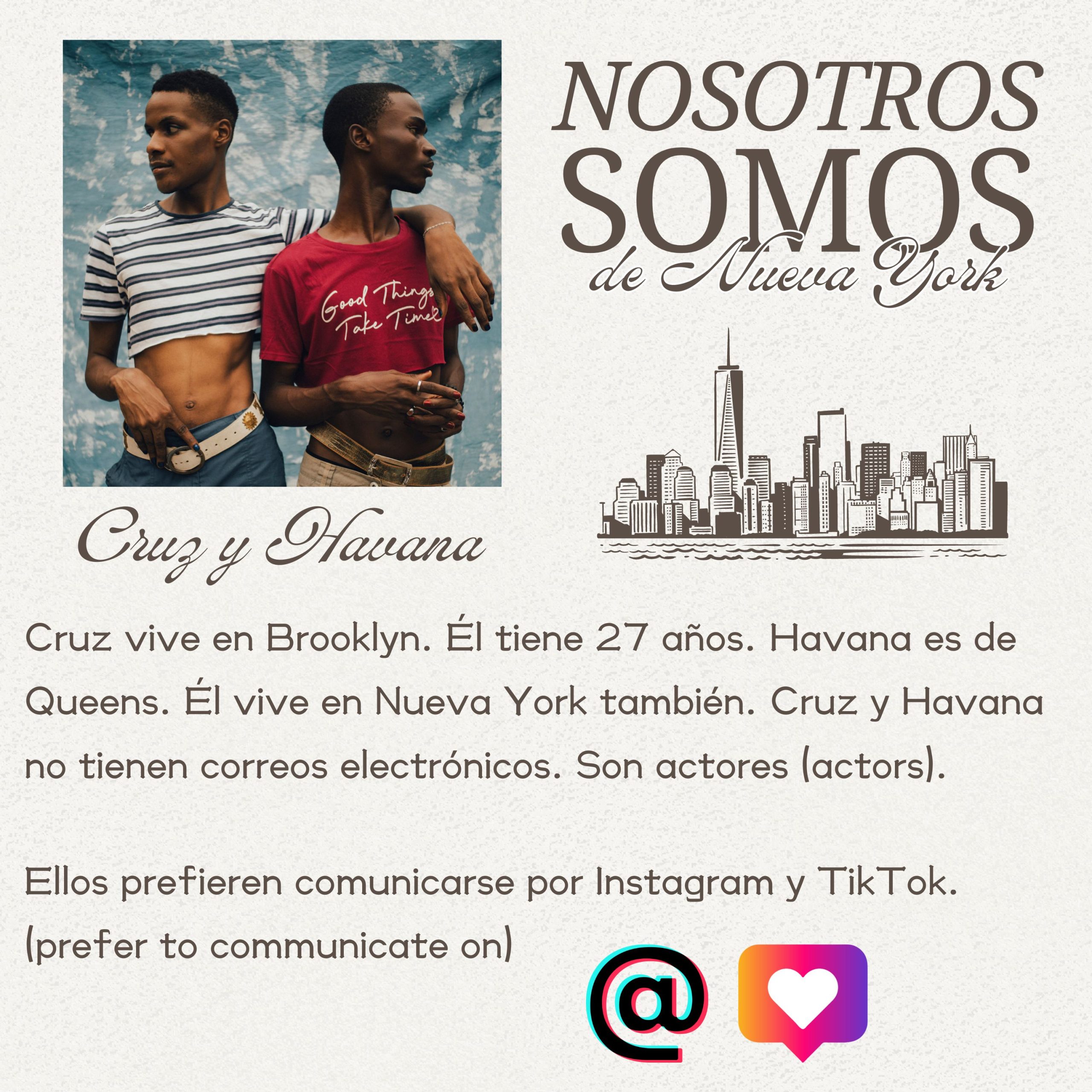
- Read the following online profile a promoter wrote for Cruz and Havana, two Latinx actors. They are part of the non-binary community in New York. What pronouns did the promoter get wrong? Find the subject pronoun errors in the following online profile, and fix them so that it reflects el lenguaje inclusivo for Cruz and Havana.
5. To understand the perspective of the Latinx non-binary community regarding gender inclusivity and language, watch the following video by Atlas Wylde.
6. After watching the video, do you have more empathy for the non-binary community and the importance of recognizing their identity in the Spanish language? Do you have more or less compassion for the non-binary community and the use of inclusive pronouns in your area? Share your opinion.
7. What was something that resonated with you from the video by Atlas Wylde?
You’ve learned how to use the verb ser to identify yourself and others with subject pronouns. Do you know how to express what you do for a living or your nationality in Spanish? Do you know how to ask others about their profession and ethnicity?
Earlier, in Jessica’s Instagram Live, she shared her ethnicity and profession. Do you remember them?
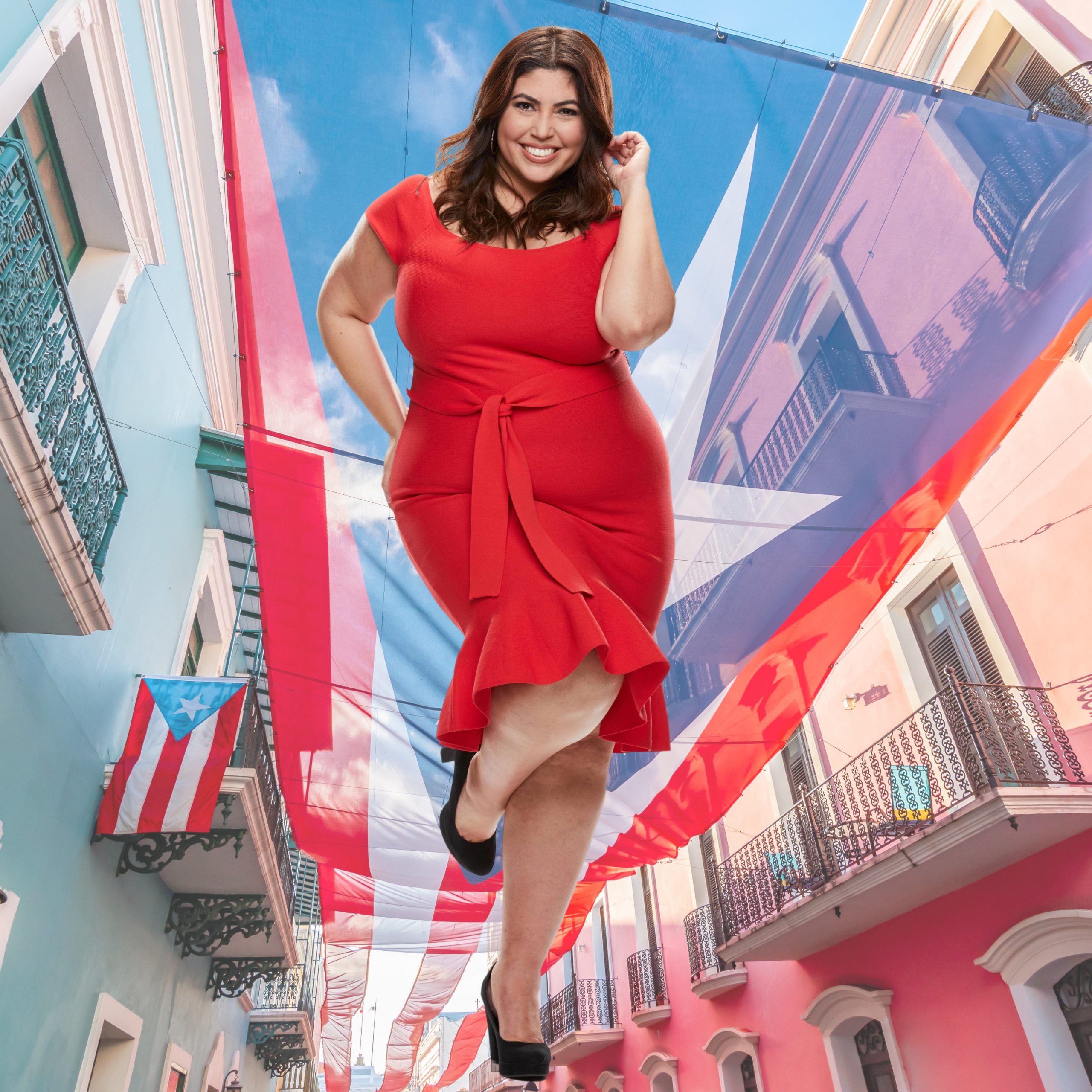
If you identified Jessica’s ethnicity as Puerto Rican, you would be correct! Muy bien. 🙂 Most think that being Puerto Rican is a nationality. Because Puerto Rico is not an independent sovereign nation, Jessica’s nationality would not be Puerto Rican. That would be her ethnicity.
The country where you were born or hold citizenship would be considered your nationality. Jessica was born in the U.S., so her actual citizenship is American, which in Spanish is estadounidense.
When asking someone what their nationality is, you would say, ¿Cuál es tu nacionalidad? What is your nationality?
To learn more about nationalities, read the following slide.
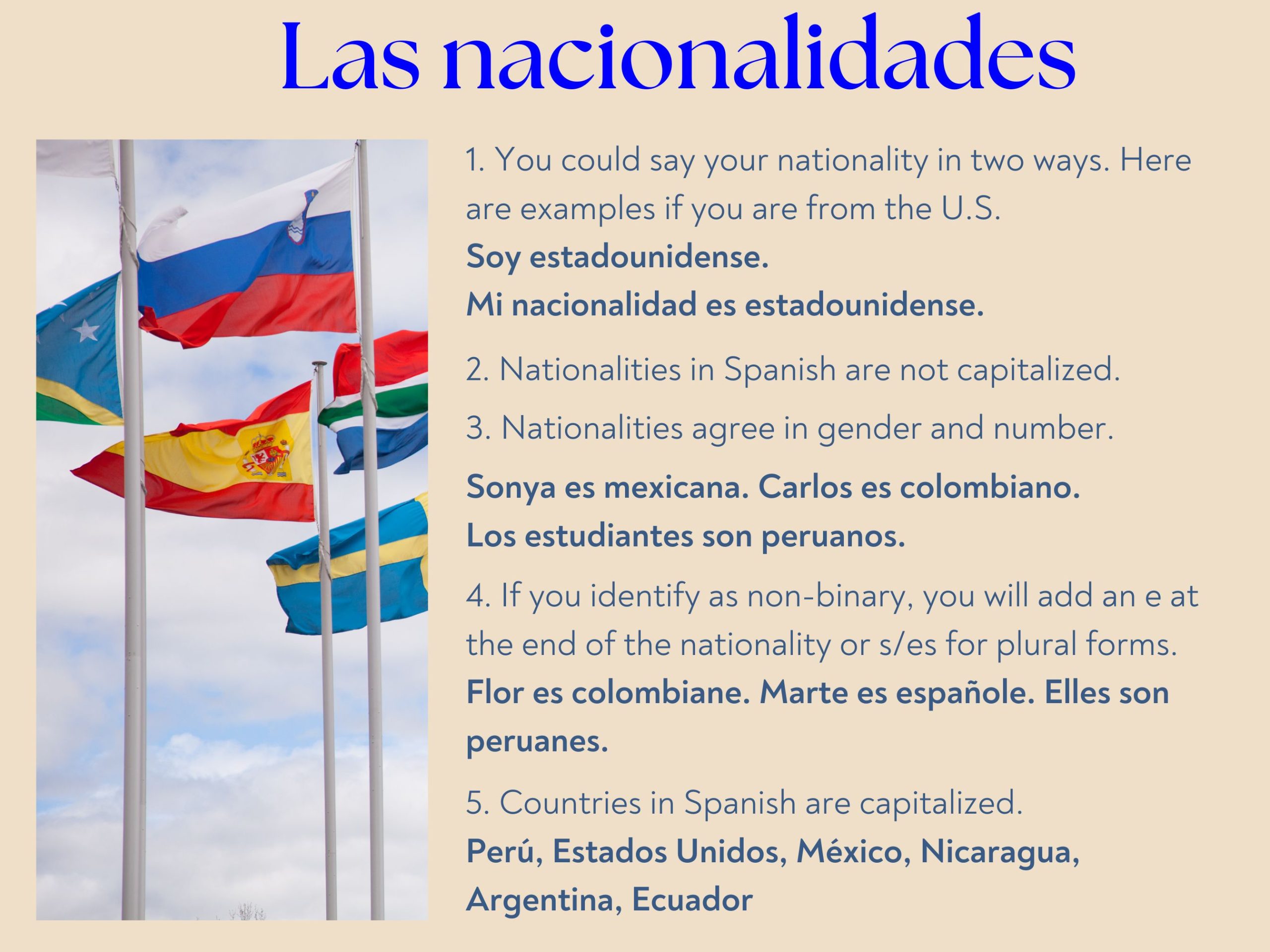
The following slide includes some nationalities where Spanish is spoken. Play the audio to hear how they are pronounced.
Actividad H
Paso 1. You will be taking part in a virtual conversation exchange program to help you develop your Spanish-speaking and intercultural competence skills. You will be selecting a Spanish-speaking partner to converse with.
Each speaker shares their brief biographies, and they include where they are from. Based on the information provided to you in the following online poster, write each conversation partner’s correct nationality in the spaces below. Be sure to include accents when necessary.

Paso 2. Watch the following video to see a Spanish language learner discuss nationality with her Latinx conversation partner.
Una conversación sobre la nacionalidad
For a transcript of the conversation, click here.
Una conversación entre Kristin y Yanina
Video by TalkAbroad
Paso 3. Your conversation partner would like to know your nationality. How will you answer?
Conversation partner- ¿Cuál es tu nacionalidad?
You answer: Soy _______________.
¡Bien hecho! 🙂
In addition to using the verb ser to state your nationality, you could use ser to say your profession. Watch as spanishteacherlatef introduces professions to you in Spanish in one of his TikTok videos. Did he mention your current or future profession? 🙂 Be sure to press the sound button on the bottom left of the video.
@spanishteacherlatef Jobs in 🇪🇸 what do you do? 😁 @mosesgotterer #spanish #spanishteacher #espanol #learnspanish #jobs #vocabulary #foryou #usa #uk #nyc
♬ Monkeys Spinning Monkeys – Kevin MacLeod & Kevin The Monkey
Spanishteacherlatef ends his video with, ¿A qué te dedicas?. This is an informal way to ask someone what they do for a living. ¿A qué se dedica? is the formal way. When getting to know a Spanish-speaker, asking what they do for a living is a common question you could ask to get to know them better.
See the following post for ways to answer, ¿A qué te dedicas?
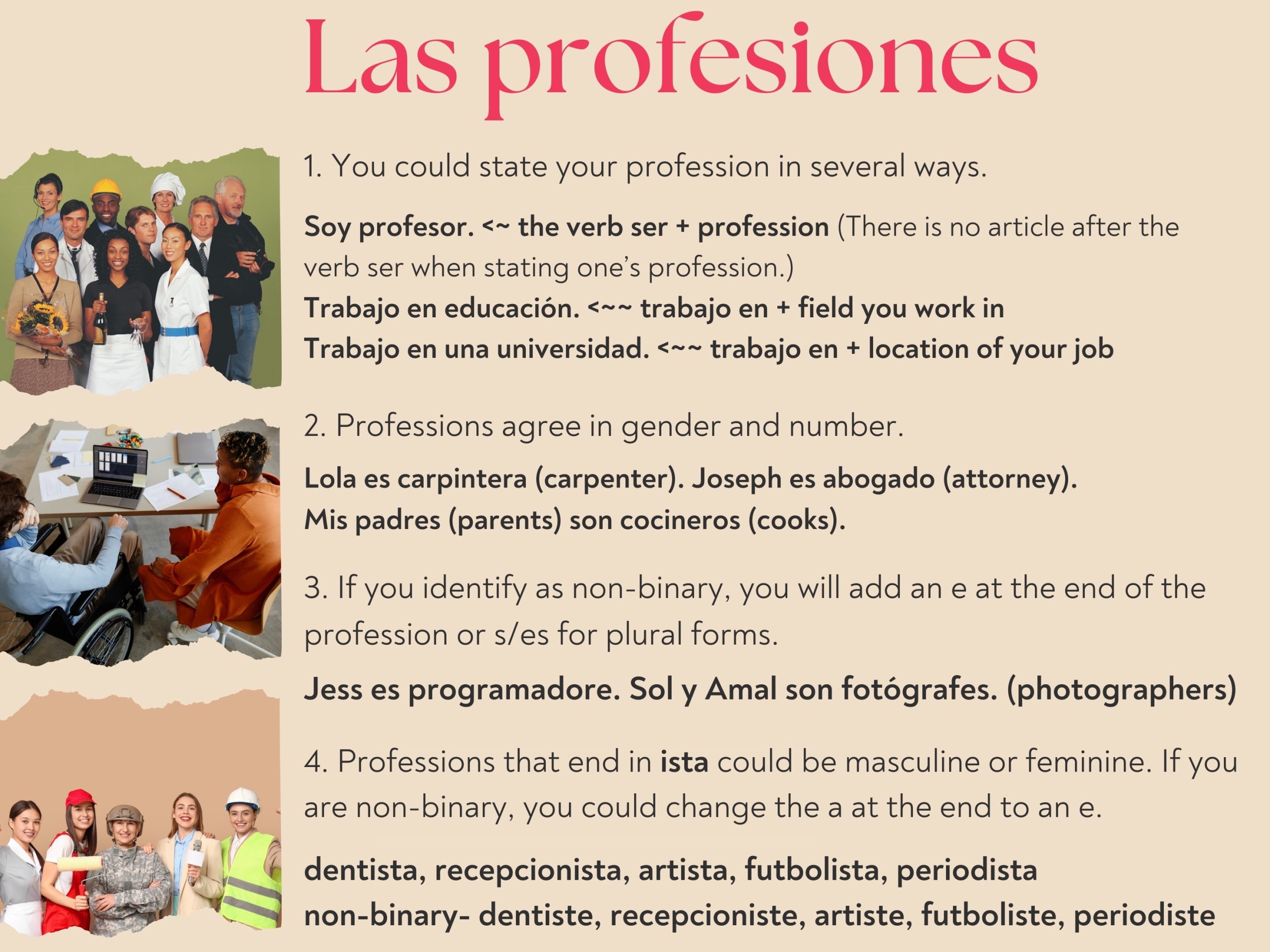
For a list of some professions in Spanish you may be pursuing, see the following slide. If yours is not on the list, you could go to www.wordreference.com.
The professions listed in the following slide are separated by a forward slash for the feminine and masculine forms. For example, a nurse in Spanish is enfermero/a. A female nurse would be enfermera. A male nurse would be enfermero. If you identify as non-binary, the profession would end in e, enfermere.
For a list of more professions in Spanish, follow this link by Livelingua.
Now that you know more about nationalities and professions in Spanish, it’s time to converse about them with others. Review the following slide for conversation prompts that could help you get to know what someone does for a living or where they work in formal and informal settings.
Actividad I
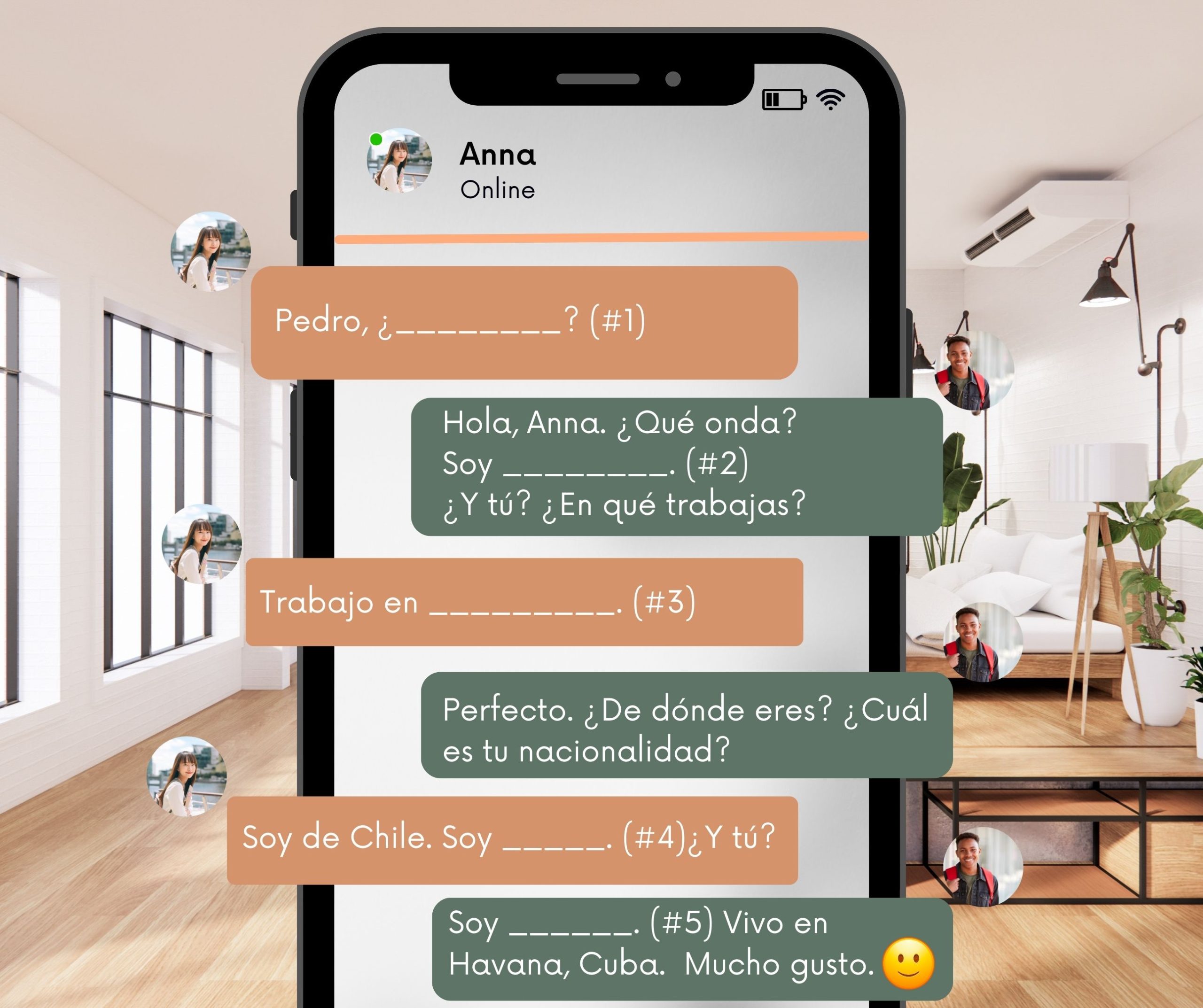
Anna and Pedro just met at a virtual seminar about volunteering in Central America. They would like to get to know each other more by asking about each other’s nationality and profession.
Based on their text exchange, what do you think they said in each blank? Select the most appropriate answer.
Valeria, a virtual conversation partner, would like to introduce herself and ask you some questions about your profession and nationality to get to know you better. Record your answers.
For a transcript of Valeria’s introduction, click here. Scroll to Valeria.
You now know how to introduce yourself, say where you’re from, state your nationality, ethnicity and profession with the verb ser. ¡Muy bien! 🙂 You’ve learned so much!
The verb ser is also used to describe your personality and physical traits. To ask someone what they’re like, you would say Hola. ¿Cómo eres? in informal settings and ¿Cómo es? in formal ones.
This is different from ¿Cómo estás?, which you will learn how to use in conversation in the next section of this chapter. ¿Cómo estás? means How are you?
Listen as Jessica Milagros describes her personality in her Instagram Live.
Actividad J
What adjectives did Jessica use to describe herself? Play the video again, if necessary.
Jessica uses adjectives that have a feminine ending because she doesn’t identify herself as non-binary. What if Jessica asks what you are like, how would you describe your personality or physicality? What if you wanted to ask someone else what they are like? How would you do that?
It is also important to know that adjectives agree in gender and number in Spanish. TeacherCatalina demonstrates how to correctly describe yourself or others with adjective agreement.
For a list of descriptive adjectives, review the following slides. Most of the slides are cognates, which means that the adjectives have similar spellings in English and Spanish, so you could decipher what they mean.
The slides are separated with a forward slash to separate masculine and feminine forms of each adjective. For example, if Teacher Catalina wanted to say she was nice, you will see the adjective simpático/a for nice. Since Teacher Catalina identifies as female, she would use the feminine form of that adjective, which would be simpática. For someone who identifies as male, he would say: Soy simpático.
Play the audio to hear each adjective pronounced.
Descriptive Adjectives Slides 1-4
Descriptive Adjectives Slides 5-7
You could also access the slides via this link.
If you identify as non-binary, you would add an e to the adjective ending.
Actividad K
Paso 1. Choose 3-4 of the adjectives from the slides you just viewed on personality and physicality to describe yourself. Write them down below. You could also access the slides via this link.
Pay close attention to adjective agreement.
Soy ________, ________ y _________. <~~ In Spanish, you do not need to put a comma before y.
Paso 2. Ask 2-3 people around you to describe themselves by following the model below.

Modelo-
Estudiante 1- Hola. ¿Cómo eres?
Estudiante 2 (female) – Buenas tardes. Soy trabajadora, innovadora, alta, activa y generosa. ¿Y tú? ¿Cómo eres?
¡Bravo! 🙂
You just learned several ways to use the verb ser to express your profession, ethnicity, nationality and physical and personality traits.
Jessica would now like to get to know you better. Answer her questions below.
III. ¿Cómo es tu rutina diaria?
Meet Martín as he describes his daily routine and asks you about yours.
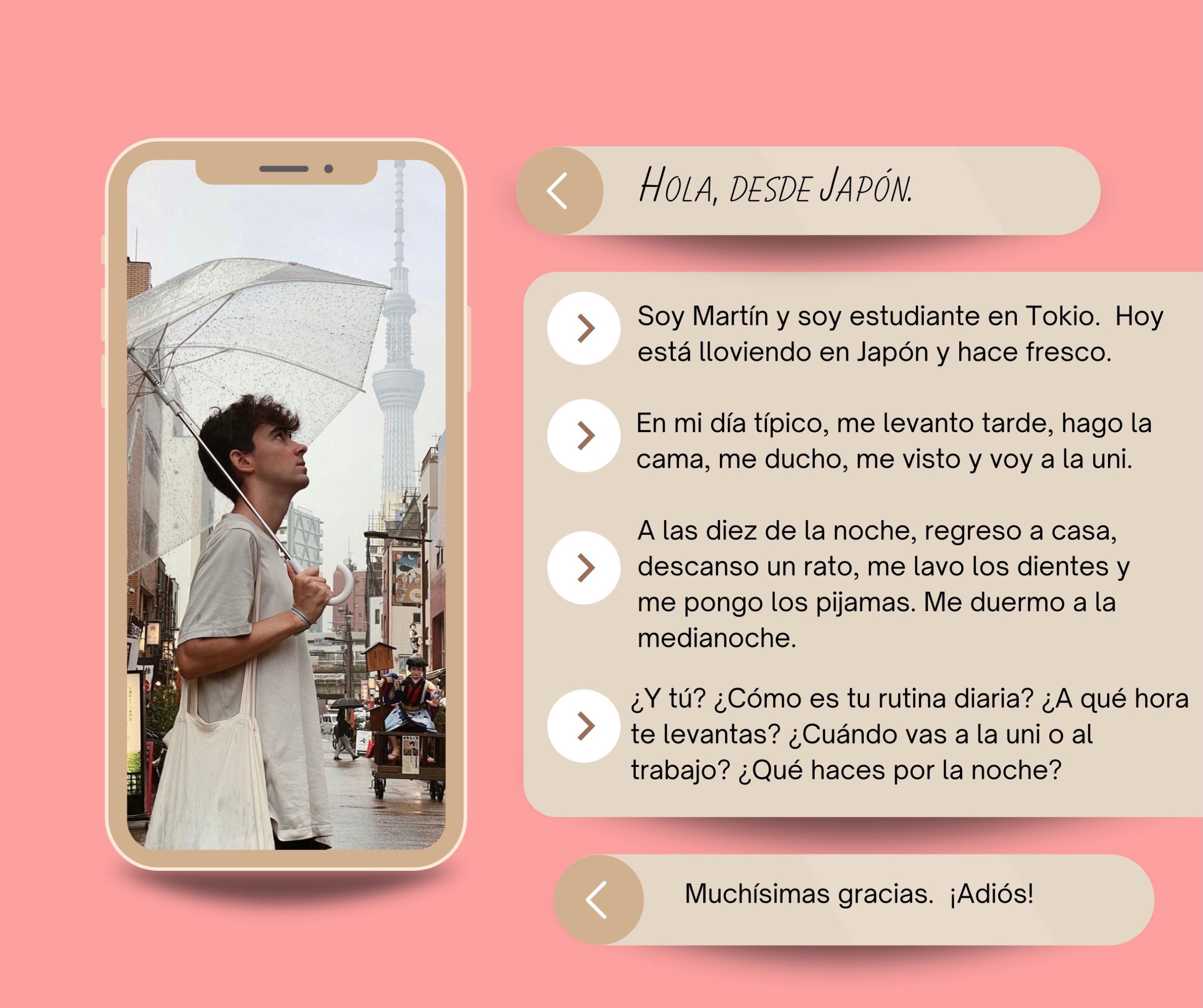
FORMA YO
The following slides contain present tense verbs you could use to describe your daily routine. These verbs are already conjugated for you in the yo form and ready to use in conversation because the goal in Nepantla is to communicate in Spanish. The conjugated verbs in the next three slides should be viewed as vocabulary to help you converse.
You will notice that the verbs are separated by regular, irregular or reflexive conjugations of the forma yo. In the third slide, the verbs have the reflexive pronoun “me” in front of them. This is because these verbs are actions you do to yourself, which makes them reflexive.
*The verbs in slides 1 and 2 do not have a “me” in front of them because they are not actions you do to yourself. They are not reflexive.
Martín’s friend pronounces the regular, irregular and reflexive verbs for you slide by slide.
Slide 1- Regular present tense verbs in the yo form
Slide 2- Irregular present tense verbs in the yo form
Slide 3- Reflexive present tense verbs in the yo form
Actividad L
Paso 1. Martín, who you met earlier, would like to share what his typical day is like in Spain. Watch the video in its entirety, as you will be asked questions about his activities.
Press CC for captions in the language you prefer.
¡Fantástico! 🙂
Actividad M
Yanna, from the University of Santo Domingo would like to know about your daily routine. Listen as she shares hers with you, and answer her questions.
For a transcript of Yanna’s video, click here. Scroll to Yanna.
¡Perfecto! 🙂
You previously expressed your daily routine in the yo form. In this section, you will learn how to describe someone else’s daily routine by using present tense verbs in the 3rd person singular, which is he, she, they (non-binary singular), you formal, or in Spanish, él, ella, elle or Ud.
Instead of the verbs ending in “o”, 3rd person singular verbs end in “a” or “e”.
AR verbs will end in a.
ER/IR verbs will end in e.
Reflexive 3rd person singular verbs will have a reflexive pronoun “se” in front of them to signify himself or herself for él/ella forms. “Se” could also mean yourself for the Ud. form. Finally, for those that classify as non-binary, “se” could mean themself.
See the following slides that include the 3rd person singular of regular, irregular and reflexive verbs already conjugated for you.
To hear how each verb is pronounced, be sure to play the audio.
Verbos regulares en la tercera persona singular
Verbos irregulares en la tercera persona singular
Verbos reflexivos en la tercera persona singular
Watch as Teacher Catalina describes the daily routine of Bas in her video with regular, irregular and reflexive verbs in the 3rd person singular.
Actividad N
Paso 1. Select the activities Bas completed during his daily routine.
___ Se despierta
___ Se estira
___ Se maquilla
___ Va al baño (bathroom)
___ Se lava los dientes
___ Se seca el pelo
___ Mira YouTube
___ Se afeita
___ Usa el perfume
___ Va al trabajo
___ Se peina
___ Desayuna
___ Maneja su coche
Click here for the answer key.
Paso 2. What do you think your instructor does on a typical day. Include 5-7 activities from the verbs you reviewed in the 3rd personal singular.
Modelo- En un día típico, mi profesora ___, _____, ____, _____ y ______.
FORMA TÚ
The informal tú verbs end in “as” or “es”, depending if the verb is an ar or er/ir verb. Additionally, the informal tú verbs will have the reflexive pronoun “te” in front of them.
AR verbs will end in as.
ER/IR verbs will end in es.
Example- Miras mucha televisión. ¿Lees libros? ¿Te duermes a la medianoche? Vas al trabajo temprano.
Watch lsedechill’s TikTok video as two students try get to know each other by using sign language to ask questions in the tú form.
@lsedechill Os traemos una pequeña conversación informal en LSE 🙌 Incluye presentación y preguntas básicas 🗣 #inclusiveconlse #lenguadesingos #lse #lenguadesignosespañola #conversación #presentación #diálogo
In order for you to ask someone questions to get to know them better, it is important to know your verbs in the tú form. See the following slides and press the audio for pronunciation of these verbs.
Verbos regulares en la forma tú
Verbos irregulares en la forma tú
Verbos reflexivos en la forma tú
Actividad O
Get to know your classmates’ daily routine by playing Lotería. Take turns asking questions about your daily habits from the Lotería sheet. You will win Lotería once you fill a row with different names. Say ¡Lotería! when you win! 🙂
To help guide you when you are asked about your daily routine, there is an answer key on the 2nd slide. 🙂
IV. ¿Cómo es tu familia?
Meet Luis, as he introduces his family and asks about yours.
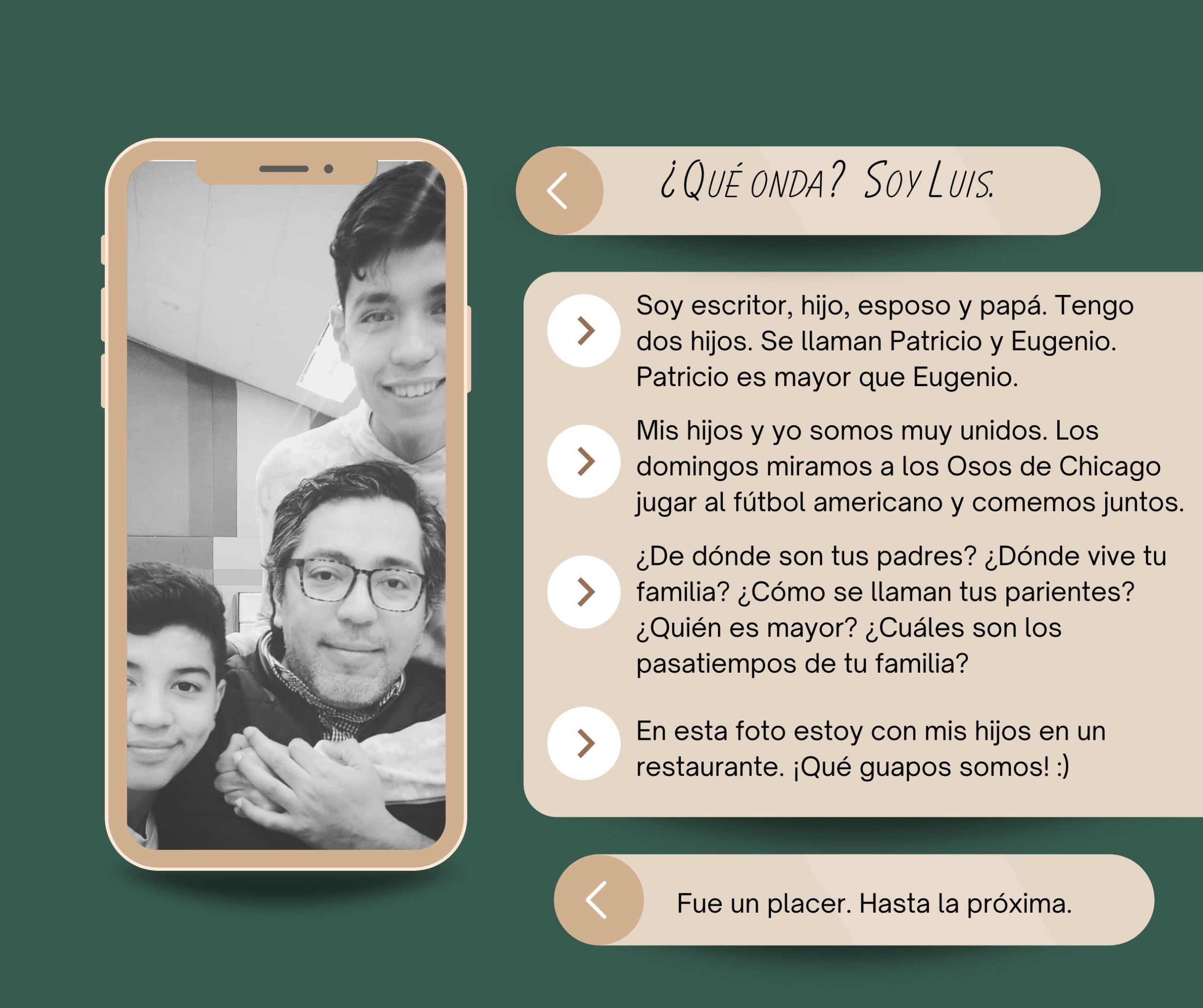
What does family mean to you? Do you have a big or small family?
Family is very important to Latinos. In Latinx countries, did you know that it is common to have several generations of family members living under the same roof? For example, in Costa Rica, sons and daughters can live with their parents until their 30s or beyond. This is true for several reasons.
First, there is a closeness by living with one’s own family. Second, by remaining in the family household, sons and daughters are able save money to buy their own homes. Third, some may choose to live with their family until they get married due to individual preference. Finally, there may be a personal reason such as sickness or individual family traditions that play a role in why several generations of family members live together.
In the following video, David, a virtual conversation partner from TalkAbroad, shares what the concept of family means in his culture. David is from Nicaragua.
Una discusión sobre la familia
Test your listening comprehension skills. What does family mean for David?
Actividad P

Paso 1. How would you describe your family? Fill in the space with at least one descriptive adjective. Remember, family is one singular unit, so your adjective should be singular and feminine.
Modelo- Mi familia es ______________.
Paso 2. Ask 2-3 students to describe their families to you.
Modelo- Hola. ¿Cómo es tu familia? Answer: Mi familia es ____.
Example- Mi familia es trabajadora y leal.
¡Qué bueno!
After asking what someone’s family is like with ¿Cómo es tu familia?, you may ask or be asked more questions about individual family members. In Spanish, there are several words you could use for family members as a whole.
parientes – family members or relatives
familiares– family members or relatives
miembros de la familia– family members
To be able to discuss them, it is important to know the vocabulary words for immediate (familia nuclear) and extended (familia extensa) family. Listen as TikTokers spanishteacherlatef and hellotalk_Spanish share family vocabulary with you.
@spanishteacherlatef Family members in 🇪🇸 #spanish #spanishvocabulary #family #spanishlesson #spanisheasy #learnspanish #uk #usa
♬ Monkeys Spinning Monkeys – Kevin MacLeod & Kevin The Monkey
@hellotalk_spanish Family in Spanish 🥰 @kallyeskally #learnspanish #spanishlesson
Actividad Q
Test your listening comprehension skills by answering the following questions based on the vocabulary presented in spanishteacherlatif and hellotalk_spanish’s videos.
How did you do? 🙂
Luis’s friend, Jessie, is sharing her family tree with you. Listen as Jessie uses some of spanishteacherlatif and hellotalk_spanish’s vocabulary to describe her immediate and extended family members and relationships. For a list of vocabulary words on family, see the 2nd slide.
Play the following audio to see how the vocabulary from slide 2 is pronounced.
Actividad R
What do you remember about Jessie’s family?
¡Fabuloso! 🙂
Actividad S
Complete the following crossword puzzle by writing in the correct relative in Spanish, based on the definitions provided. Placing accents is not possible in this crossword puzzle due to the platform’s restrictions; however, you should still know where accents are located in the new vocabulary words you learn for your own knowledge.
If you would like to get to know someone else’s family better, you could ask questions using any of the following interrogative words.
¿Cómo? (How or What) – ¿Cómo se llaman tus parientes?
¿Qué? (What) – ¿Qué música escuchan tus padres?
¿Cuándo? (When) – ¿Cuándo visitas a tu familia extensa?
¿Por qué? (Why) – ¿Por qué tienes o no tienes una mascota?
¿A qué hora? (What time)- ¿A qué hora se levanta tu familia?
¿Dónde? (Where) – ¿Dónde vive tu familia?
¿Cuál? (Which/What) – ¿Cuál es el nombre de tu abuelo o abuela?
¿Cuántos? (How many) – ¿Cuántos años tienen tus familiares?
Listen as StoryLearningSpanish reviews some of these interrogative words with you.
Actividad T
Find a partner. Choose 5 total questions from the following slides to get to know your classmate’s family. Then switch roles.
Watch as a Spanish language student and her TalkAbroad conversation exchange partner discuss the topic of family.
Una conversación sobre la familia
Did you understand most of the conversation? Did you hear the questions the student and her conversation partner asked about each other’s families?
Intercultural reflection 3
The Murph’s Life Foundation helps families across Latin America that need financial support. Murph often posts his philanthropic work on his website and social media platforms. To learn more about Murph and his mission of helping Latinos, visit the following sources.
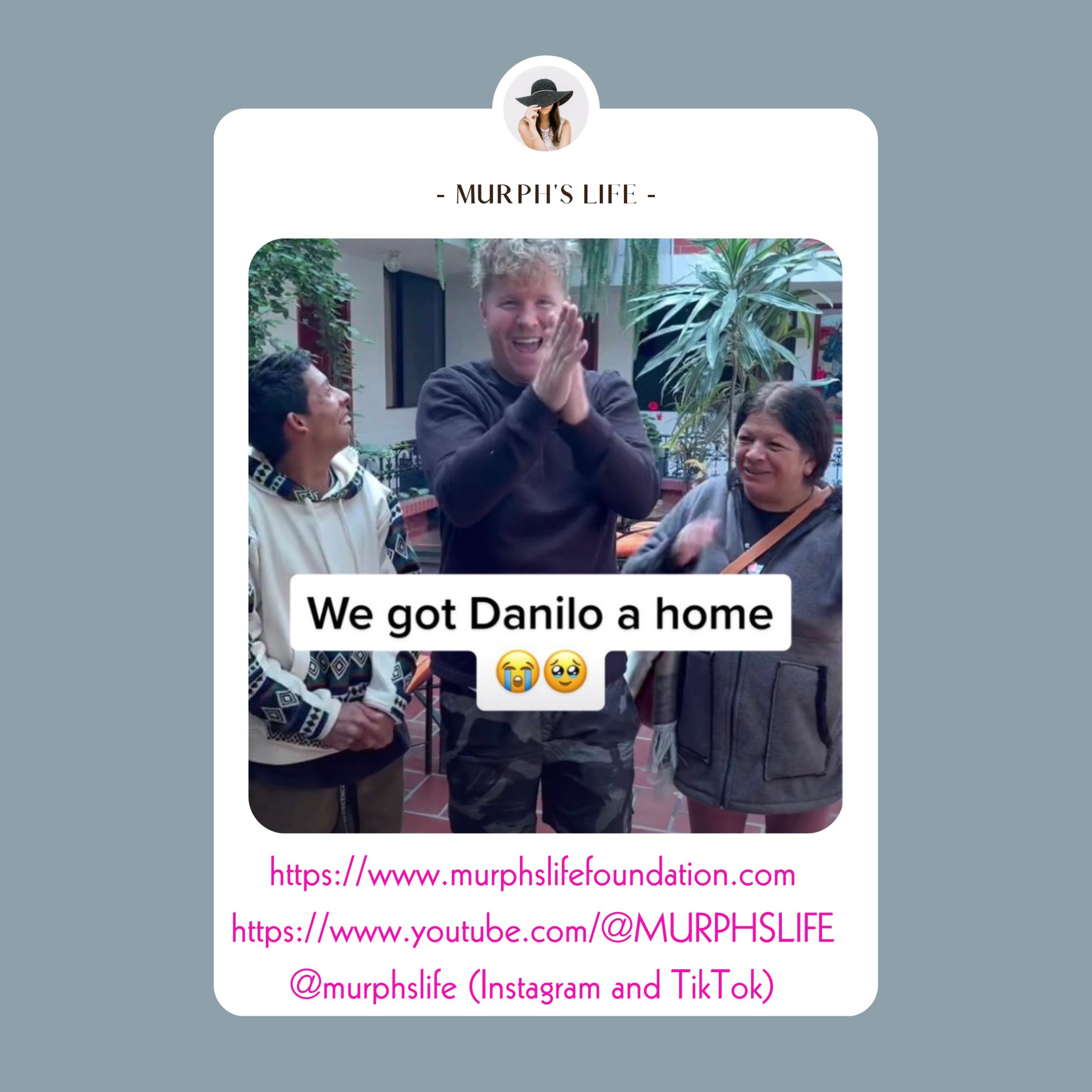
To really understand how others live around the world, it is important to immerse yourself in the world of that person. The following video is of Murph living with a humble family in Ecuador. He puts himself in their shoes and daily life to deeply comprehend the lifestyle of a dad trying to support his three kids.
Explore more
Paso 1. Use vocabulary on family to introduce who the family members are in the video.
Paso 2. Compare your life now to this family’s life in Ecuador. Is it similar or different? Could you see yourself living with a family in Latin America as Murph did? What would you hope to gain from the experience? What would be the benefits of living with a new family in Latin America? What would you like to share about your own culture with them?
Paso 3. Go to one of Murph Life’s social media platforms and select a video that inspires you. Explain why you chose that video and how it impacted you.
V. ¿Cómo son tus hábitos de comer?
You introduced yourself, shared more personal details about your life, daily routine and family, and now you get to describe your daily eating habits and favorite foods and ask others about theirs.
Meet Anita. She is going to describe her daily eating habits and favorite foods in Cuba and ask you about yours.
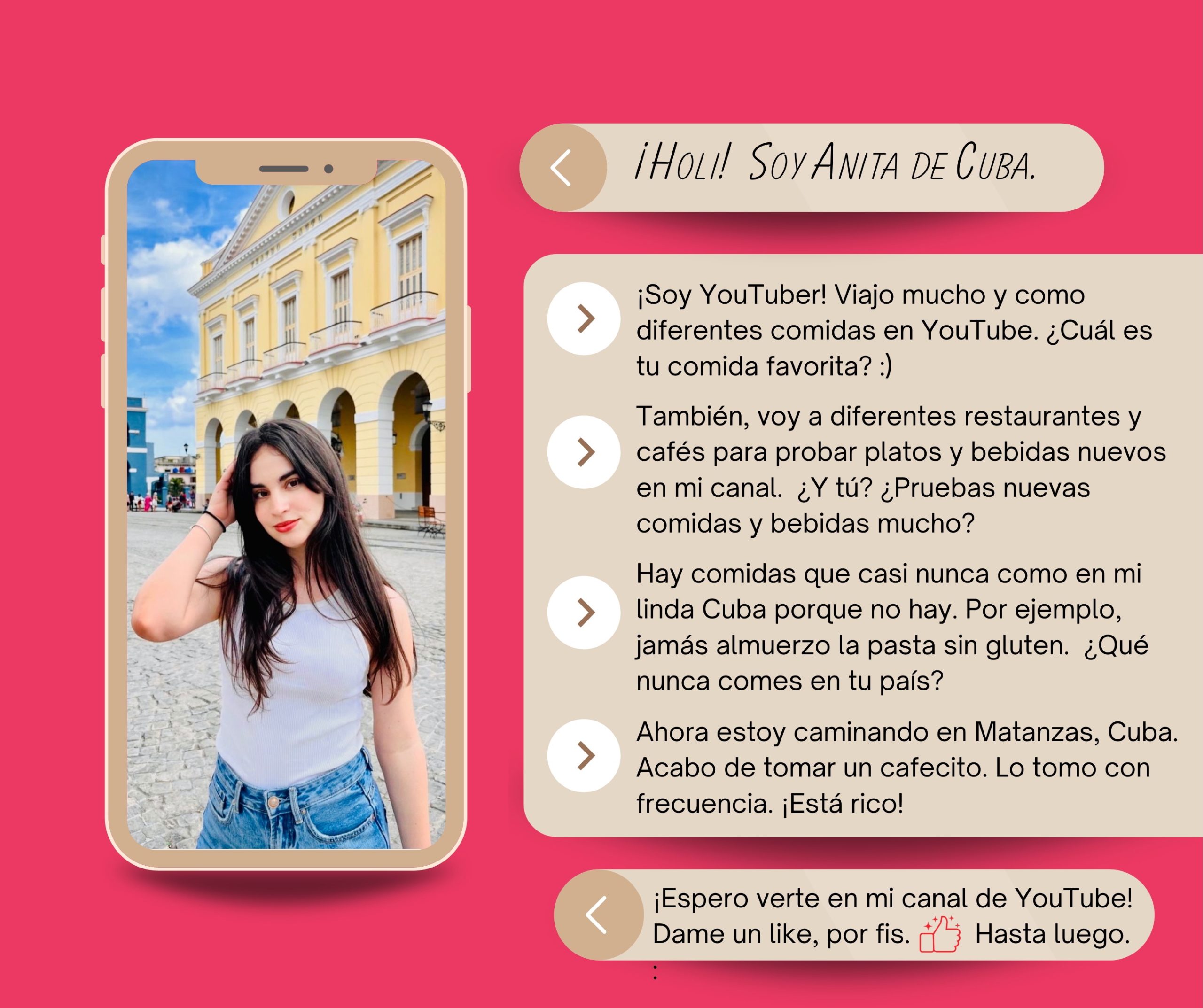
Have you ever tried Latinx food? What are the best Latinx dishes that you’ve had? Is there a Latinx restaurant you recommend?
Did you know in Spanish there are particular verbs associated with eating particular meals? In English, you would say: I eat a sandwich for lunch, or I eat spaghetti for dinner. However, in Spanish, you would use the actual verbs almorzar to describe what you eat for lunch and cenar to describe what you eat for dinner. See the following example.
Example- Almuerzo un sándwich al mediodía y ceno espaguetis por la noche.
Explore the different verbs used for meals (las comidas) in Spanish in the following slide. Play the audio to hear how they are pronounced.
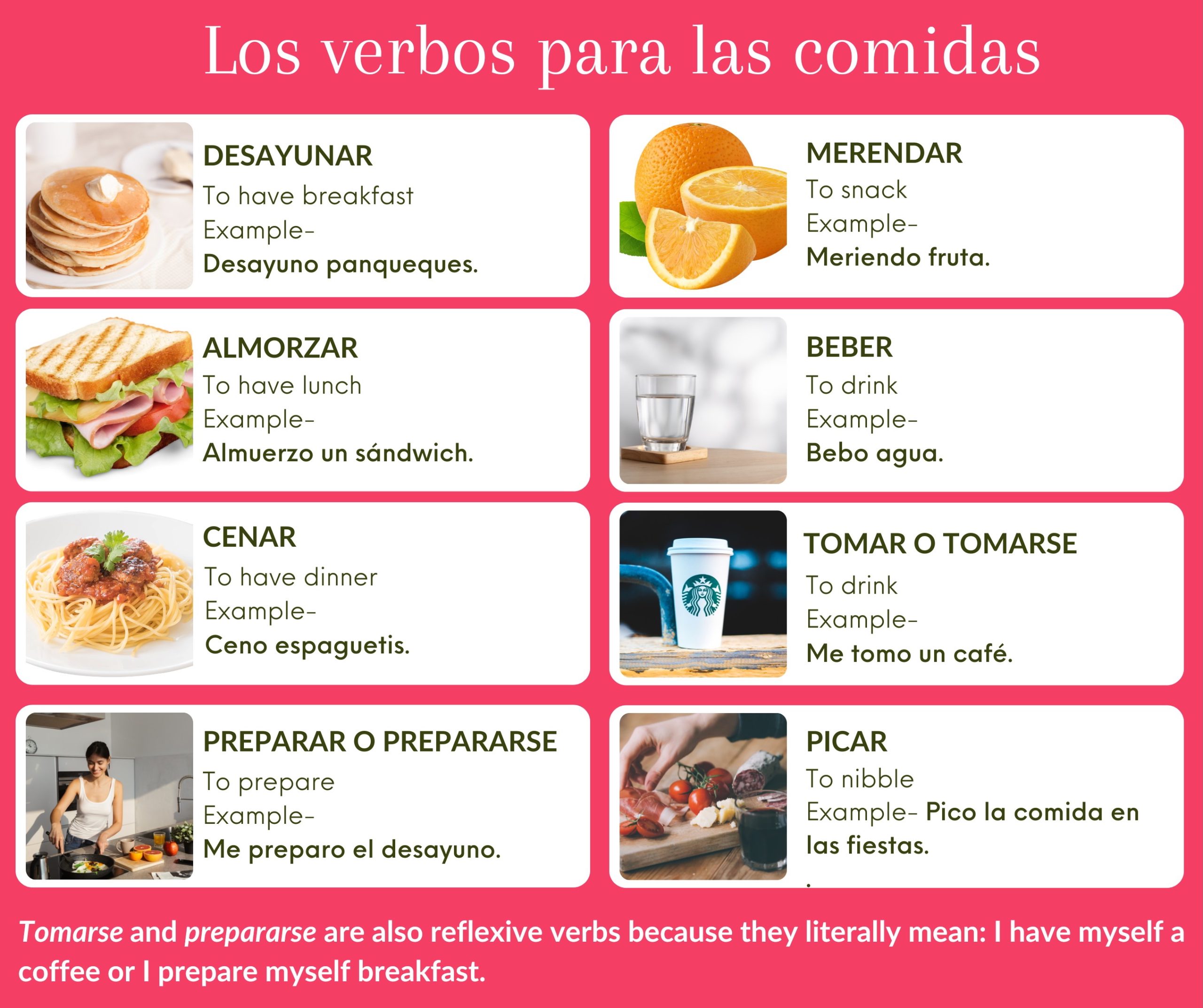
Anita, who you met earlier is from tropical Cuba. Her friend, Alejandra, is from another tropical country, Costa Rica. Alejandra uses the verbs you just learned to describe her daily meals.
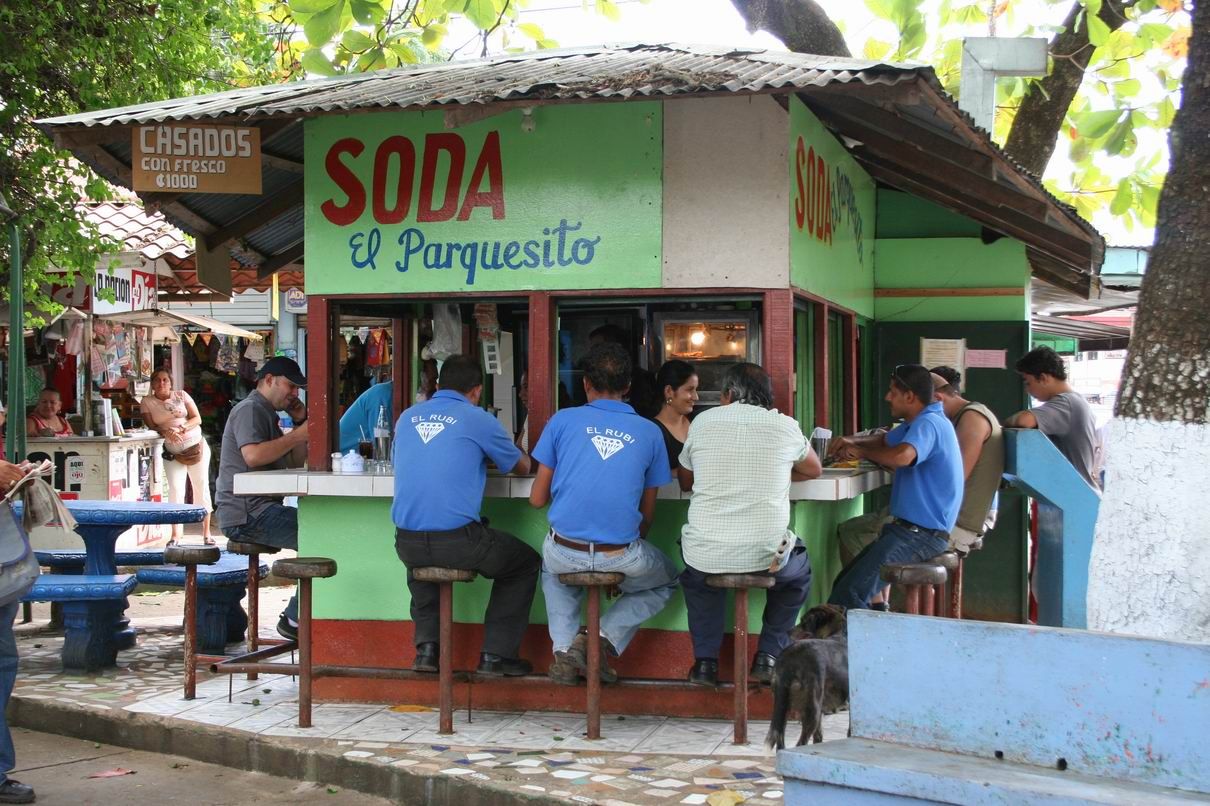
Before you listen to Alejandra’s description of her eating habits, it is important to know that In Costa Rica, a soda is a local restaurant where you can eat a typical casado, which includes rice, beans, salad or plantains, and a meat dish with drink at an affordable price (around $4.00). The word casado technically means married. The foods in the casado are married together to bring you a hearty meal. 🙂
Additionally, you should be aware that gallo pinto is a popular dish in Central America, made up of rice, beans, vegetables and spices. Costa Rican tamales are similar to Mexican tamales, but in Central America, they are made with banana leaves and have different fillings such as potatoes, rice, different meats and vegetables.
In the United States, dinner is the biggest meal of the day. However, in Spain and Latin America, lunch is the main meal of the day. Unlike in the U.S., where lunch is eaten within a 30-minute break or less, in Spain and Latin America, lunch takes anywhere from 2-4 hours to eat and enjoy.
Why do you think there is such a difference between lunch and dinner times between the U.S. and Spanish-speaking countries? What are the benefits and disadvantages to eating a 30-minute or 2-3 hour lunch? Share your opinion.
With this background information, you are ready to listen to Alejandra’s eating habits in Costa Rica.

Actividad U
Do you remember what Alejandra eats for breakfast, lunch, dinner and snack? Check your memory and listening comprehension skills by completing the following activity individually.
You’ve discussed different foods from Latin America, and you learned about traditional foods eaten in Costa Rica. What foods form part of the U.S. diet? If someone were to ask you about your daily eating habits, would you be able to mention the foods you eat in Spanish?
The following slides include typical foods eaten in the United States for different meals and snacks that could help you express what you eat in a typical day.
Listen as Alejandra pronounces these foods for you in Spanish.
Slide 1- Los desayunos
Slide 2- El almuerzo y la cena
Slide 3- Los postres y meriendas
*If there is a food that you normally eat that it is not located in the previous slides, feel free to look it up at www.wordreference.com.
Actividad V
Based on the slides you just reviewed, place the foods typically eaten for breakfast, lunch, dinner and snack in their appropriate categories.
How did you do?
¡Muy bien! 🙂
Similar to Alejandra, Anita would like to share a typical lunch she has in Cuba. Is your typical lunch similar or different?
You could press CC for captions in the language you prefer.
Would you like to try Anita’s traditional lunch?
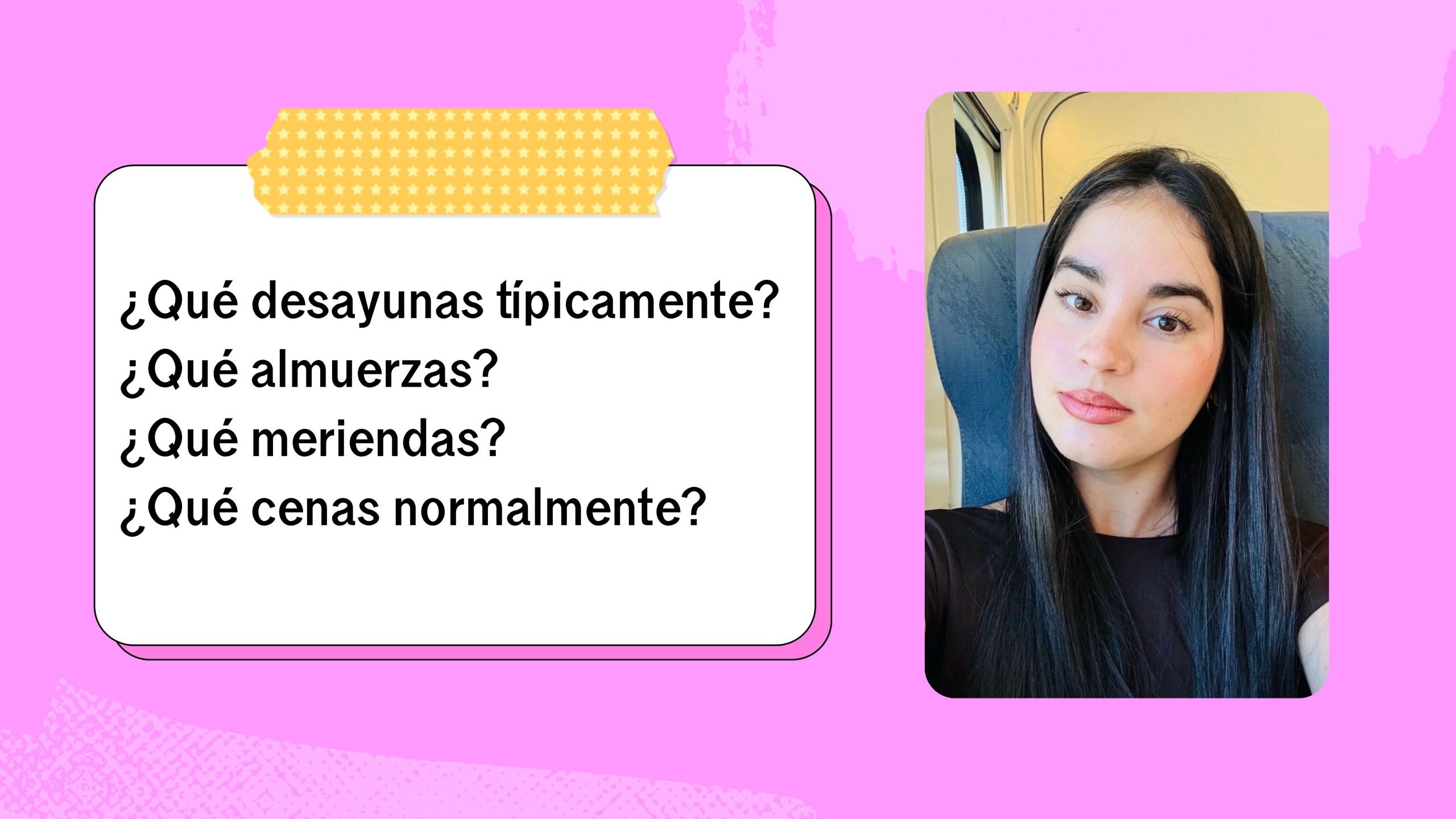
Anita would like to know what your daily eating habits are like. Record your answers for her. Remember to use the verbs in each question in your answer.
For example- ¿Qué almuerzas típicamente? Answer- Típicamente, almuerzo un sándwich con un refresco.
Intercultural Reflection 4
In Spanish, there is a term called la inseguridad alimentaria, which means food insecurity. La inseguridad alimentaria is when people do not have access to an adequate quantity of food or quality food that meets one’s basic needs. To learn more about food insecurity in English, click on this article by Feeding America. To learn more about la inseguridad alimentaria in Spanish, read the following article by National Geographic.
Social media influencer, Anita Mateu, invites you to explore the issue of la inseguridad alimentaria as she takes you through a day in her life in Cuba. Have you ever been to Cuba? Do you have friends or family from there or that currently live in Cuba? Do you know any traditional Cuban dishes? Did you know that food is scarce in Cuba?
Press CC for captions in the language you prefer as you watch Anita’s YouTube video about food insecurity in Cuba and in her home.
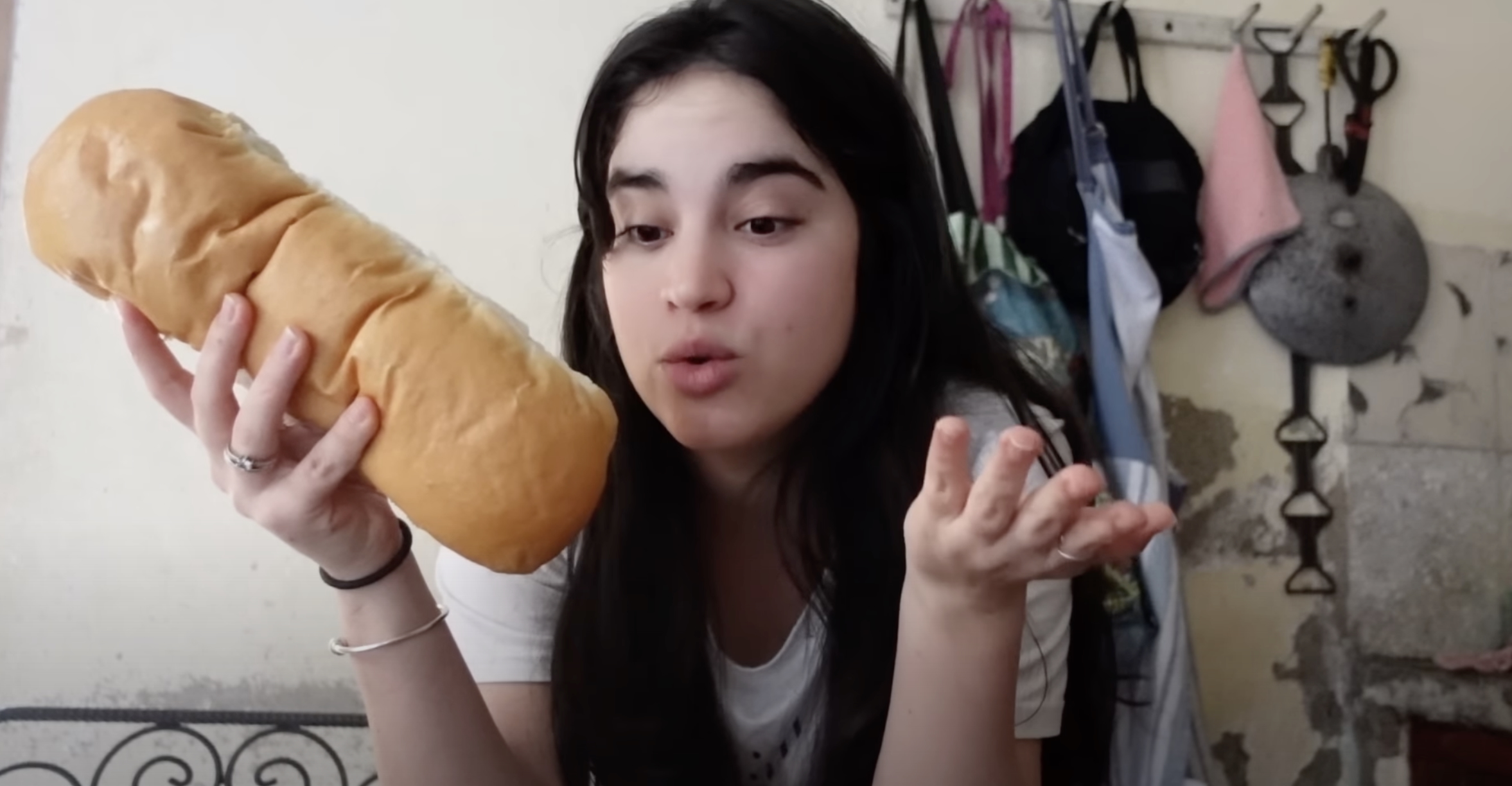
To watch video, click here.
Explore more
Paso 1. What are your initial reactions to Anita’s video about the food situation in Cuba? Were you aware of how difficult it was to obtain food there? Have you experienced food insecurity in your life or community? If not, do videos like Anita’s open your eyes and heart to the issues of la inseguridad alimentaria? Do you feel more compassion and empathy for those that do not have access to food for their livelihood?
Paso 2. Name 5-7 foods you observed in Anita’s video in Spanish. Name a food that is new for you. Which food do you like and why?
Modelo- En el video, hay (name 5-7 foods). Una comida nueva para mí es ______. En el video, me gusta ______ porque ______.
Paso 3. Anita now lives in Spain, and she is able to send her family money to help them financially. This is common for many Latinos that work in the U.S. They help their families by sending them money for food and basic life needs. Do you know someone that works in the States and sends money home to their families? How would you feel if you had to leave USA to find work and send money to support your family? By putting yourself in the shoes of someone like Anita, who has to work abroad to support her family, do you better understand the struggles Cubans or other Latinos face?
Paso 4. If you would like to support food pantries or help combat food insecurity in your community, you could donate to the following organizations. If you are experiencing food scarcity, you could also visit these locations for help in the Chicagoland area.
Loaves & Fishes Community Service
To learn more about food insecurity in the Latinx community in Chicago, watch the following video by WTTW.
Latin food is very vibrant. Tropical fruits and vegetables have bright colors and are excellent for your health. In Costa Rica and Cuba, for example, it is common to have drinks that are made of fresh fruit. They could be called jugo de + fruit in Spanish or agua de + fruit in Spanish. Examples- jugo de papaya o agua de piña.
If asked, could you describe a fruit, vegetable or drink in Spanish by its color? Do you know your colors in Spanish? Listen as they are pronounced for you.
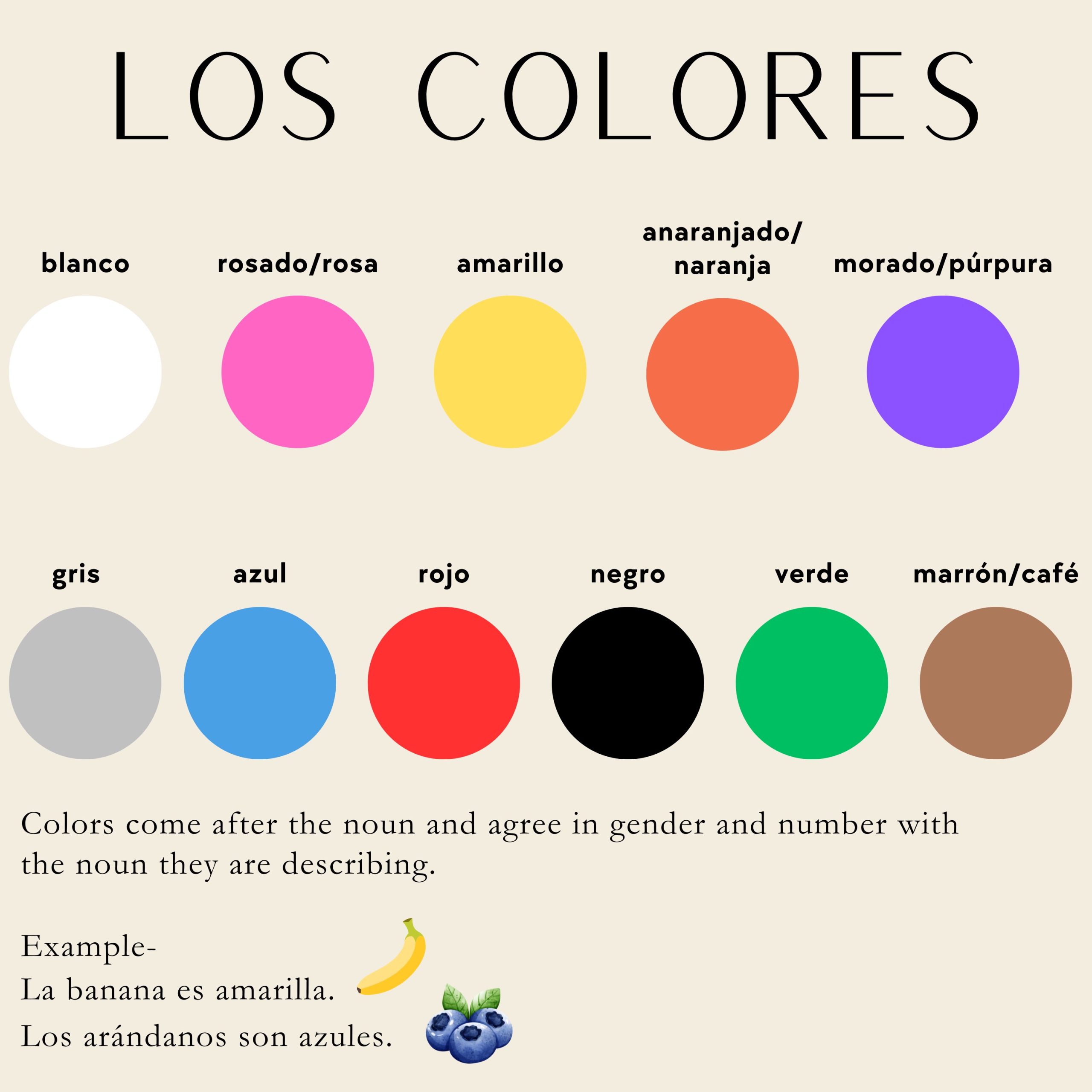
Review the following slides to also learn about fruits, vegetables and drinks in Spanish.
Play the audio for the pronunciation of each food or drink.
Slide 1- Las frutas
Slide 2- Las verduras
Slide 3- Las bebidas
Francisco from StoryLearning Spanish breaks down the most popular drinks for you in Spanish. What do you think they are? 🙂
Actividad W
Paso 1. Based on the colors and information you learned about vegetables, fruits and drinks, select the correct answer for each description.
Paso 2. Your Spanish-speaking conversation partner would like to know more about your eating habits. Send them a text in WhatsApp by answering any 5 of the following questions.
To see examples of answers to each question, review the 2nd slide.
Modelo- Hola. Voy a responder a tus preguntas sobre mis hábitos de comer. Típicamente, desayuno café con pan tostado. Mi restaurante favorito es Portillos porque sirven hamburguesas y papas fritas. No me gustan las manzanas. Etc.
VI. Chapter 6 Final Assessment
You’ve met Gabby, Jessica, Martín, Luis and Anita. You’ve learned about them, their daily routine, family and eating habits. They each have a question for you. Record your answers with the information you’ve learned from this chapter. 🙂