7 ¿Cuál es tu día festivo favorito?
Your Chapter 7 task is to describe your favorite holidays and ask others about theirs.
Meet Dulce. She is going to describe her favorite holidays and what she gives to others as gifts.
Steps to take to achieve this task:
- ¿Cuál es tu día festivo favorito?– describe the holidays you celebrate and compare and contrast them to Spanish and Latinx ones
- ¿Qué sabes?– ask questions about holiday celebrations using the verbs saber and conocer
- ¿Qué vas a celebrar este año?– discuss what you are going to celebrate this year with the verb ir + a + infinitive
- ¿Qué le regalas a tu familia?– use indirect object pronouns to describe who is going to receive gifts at your holiday celebrations
- ¿Cuál es el mejor regalo?– use relative and absolute superlatives to describe the best and worst parts of the holiday season
- Task 7 Assessment– take part in Dulce’s podcast to discuss your favorite holidays, what you are going to celebrate this year, who is going to receive gifts, and ask her questions about the holidays
I. ¿Cuál es tu día festivo favorito?
Dulce mentioned that her favorite holiday was Día de los Muertos. Do you know what it is?
Watch this video clip by Rick Kilbrai, where he posts a scene from Coco about Día de los Muertos.
What días festivos (holidays) do you celebrate? Are any of them written on the package below?
For example- Celebro Diwali. OR Celebro la Noche de Brujas y el Día de Acción de Gracias. OR Celebro Kwanzaa con mi familia.
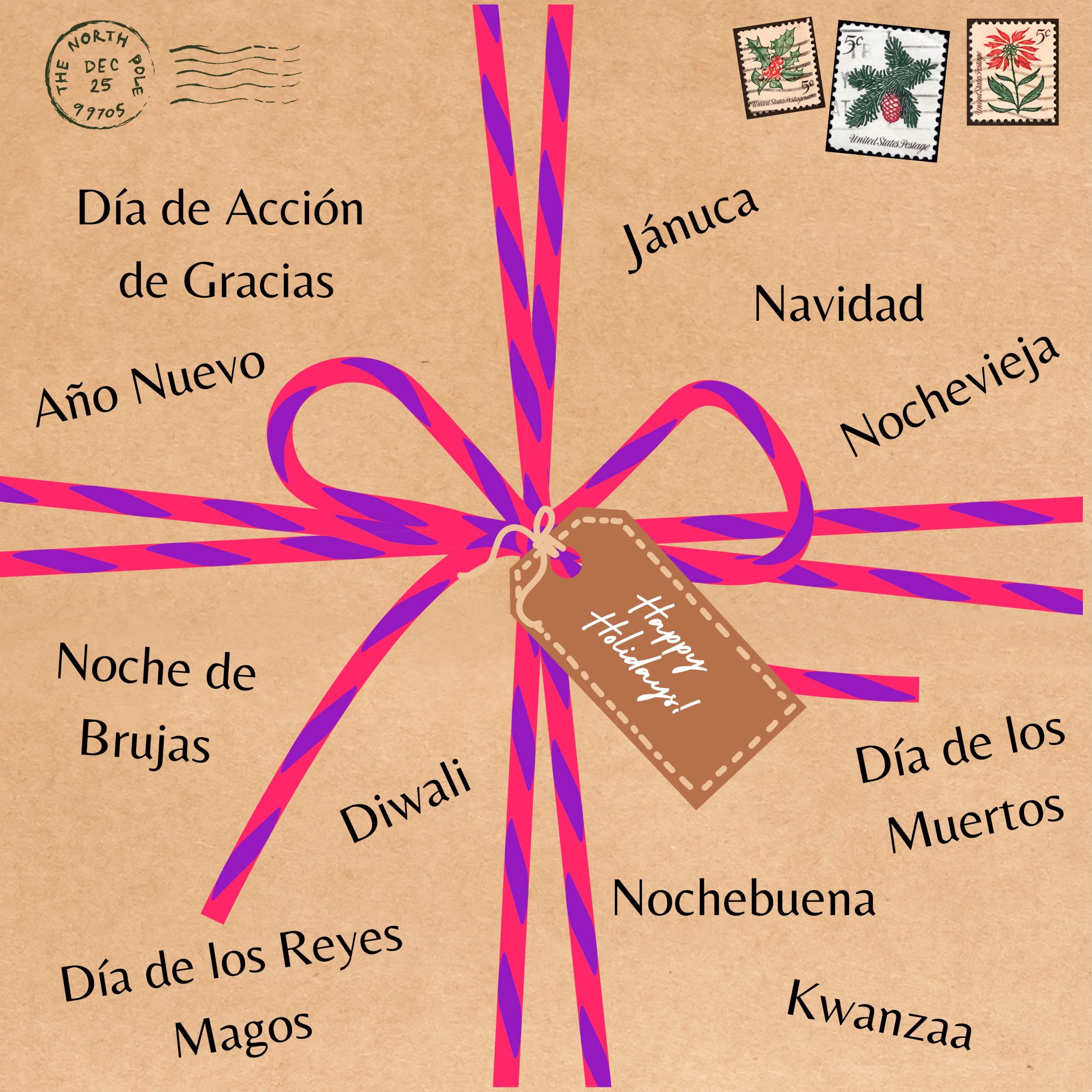
Have you ever taken part in a Spanish or Latinx holiday? What did you celebrate? How was it?
If not, have you heard the following Christmas song in Spanish by José Feliciano before?
What is interesting about “Feliz Navidad” is that this song, which is written in both Spanish and English, crossed cultures and became one of the most popular songs played during Christmas worldwide.
Did you know that Christmas Eve, Christmas, New Year’s Eve and New Years are traditional holidays that are celebrated in both English and Spanish-speaking worlds? However, they have their own traditions and ways to commemorate the day.
Watch as Lingo Mastery Spanish and Pero Like share their New Year’s Eve and Nochebuena traditions in Latin America and in the States.
Other holidays such as el Día de los Reyes Magos and el Día de los Muertos are predominately celebrated in Spanish-speaking countries, although Latinos that live in the U.S. and other countries, do celebrate these holidays as well.
Listen as Lin-Manuel Miranda shares his memories of El Día de los Reyes Magos with you through this video by the Washington Post.
Have you ever donated toys or clothing to those in need during the holidays? Have you ever sponsored a family? If not, would you like to this year?
The Latin American Association sponsors a toy drive for kids. The Chicago Community Trust also helps Latinx communities in need.
Like Lin-Manuel Miranda, MamainMadrid also celebrates el Día de los Reyes Magos, but in Spain. The traditions may be a little different. Watch as MamainMadrid walks you through the celebration in a small town by her home.
Be sure to press sound on the bottom right of the video.
Would you like to experience Nochevieja, Nochebuena or Día de los Reyes Magos in a Spanish-speaking country after watching how each holiday is celebrated? What do you find interesting about these holidays? What was most surprising to you?
Do you know how to say Merry Christmas, Happy Hanukkah or Happy New Year in Spanish? Watch the following video by Learn Spanish and Enjoy as she pronounces these useful phrases for the holiday season. 🙂
Dulce, who you met at the beginning of this chapter, is Mexican-American and celebrates both American and Mexican holidays with her family.
At Dulce’s local church, the list of holidays that will be celebrated this year was just posted on the church’s website. Listen as one of the kids from Dulce’s church, Pía, reads them to you.
Actividad A
Match the following holidays that Pía mentioned to the month in which they take place and when Dulce’s church plans to celebrate them. 🙂
How did you do?
Some additional holidays that are also celebrated are Jánuca (Hanukkah), Carnaval (febrero-marzo), Semana Santa (Holy Week), Diwali and Kwanzaa.
Do you celebrate any of these holidays? How do you celebrate them? What is meaningful to you about them?
Actividad B
Paso 1. Dulce is looking forward to celebrating the different holidays Pía mentioned at her church. However, Dulce has some favorites. Select the holidays Dulce is describing in the following activity.

Dulce loves Día de los Muertos. To see Dulce on Day of the Dead, click on the following video, and play the sound by clicking on the bottom right of the video.
Dulce en el Día de los Muertos
Paso 2. Dulce just shared some of her favorite holidays. Ask 2-3 students around you what their favorite holidays are. Each student must name at least two or more.
Modelo- Hola. ¿Cuáles son tus días festivos favoritos? Answer- Mis días festivos favoritos son la Noche de Brujas y la Nochevieja.
Which holidays are popular amongst your classmates?
¡Bravo! 🙂
Actividad C
As a yogi, Dulce creates inspiration cards. Dulce recently made a small deck of these cards with her favorite American holidays. In groups of 3-4 students, go through the inspiration cards and select your favorite parts of each holiday, if you celebrate them.
If there is a holiday you do not celebrate, feel free to include the holiday you do celebrate and what your favorite parts of that holiday are.
Modelo- Mis partes favoritas de la Navidad son los regalos, la familia, los amigos y las galletas de Navidad.
Another example- Mis partes favoritas de la Noche de Brujas son los disfraces, los dulces y las películas de terror.
*If there is something you love about a particular holiday, and it’s not on the inspiration card, feel free to look it up on www.wordreference.com.
Dulce would like you to learn about some of the Mexican holidays she celebrates. In the following video, Dulce introduces you to Día de los Muertos and treats you to a makeup tutorial from The Book of Life to celebrate the holiday.
ChidoChicago recently shared her personal video from her visit to the ofrendas and alters in Chicago on Day of the Dead. Be sure to press sound on the bottom right of the video.
If you would like to create your own alter to honor a loved one who has passed on, you could follow this video by Fue Tete DIY.
Actividad D
Have you ever built a Day of the Dead alter? With another person, plan an ofrenda together. Discuss who you would like to honor, and what you would like to put on your alter based on the videos you saw by Dulce, Chido Chicago and Tete DIY.
The song in the background is called “Tu Cárcel” by Lila Downs.
Modelo- Quiero recordar a mi abuelita, Rosa. En mi ofrenda quiero poner fotos de mi abuelita, velas, flores de cempasúchil, sus bebidas favoritas y pan de muerto.
¡Bravo! 🙂
Intercultural reflection 1
Although Dulce provided you an introduction to Día de los Muertos and Tete showed you how to create an alter, to truly understand what Día de los Muertos means to Latinos, it is important to hear from them personally.
Ford Quarterman, a social media influencer and content creator, traveled to Mexico to experience his first Día de los Muertos. Watch as he takes you through Michoacán, one of the most traditional places to experience Día de los Muertos.
Explore more
- Name 5 new words related to Día de los Muertos that you learned in Spanish from this video.
- What did you learn from the perspective of Mexicans about Día de los Muertos? Was this perspective new to you? How so?
- What moved you from Ford’s video about Día de los Muertos? Has this changed your perspective about death or how Latinos view death?
- Who is someone you would like to honor and remember on Día de los Muertos. What did this person mean to you? What would you like to put on their alter and why?
- Chido Chicago walked you through a local celebration in Chicago celebrating Día de los Muertos. Would you ever take part in such a celebration as Chido Chicago and Ford did, given the opportunity?
- If you are in the Chicago area and would like to explore Día de los Muertos in a Mexican-American community, you could visit The National Museum of Mexican Art. In November, you could take part in the same celebration Chido Chicago did.
Actividad E
Paso 1. Watch the following award-winning animated film by Ashley Graham, Kate Reynolds and Lindsay St, which celebrates Día de los Muertos, posted by CG Meet Up.
Paso 2. In groups of 3-4 students, discuss the following questions about the short film.
- ¿Qué aspectos de Día de los Muertos hay en el video? En el video hay, _____, _____, ____ y _____.
- ¿Cuál es tu parte favorita del video? Me gusta _________.
- ¿El video tiene un tono (tone) feliz, triste o los dos? El video tiene un tono _____ porque _______.
- ¿Recomiendas este video para tu familia y amigos? ¿Por qué? Sí, recomiendo este video para mi familia y amigos porque ______.
Finally, Cinco de Mayo is very important to Dulce. Some of her American friends confuse this day for Mexican Independence Day. As a result, Dulce created a slide that explains the difference between Cinco de Mayo and Mexican Independence Day and how both holidays are celebrated.
Cinco de Mayo vs Día de la Independencia de México
Unfortunately, Cinco de Mayo has fallen victim to instances of cultural appropriation. Huffpost posted a video about how not to celebrate Cinco de Mayo.
To learn ways to celebrate Cinco de Mayo respectfully, Dulce is sharing the following article by V Magazine.
Actividad F
In groups of 2-3 students, answer the following questions together. You could discuss these questions in English.
The song in the background is called “Qué Me Vas a Dar” by Jenni Rivera.
Refer to the Cinco de Mayo vs Día de la Independencia de México slide as a guide.
- What is the difference between Cinco de Mayo and Día de la Independencia de México?
- What are examples of cultural appropriation when celebrating Cinco de Mayo that are not welcome at all by Mexicans?
- Name 3-4 respectful ways to show cultural appreciation versus cultural appropriation when celebrating Cinco de Mayo.
You’ve learned how to express holidays in Spanish, how they are celebrated in Spanish and Latinx communities, and when they occur.
Your task in this chapter is to describe your favorite holidays and ask others about theirs, particularly those from Spanish-speaking countries. To start a conversation about the holidays, refer to the following slide.
Play the audio to hear the questions pronounced in Spanish. You can also see sample answers if asked the same questions.
Actividad G
In groups of two, select 4 questions from the conversation questions about holidays to ask your classmate as practice for your upcoming virtual exchange with a Spanish speaker. Then, your partner will select 4 new questions to ask you about the holidays.
The song in the background is called “El Cantante” by Marc Anthony.
What did you learn about your partner’s holiday traditions? 🙂
II. ¿Qué sabes?
To better compare and contrast your holiday traditions with Latinx ones, it is important to ask more questions. You could use the verbs saber and conocer to accomplish this. Both verbs mean to know. However, saber and conocer are used in different contexts.
Watch as Breakthrough Spanish describes the differences between saber and conocer with examples in context.
For a summary of the verbs saber and conocer and how to use them in conversation, see the following slide.
Listen as Danielito describes the holidays to his little sister using saber and conocer.
Activity H
Select why Danielito used saber and conocer in the following contexts as he described the holidays to his little sister.
¡Excelente! 🙂
Actividad I
See if you could select whether to use saber or conocer in the following contexts as well.

¡Muy bien! 🙂
Listen as Celia describes her upcoming Christmas Eve celebration using the verbs saber and conocer.
For a transcript of Celia’s video, click here. Scroll to Celia.
Actividad J
Test your listening comprehension skills by completing the following activity about Celia’s Christmas Eve celebration.
¡Fabuloso! 🙂
Actividad K
Paso 1. Celia asked you some questions in her video. Record your answers for her. Be sure to greet her and tell her where you live.
Modelo- Hola, Celia. Mi nombre es _____ y vivo en Naperville, Illinois, cerca de Chicago. (Then answer her questions.)
Paso 2. Ask Celia a question using the verb saber and another one using the verb conocer to see what she knows or is familiar with regarding the holidays you celebrate.
Modelo- Celia, tengo algunas preguntas para ti. ¿Sabes cuándo los estadounidenses abren los regalos de Navidad? ¿Conoces algunas películas de Navidad en inglés?
¡Perfecto! 🙂
Now that you know how to use both verbs, saber and conocer, you are ready to form questions for your upcoming conversation with a native speaker of Spanish regarding the holidays.
Actividad L
In preparation for your upcoming virtual conversation exchange with a Spanish speaker, with a partner, create at least 5 questions together you could ask regarding the holidays using the verbs saber and conocer.
You could ask your virtual conversation partner what they know or are familiar with concerning the holidays you celebrate. Or, you could ask them more questions about the holidays they celebrate. It’s completely up to you! :). Read your questions to the class.
The song in the background is “Navidad Sin Ti” by Marco Antonio Solís.
III. ¿Qué vas a celebrar este año?
You have a great set of questions about the holidays to use in your next conversation with a Spanish-speaker. ¡Fabuloso! :).
If you would like to ask someone what they are going to do this year for the holidays, you would use the verb ir + a + an infinitive to form a future-like tense. Or, you could ask someone where they are going this year with the verb ir by itself.
Watch as Teacher Catalina introduces you to the verb ir to describe where you are going.
Teacher Catalina also presents how to use the verb ir + a + infinitive to describe a future action.
For a summary of the two uses of the verb ir Teacher Catalina introduced in her videos, see the following slide.
Actividad M
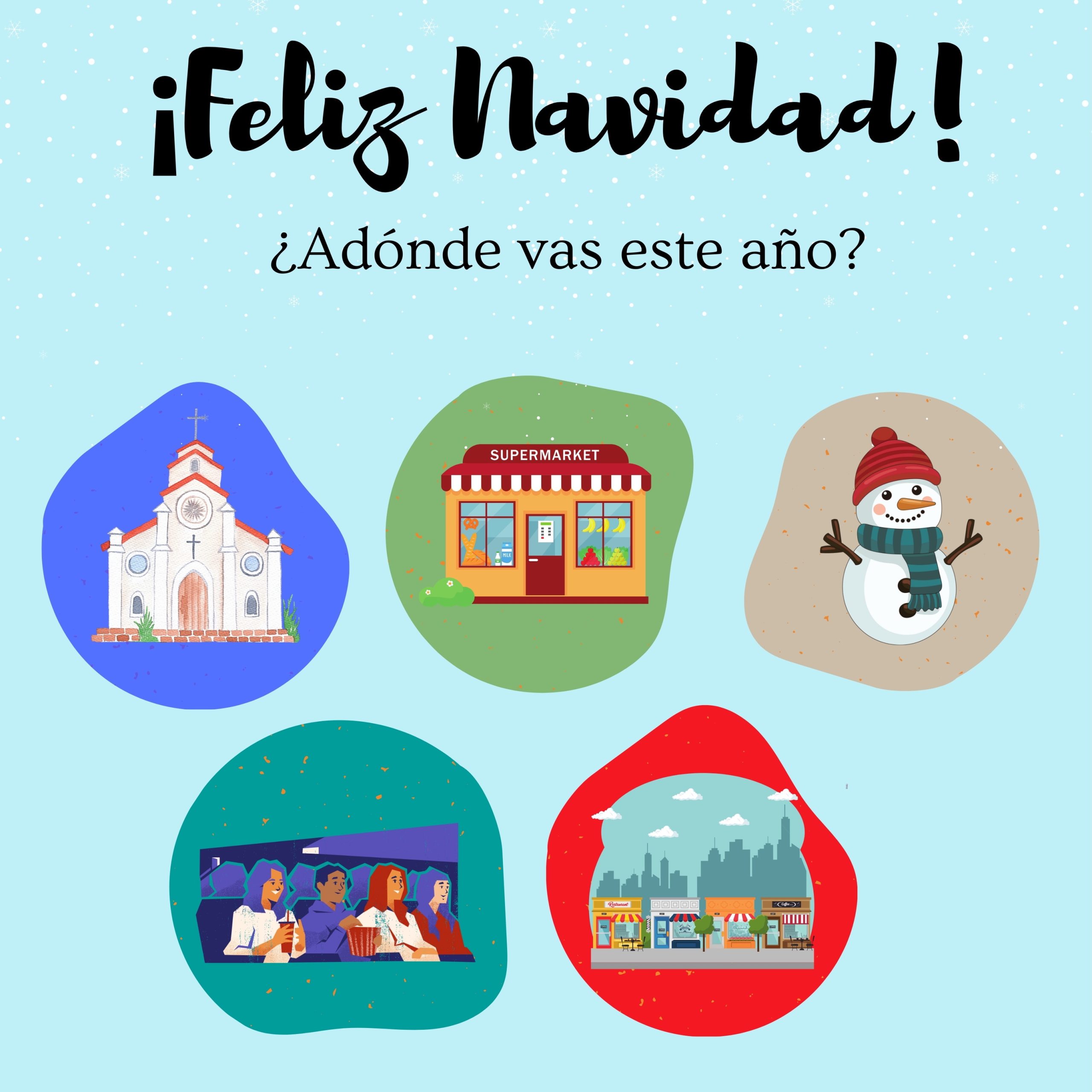
Paso 1. ¿Adónde vas este año? Select the correct answer that describes where people are going this holiday season. Pay close attention to the articles in the location used after ir + a.
Paso 2. Ask the following questions to different students to find out where they go during the holiday season.
- ¿Adónde vas para la Navidad?
- ¿Adónde vas para celebrar el Día de Acción de Gracias típicamente?
- ¿Adónde vas para celebrar la Nochevieja?
- ¿Vas a diferentes casas y dices truco o trato en la Noche de Brujas?
Share your findings with the class. 🙂
¡Bravo! 🙂
Dulce is excited for the New Year! She would like to know what resolutions you are going to make or what goals you are going to manifest for yourself in this next year. Dulce would like to help you by starting you off with some journal prompts.
Actividad N
Paso 1. Choose any 2 of Dulce’s journal prompts below and write your answers down.

- What are 5 things you are going to say no to this year? Example- Voy a decir no a ____, _____, ____, _____ y ______.
- What am I going to do to take more responsibility for my own life? Example- Para tomar más responsabilidad de mi vida, voy a _____ y _____. <~~ use infinitive verbs in the spaces since you are discussing what you are going to do
- Three ways I am going to connect with nature. Example- Para estar más conectada con la naturaleza, voy a caminar en el parque, _____ y _____. <~~ use infinitive verbs in the spaces
- What am I going to feel while living my dreams? Example- Voy a sentir ______ cuando estoy realizando mis sueños.
Paso 2. Find a partner, and share at least one of your answers with them.
Paso 3. Write 3 New Year’s resolutions that you are going to make this year.
Modelo- Mis 3 Resoluciones para el Año Nuevo Example- Voy a dormir 8 horas o más.
- Voy a ______. <~~ verb in the infinitive required
- Voy a ______. <~~ verb in the infinitive required
- Voy a ______. <~~ verb in the infinitive required
Feel free to use the following slide of popular verbs to help you write your resolutions. 🙂
Paso 4. Create 2-3 questions you would like to ask a Spanish speaker to learn about their goals or resolutions. You could also ask them what they are going to do this holiday season.
Modelo- ¿Qué resoluciones vas a hacer para el Año Nuevo? ¿Qué vas a hacer para los días festivos? ¿Vas a visitar a tu familia?
IV. ¿Qué le vas a regalar a tu familia?
The holidays are such a fun time to celebrate with family and friends. Do you exchange gifts or acts of kindness during the holidays? Who do you give gifts or provide acts of kindness to? In Spanish, when you identify someone who is going to receive an action, object, or in this case, a gift, you would use an indirect object pronoun to identify that person.
Listen as Dulce discusses what she is going to gift to her different family members for Christmas.
Did you notice that Dulce used the indirect object pronoun, Le, to identify who is receiving her gifts?
For example, Dulce says:
A mi madre le voy a regalar maquillaje. I am going to gift her makeup.
A mi esposo le voy a dar ropa. I am going to give him clothes.
A mi hijo voy a comprarle zapatos de tenis. I am going to buy him tennis shoes.
The indirect object pronoun, Le, replaces a mi madre, a mi esposo and a mi hijo
Watch as Speak Spanish with Paula introduces you to indirect object pronouns and how to use them in a sentence to signal who is receiving the action or object.
The following slide summarizes the indirect object pronouns Paula introduced you to in Spanish and how to use them when discussing the holidays.
Actividad O
Based on what you just learned from Paula’s video and the slide on indirect object pronouns, determine which indirect object pronoun would be used for the following people.
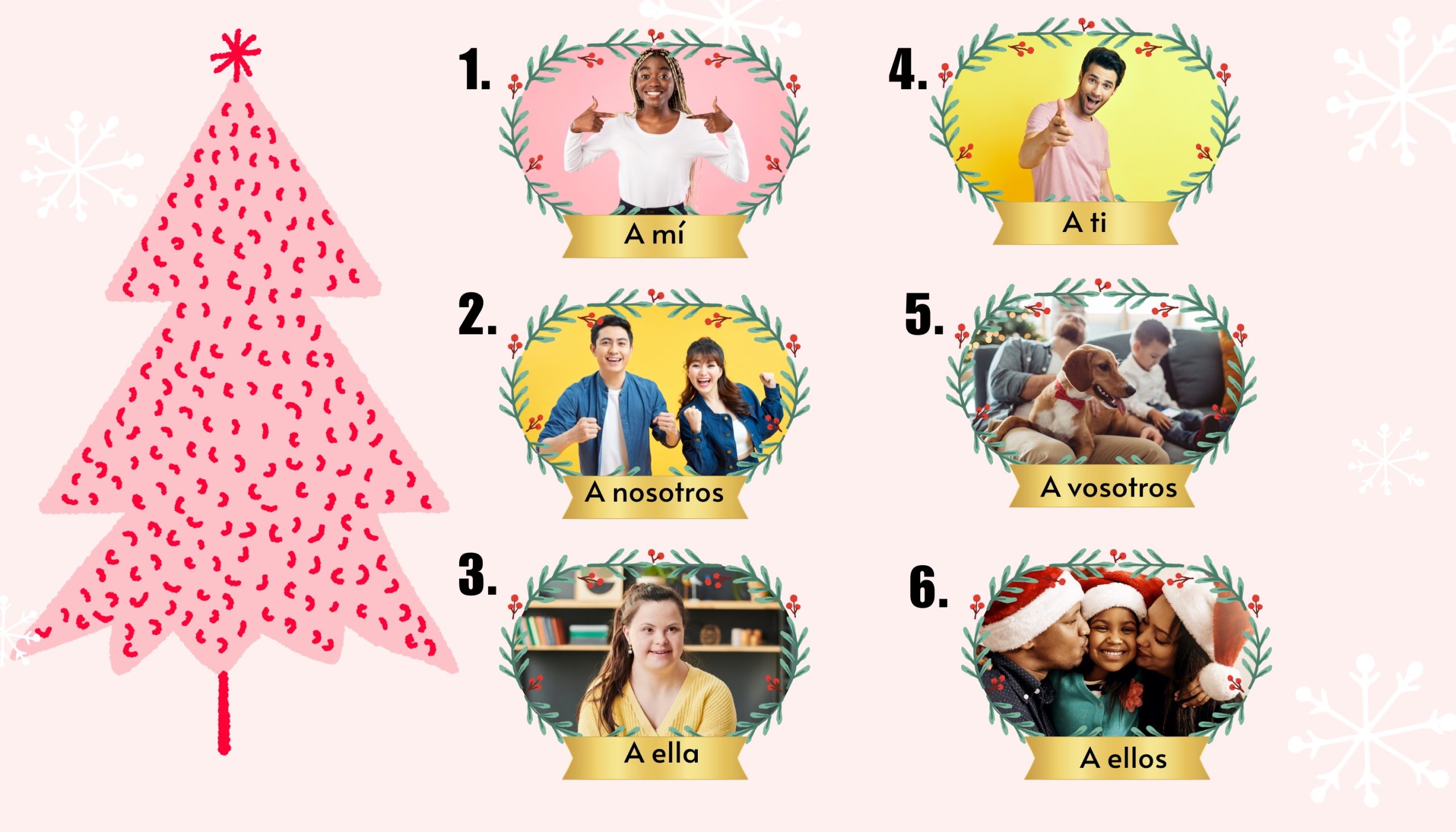
¡Muy bien! :). Dulce is such a gift giver! 🙂 Earlier, she shared what she plans to get her mom, husband and son for Christmas. However, Dulce has not completed her Christmas shopping! 🙂
See the following slide to see what Dulce plans to give her friends, kids from church, and other family members this holiday season.
Actividad P
¡Excelente! 🙂 Earlier Dulce asked you what you plan to gift your friends and family for the holidays. Complete the following activity to describe what you plan to give and to whom this holiday season using indirect object pronouns. You will ask what others are going to gift as well. ¡Qué divertido! 🙂
Actividad Q
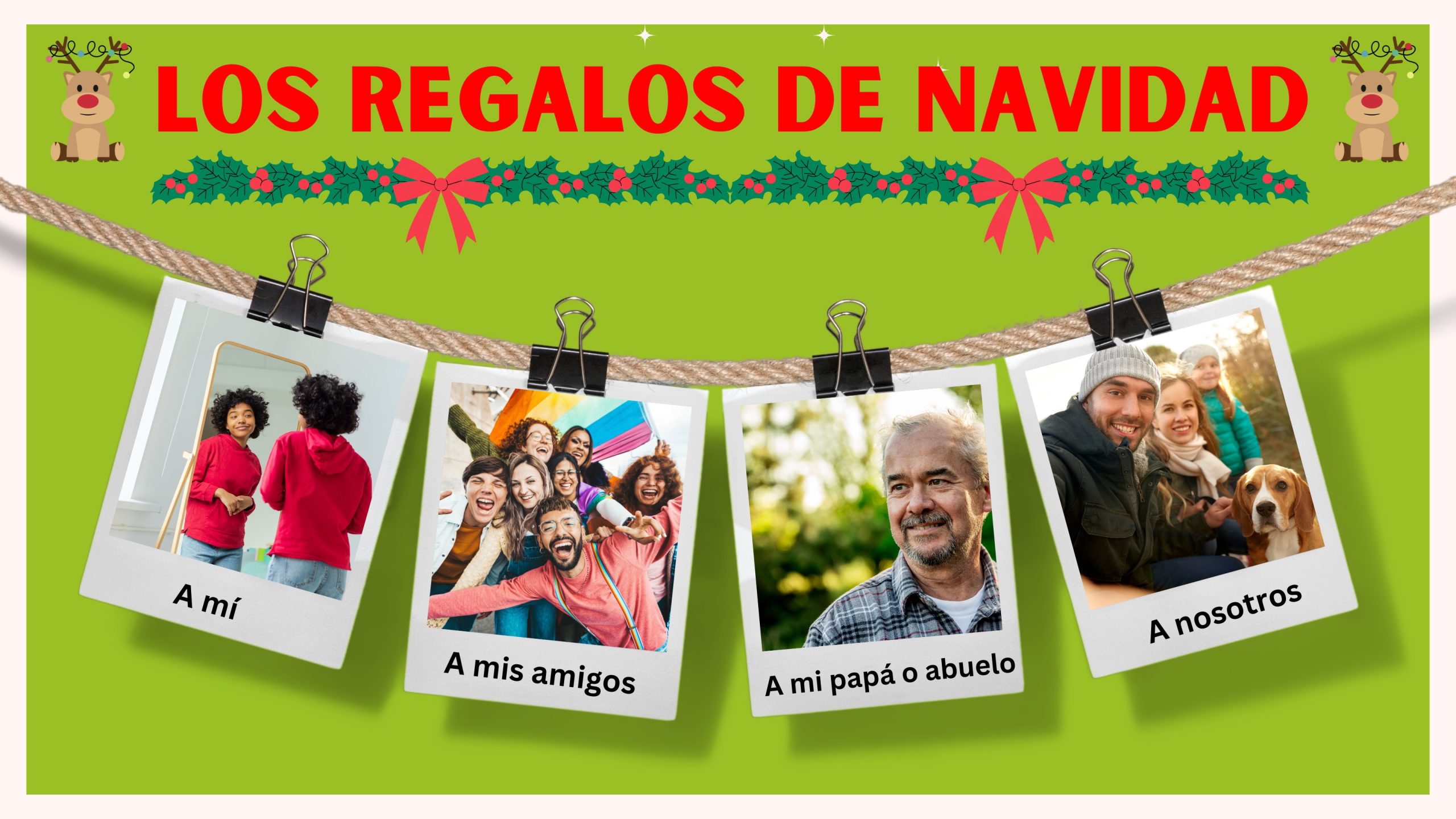
Paso 1. List what you plan to gift yourself, your friends, your dad or grandpa or yourself and your family for the holidays. Fill in the spaces with the gifts! 🙂 How fun! 🙂
- Voy a comprarme ___________. (I am going to buy myself)
- A mis amigos, voy a regalarles ________ y ________. (I am going to buy my friends)
- A mi papá, voy a darle _________ para la Navidad. (I am going to give my dad)
- A mi familia y yo, voy a comprarnos _______ este año. (I am going to buy my family and I)
Paso 2. Ask a different student one of the 3 questions below to see what they plan on gifting to their family and friends this holiday season.
- ¿Qué le vas a comprar a tu madre? Answer- Le voy a comprar ______. OR Voy a comprarle _______.
- ¿Qué les vas a regalar a tus amigos para los días festivos? Answer- Les voy a regalar ________. OR Voy a regalarles _______.
- ¿Qué te vas a dar este año? (What are you going to give yourself this year?) Answer- Me voy a dar _____. OR Voy a darme _____.
V. ¿Cuál es el mejor regalo?
Do you remember the best gift you ever received during the holiday season? What was the worst? Or, what was the best experience you had during the holidays? What was the worst?
When expressing the best, worst or extremes, you will need to use the superlative. This is a form of an adjective or adverb that shows the highest or lowest degree of something.
Watch as Sneaker Family describes the 5 best gifts under 50 euros for this holiday season.
Do you agree with his selections? What do you think are the best gifts to give or receive for Navidad, Jánuca, el Día de los Reyes Magos, Amigos Invisibles (Secret Santa), Kwanzaa, Diwali or other holidays you celebrate?
Did you know that in Spanish, there are several ways to express extremes using the superlative? Watch as Hoy Hablamos introduces you to the relative and absolute superlatives in Spanish.
Press CC for captions in the language you prefer.
To view a summary of Hoy Hablamos’s examples of relative and absolute superlatives, review the following slides.
Notice that in the slides, the word súper has an accent, and the words mega, ultra and extra are treated as separate words in front of the adjectives. That is how these superlative words are written in most of Latin America and Spain today.
For more examples of how to form absolute superlatives with ísimo, click on this link.
Actividad R
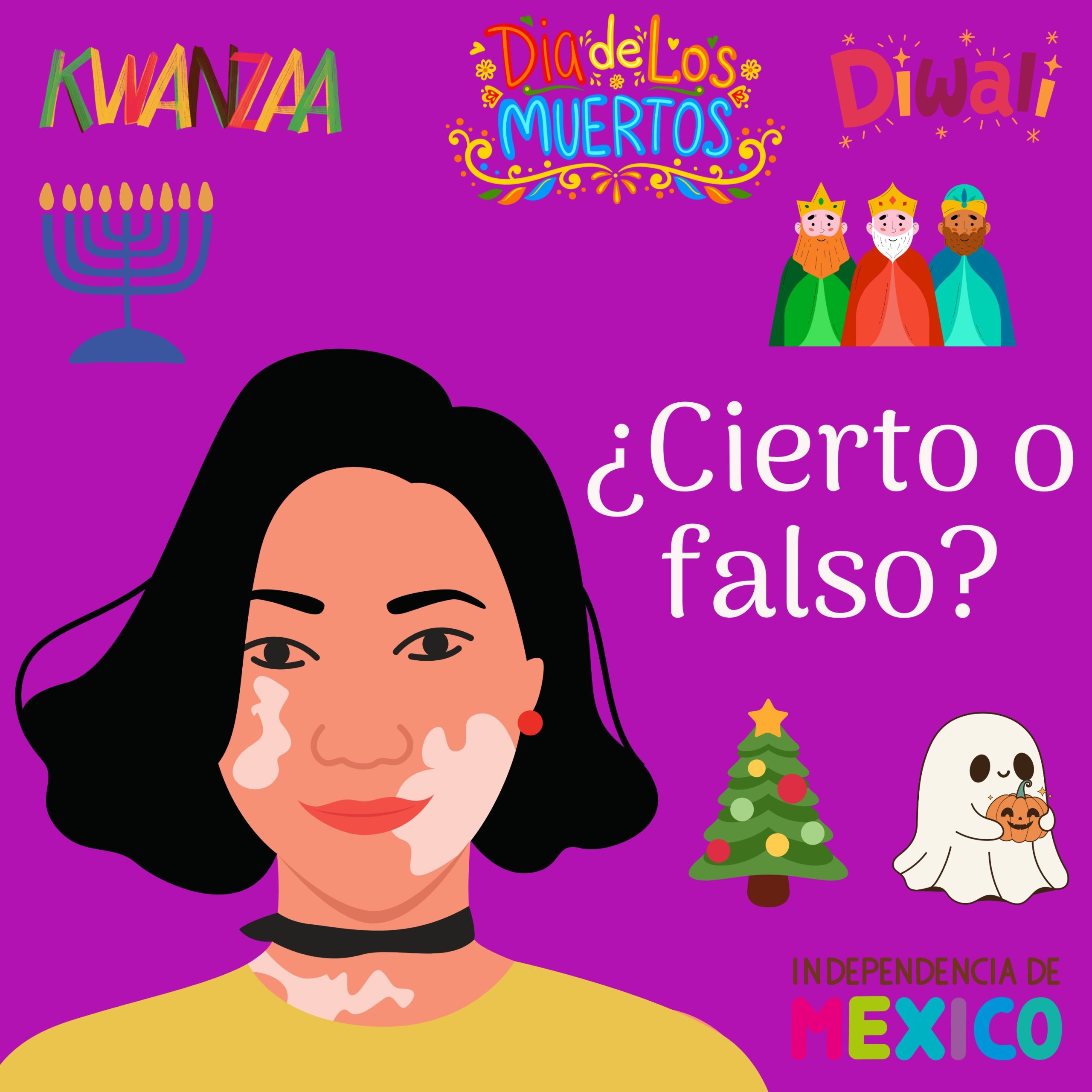
Based on what you’ve learned about the holidays, select the correct answer for each question using relative superlatives.
¡Bravo! 🙂
Actividad S
Paso 1. Dulce loves giving greeting cards during the holidays.

Paso 2. Dulce is sharing some extra details about her holiday season. Convert the adjective she uses to an absolute superlative using ísimo/a/s. Then mark whether you agree or disagree with cierto or falso.
Modelo- adjetivo: viejo Answer: Tengo un árbol de Navidad viejísimo. C/F (Cierto)
- adjetivo: mucho Tengo ________ decoraciones navideñas en mi casa. C/F
- adjetivo: lindo (pretty) Tengo luces (lights) __________ en mis ventanas. C/F
- adjetivo: aburrido Mi familia piensa que la Navidad es ________. C/F
- adjetivo: sabroso (tasty). Los tamales son _______________. C/F
Paso 3. Choose sentence 2, 3 or 4 from Paso 2, and use a different absolute superlative for the adjective in that sentence true for you or your family.
Modelo- Mi familia piensa que la Navidad es súper divertida.
Actividad T
Paso 1. What is your opinion about the following gifts for the holiday season? Write your response using a relative or absolute superlative in each answer.
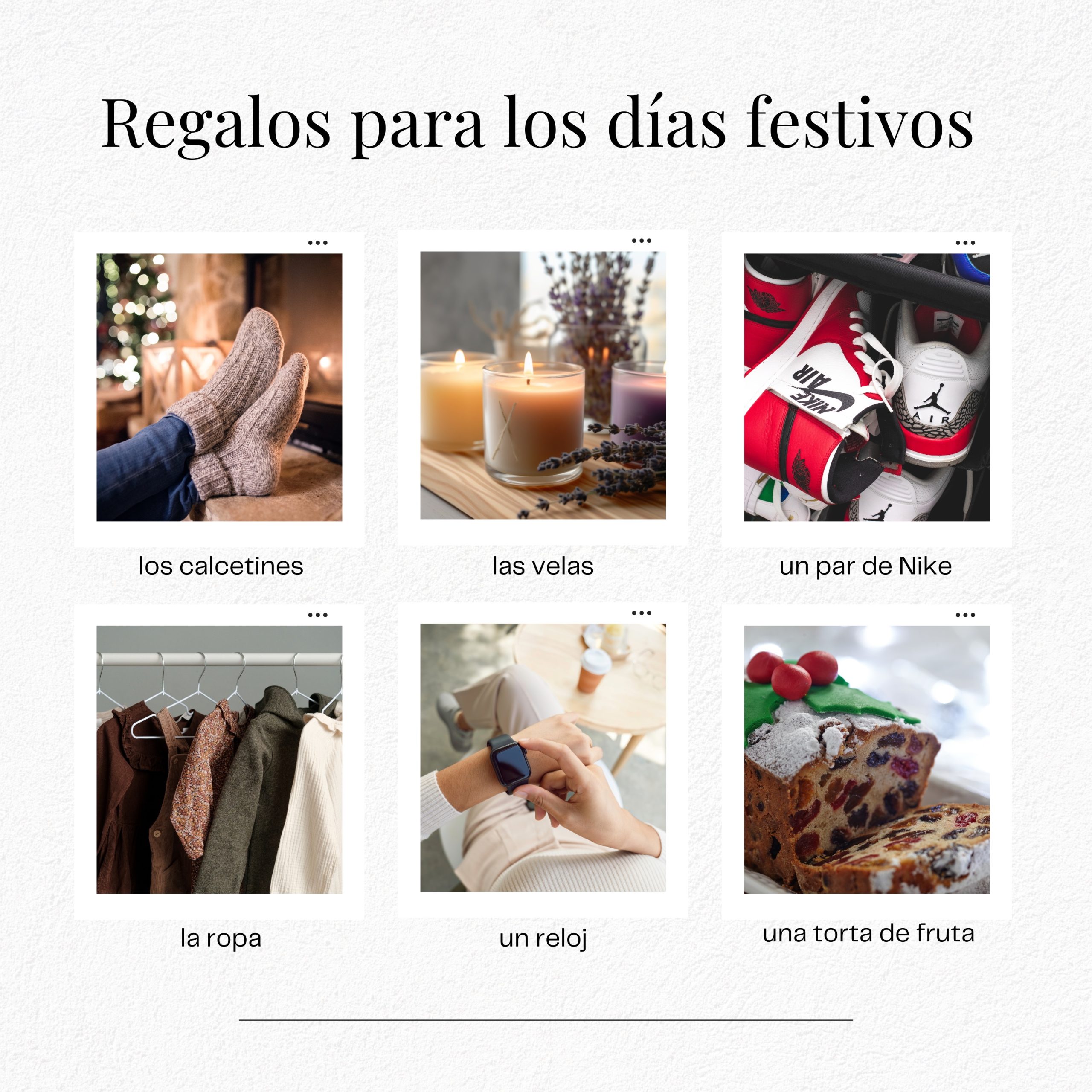
Modelo- ¿Qué opinas del iPhone como regalo para los días festivos?
Examples of possible answers: El iPhone es el mejor regalo de los días festivos. El iPhone es buenísimo. El iPhone es súper caro.
- ¿Qué opinas de los calcetines (socks) como regalo? Answer- Los calcetines son un regalo malísimo. OR Los calcetines son el peor regalo de los días festivos. OR Los calcetines son muy útiles (useful) durante el invierno.
- ¿Qué opinas de las velas (candles) como regalo?
- ¿Qué opinas de un par de Nike como regalo?
- ¿Qué opinas de la ropa como regalo?
- ¿Qué opinas de un reloj (a watch) para los días festivos?
- ¿Qué opinas de una torta de frutas (fruit cake) como regalo?
Paso 2. With a partner, take turns asking each other the questions from Paso 1 and sharing your answers.
Do you have similar opinions?
Actividad U
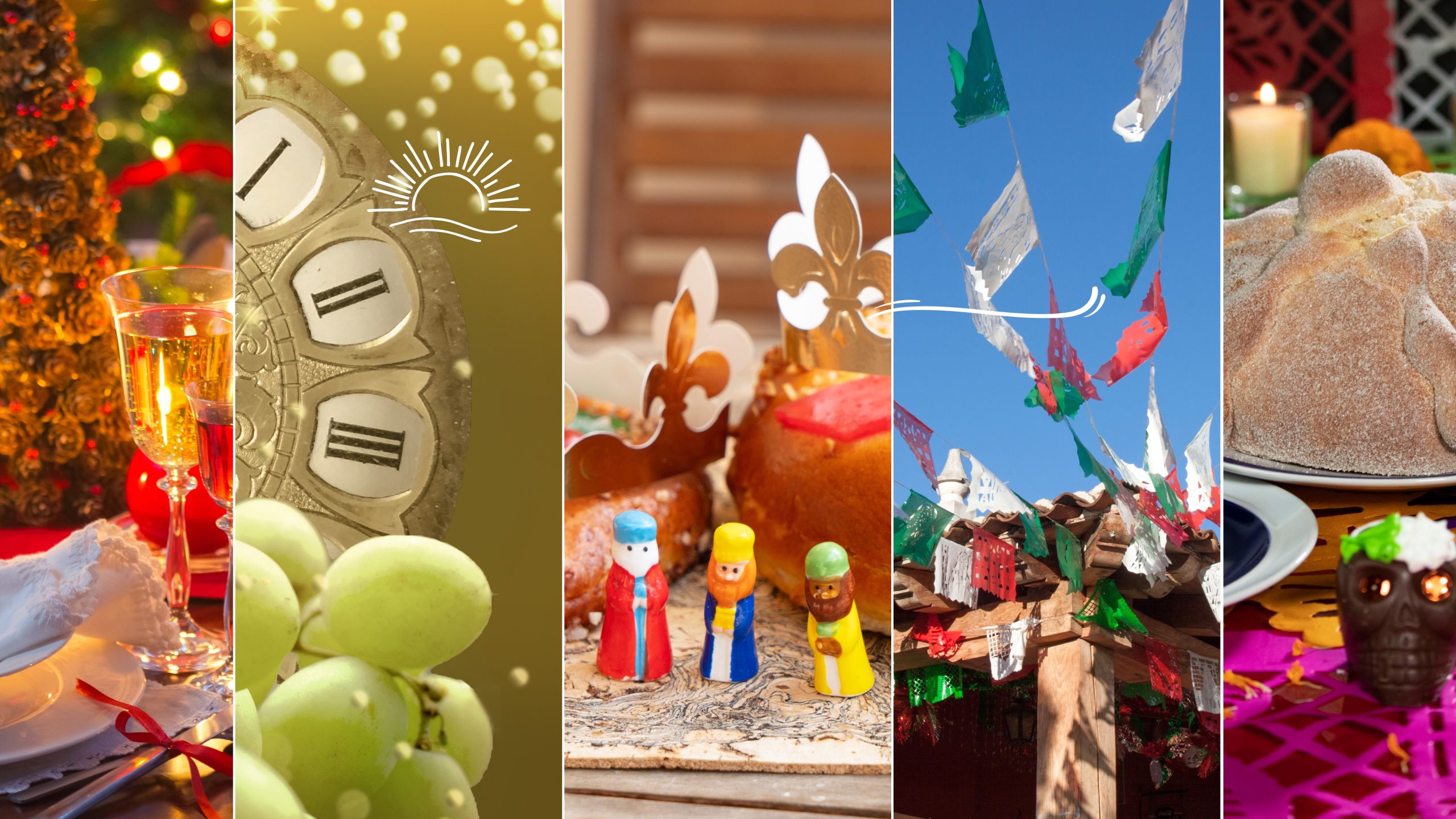
In groups of 3-4, take turns giving your opinion about the following holidays and traditions using absolute and relative superlatives, based on what you’ve learned so far.
Modelo- En el Día de la Independencia de México hay muchísimos gritos en la ciudad de México.
- La Nochebuena
- La Nochevieja
- El Día de los Reyes Magos
- Cinco de Mayo
- El Día de los Muertos
¡Bravo! 🙂
Intercultural reflection 2
You learned earlier that Dulce celebrates both American and Mexican holidays. You learned some traditions that the Latinx community practices during their holidays, but do you know the major differences between a U.S. Christmas versus a Mexican one?
Make a list of 3 holiday traditions in Mexico or the Latinx world that you’ve learned in this chapter.
Watch as Superholly breaks down the 10 major differences between Christmas in the U.S. versus Mexico in her YouTube video.
You could press CC for captions in the language you prefer.
Explore more
- List 5 differences Superholly makes between Christmas in the U.S. versus Mexico. Did you find any similarities? What are they?
- Do you agree with Superholly’s list? Do you feel Superholly accurately represented Christmas in the U.S.? If not, what would you take away or add to her list?
- What more did you learn about how Mexicans celebrate Christmas? Are there any traditions that you would like to try or adopt in the future?
- Use relative or absolute superlatives to describe the food, drinks, and music in either an American or Mexican Christmas. Modelo- Los buñuelos son riquísimos en la Navidad mexicana.
- Use a relative superlative to describe any aspect of Christmas in the U.S. and in Mexico that you learned from SuperHolly’s video. Modelo- Las canciones navideñas mexicanas son las más religiosas de todas porque incluyen Belén en muchas. La mejor bebida navideña de los Estados Unidos es el rompope (eggnog).
VI. Chapter 7 Final Assessment
In Chapter 7, you learned about holidays celebrated in the U.S. and Spanish-speaking countries, you asked questions with saber and conocer about Latinx holidays, and you discussed what you are going to celebrate this year and what you plan to give to others for the holiday season. Finally, you used relative and absolute superlatives to share your opinion about holiday traditions in both the U.S. and Spanish-speaking countries.
For your Chapter 7 Final Assessment, you will participate in The Dulce Candy Podcast and answer Dulce’s questions about the holidays. Record your answers and be sure to not miss any questions.