4 ¿Cómo es tu familia?
Your Chapter 4 task is to describe your family through photos or videos and ask others about theirs.
Meet Luis, as he introduces his family and asks you about yours.
Steps to take to achieve this task:
- ¿Cómo es tu familia?- describe your family and ask others about theirs
- ¿Quién es mayor? – compare and contrast your family members
- ¿Qué hacéis juntos?– use vosotros and nosotros present tense verbs to discuss family
- Más preguntas sobre tu familia- Use interrogative words and possessive adjectives to ask more questions about family
- ¡Qué lindos!- Use demonstrative adjectives and pronouns and exclamations when describing family members through photos or videos
- Task 4 Assessment– describe your family through photos or videos ask ask others about theirs
I. ¿Cómo es tu familia?
What does family mean to you? Do you have a big or small family?
Family is very important to Latinos. In Latinx countries, did you know that it is common to have several generations of family members living under the same roof? For example, in Costa Rica, sons and daughters can live with their parents until their 30s or beyond. This is true for several reasons.
First, there is a closeness by living with one’s own family. Second, by remaining in the family household, family members are able save money to buy their own homes. Third, some may choose to live with their family until they get married due to individual preference. Finally, there may be a personal reason such as sickness or individual family traditions that play a role in why several generations of family members live together.
In the following video, David, a virtual conversation partner from TalkAbroad, shares what the concept of family means in his culture. David is from Nicaragua.
Una discusión sobre la familia
Test your listening comprehension skills. What does family mean for David?
To start your own conversation about family with a Spanish-speaker, you could ask:
¿Cómo es tu familia? means what is your family like, or describe your family. This is different from ¿Cómo está tu familia?, which means how is your family doing?
You would answer ¿Cómo es tu familia? by using the verb ser + descriptive adjectives, similar to the ones that you learned in Lesson 2. Click on the following link to access those descriptive adjectives.
Unlike in English where family consists of more than one person, the word family in Spanish is considered one singular unit; therefore, the word is singular, not plural. Additionally, the word familia is feminine, so the descriptive adjective you use needs to agree in number and gender with the word, familia.
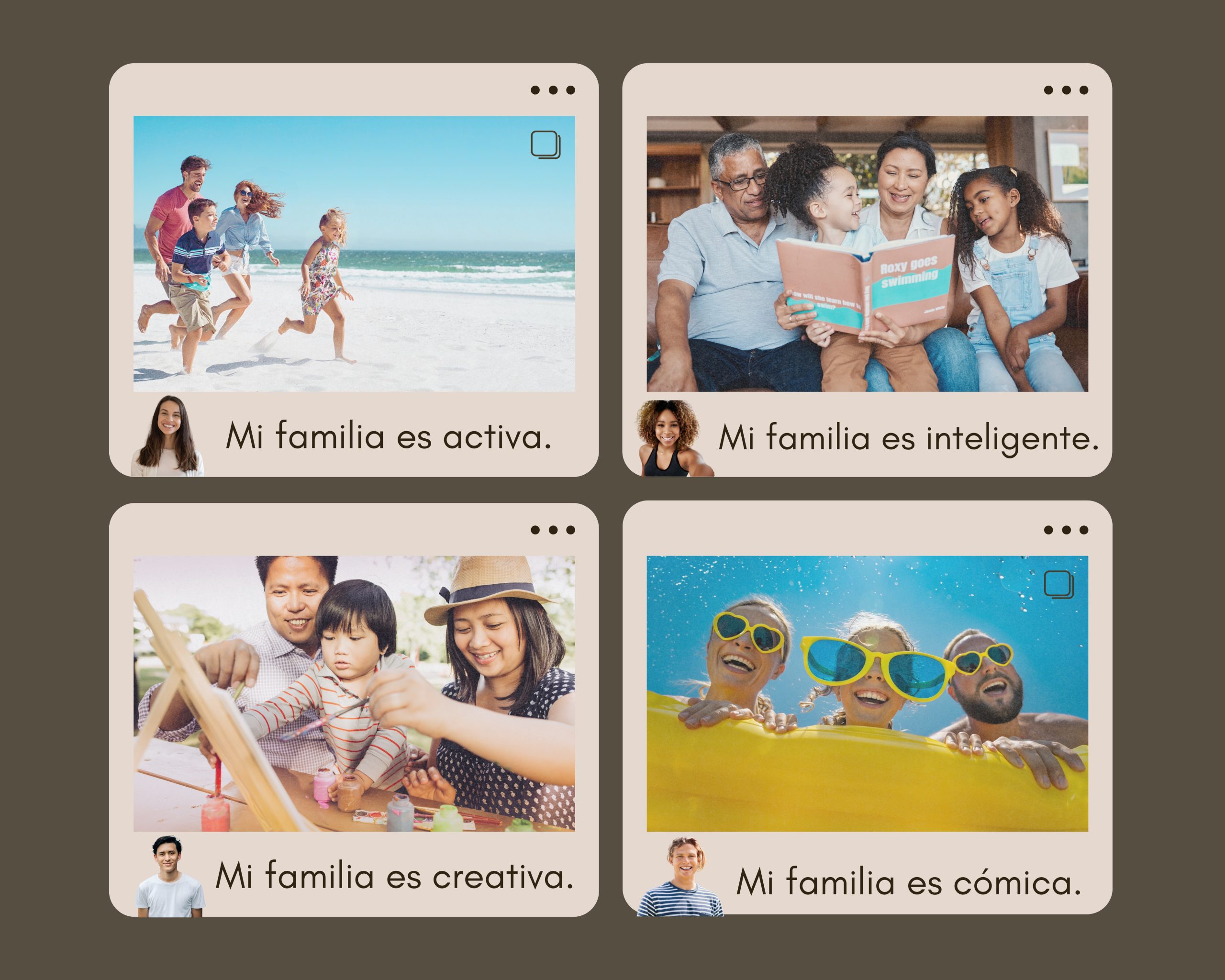
Example- Mi familia es trabajadora (hard-working). OR Mi familia es alta (tall).
See how the following students describe their families using different descriptive adjectives.
Actividad A

Paso 1. How would you describe your family? Fill in the space with at least one descriptive adjective. Remember, family is one singular unit, so your adjective should be singular and feminine.
Modelo- Mi familia es ______________.
Paso 2. Ask 2-3 students to describe their families to you.
Modelo- Hola. ¿Cómo es tu familia? Answer: Mi familia es ____.
Example- Mi familia es trabajadora y leal.
After asking what someone’s family is like with ¿Cómo es tu familia?, you may ask or be asked more questions about individual family members. In Spanish, there are several words you could use for family members as a whole.
parientes – family members or relatives
familiares– family members or relatives
miembros de la familia– family members
If you would like to describe specific family members, it is important to know the vocabulary words for immediate (familia nuclear) and extended family (familia extensa). Listen as TikTokers spanishteacherlatef and hellotalk_Spanish share family vocabulary with you.
@spanishteacherlatef Family members in 🇪🇸 #spanish #spanishvocabulary #family #spanishlesson #spanisheasy #learnspanish #uk #usa
♬ Monkeys Spinning Monkeys – Kevin MacLeod & Kevin The Monkey
@hellotalk_spanish Family in Spanish 🥰 @kallyeskally #learnspanish #spanishlesson
Actividad B
Test your listening comprehension skills by answering the following questions based on the vocabulary presented in spanishteacherlatif and hellotalk_spanish’s videos.
How did you do? 🙂
You met Luis at the beginning of this chapter. His friend, Jessie, is sharing her family tree. Listen as Jessie uses some of spanishteacherlatif and hellotalk_spanish’s vocabulary to describe her immediate and extended family members and relationships.
For a list of vocabulary words on family, see the 2nd slide.
Play the following audio to see how the vocabulary from slide 2 is pronounced.
Actividad C
What do you remember about Jessie’s family?
¡Excelente! 🙂
Actividad D
Complete the following crossword puzzle by typing in the correct relative in Spanish, based on the definitions provided. Placing accents is not possible in this crossword puzzle due to the platform’s restrictions; however, you should still know where accents are located in the new vocabulary words you learn for your own knowledge.
¡Qué bien! 🙂
Actividad E
Paso 1. Luis took a break from writing his next book to introduce his family to you through photos.
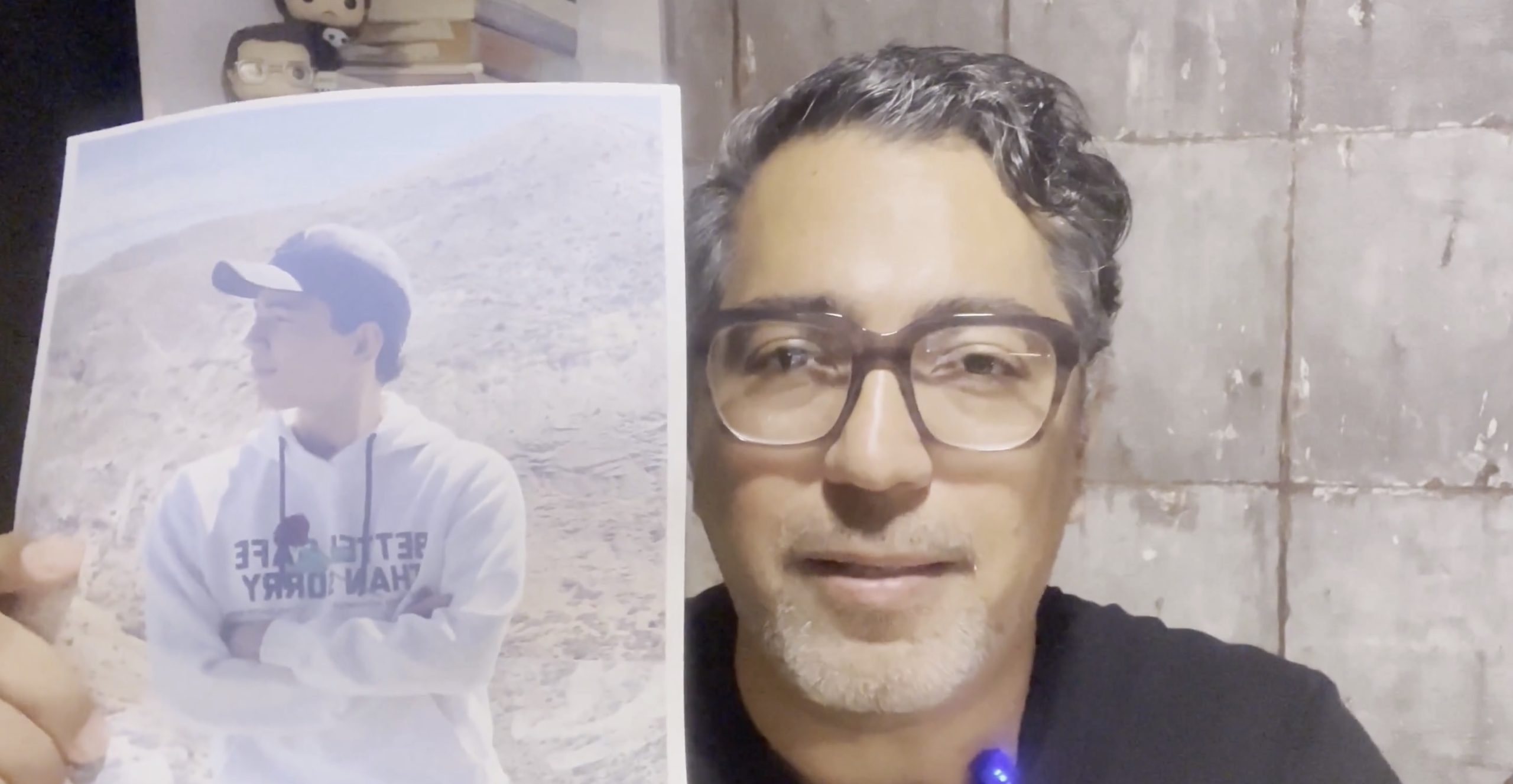
Play the video here.
Intercultural Reflection 1
Latinx families come in many forms. There are two-parent households, single parent, blended families, same-sex couples, adopted parents, grandparent-led families, and several more variations. Each family is unique in their own way.
Traditionally, there has been a stigma attached to Latinx fathers as being machista, or someone who exhibits male chauvinism or a traditional patriarchal dominance in the household.
Have you experienced traditional gender roles in your family structure or seen them in someone else’s family? What type of household were you raised in?
A few years ago, a young Latinx son, Daniel Lemus, who has a passion for makeup, unexpectedly came out to his Mexican father while video recording himself doing a makeup tutorial. What do you think the reaction of the father was upon seeing his son put makeup on?
NowThis Impact shares Daniel’s video and his father’s reaction.
Explore more
1. Were you surprised by the father’s reaction? Share your thoughts.
2. How did this video make you feel? Do you feel there should be more empathy and compassion for family members that are in the closet, especially Latinx ones that come from traditional households?
3. In Spanish, “papa” or “papas” is a term of endearment for a son or grandson. In Daniel’s video, you hear the Mexican father call his son “papa” repeatedly, as he supports Daniel’s decision to embrace makeup and his identity.
Are there terms or nicknames used for certain family members as a sign of endearment in your culture or language? What are they? What do they mean?
4. The use of “ito” or “ita” at the end of words could also show endearment or affection in the Spanish language. You would drop the o or a at the end of a word and place ito or ita, depending if the word is masculine or feminine. It could also mean “little.” This is called a diminutive.
For example- Hijo would be hijito. Hija would be- hijita.
In groups of 3-4, write the term of endearment for each of these family members with ito or ita.
A. Mamá
B. Papá
C. Abuelo
D. Abuela
E. Hermano
F. Hermana
5. If you would like to learn about Daniel’s reaction when coming out to his dad, read the following article by YourTango.
II. ¿Quién es mayor?
Earlier you saw Luis introduce his sons and share details about them. He compared Eugenio and Patricio by stating who was younger or older and who was more introverted and studious.
In conversation, you may also be asked to compare your family members in Spanish, or you may want to ask someone to compare their family members.
Listen as Angela, a colleague of Luis’s, compares her friends in the following 4 slides.
Be sure to click on the next slide after each of Angela’s comparisons.
See the following slide for a list of comparisons in Spanish and examples of how they are used in context.
Play the audio to hear how each comparison is pronounced.
To learn more about comparisons (also called comparativos) in Spanish, and how to use them in conversation, watch the following video by Borja Odriozola.
You could press CC for captions in the language you prefer.
Actividad F
Based on Borja’s explanation of comparisons, select the correct answer for each question.
¡Excelente! 🙂
Actividad G
In groups of 3-4 students, practice using comparisons by sharing your opinion about the following people, items and activities.
Modelo- Leer libros es menos divertido que escuchar música.
¡Interesante! 🙂
Actividad H
Just as Luis shared photos of his family, described them and compared his family members, you will do the same.
Select a partner. Choose a photo of two family members or two of your friends. Show your partner the photos as you describe and compare them. You should have at least two comparisons. Then switch roles. Follow the model.
Modelo- ¡Hola! 🙂 Esta foto es de mis padres. Viven en Washington D.C. Mi madre se llama Sierra. Tiene 58 años y es muy simpática. Mi padre se llama Henry. Tiene 59 años y es alto, inteligente y trabajador. Mi madre es menor que mi padre. Mi padre es más cómico que mi madre.

Intercultural Reflection 2
HipLatina is a platform that promotes inspiration, empowerment and entertainment for forward-thinking Latinas. The content is very unique, modern and provokes thought. To learn more about HipLatina, please visit their following social media platforms.
@hip_latina (Instagram and Twitter)
Explore more
HipLatina posted new gifs that represent their brand and mission on their Instagram account.

Paso 1. In groups, discuss what you think some of these gifs mean to the Latinx community in particular. Why do you think they were selected to represent Latinas?
Paso 2. Create your own gifs using the comparisons más (more), menos (less) y mejor/es (better) as statements based on your beliefs and what is important to you or your community.
Example- ¡Más paz! ¡Menos violencia! ¡Mejores escuelas!
What statements would you like to make with your gifs?
Paso 3. Go a step further and create your own gif that best represents you. Are there words you would like to use, an image or both? Take a few minutes to think of one. Share your gif with other students. Discuss why you chose your particular gif, and what it means to you.
Paso 4. Do you think your gif could help people better understand you? How so? Do you think learning about your classmates’ gifs will help you better understand them? Could a better understanding of someone’s beliefs and what they represent foster more communication and empathy in the world? Share your opinion.
III. ¿Qué hacéis juntos?
In Chapter 3, you were introduced to various subject pronouns in Spanish and regular, irregular and reflexive verbs. In most parts of Spain, the subject pronoun, vosotros, (you plural) is used to address a group of people informally. If someone were to ask you what you and your family do in the vosotros form, you would answer in the nosotros form.
Depending on where you live, you will most likely hear the Uds. form to mean you plural instead of vosotros. Most Latin Americans do not know the vosotros form because they were not raised using it. Listen as Meli from spanishstudio explains the difference between nosotros and vosotros, and why she uses Uds. for you plural.
Although you may never use the vosotros form where you live, it is still important to recognize it in case you do meet and converse with someone from Spain through your virtual conversation program or in real life.
@spanishstudio Replying to @E hola chica 💕 aquí está la explicación para ti, sobre “nosotros vs vosotros” in spanish ☺️ i hope is helpful #hispanic #spanishtiktok #learnwithtiktok #spanishteacher #hispanictiktok #spanish #español #spanishlesson #learnontiktok #teachersoftiktok #spanishclass #language #latina
*Meli did not include the non-binary forms of nosotros and vosotros in her video, which are nosotres and vosotres. They are important to acknowledge.

1. The vosotros present tense verbs end in the following way:
AR verbs will end in áis
ER verbs will end in éis
IR verbs will end in ís
Reflexive verbs have the reflexive pronoun os in front of them
Example- ¿Vuestra familia y tú miráis mucha televisión? ¿Leéis libros juntos (together)? ¿Vivís en la misma ciudad? ¿Os dormís temprano como familia (as a family)?
2. The nosotros present tense verbs end in the following way:
AR verbs will end in amos
ER verbs will end in emos
IR verbs will end in imos
Reflexive verbs have the reflexive pronoun nos in front of them
Example- Mi familia y yo miramos la tele en español. Comemos tamales en la Navidad. Vivimos en estados diferentes. Nos levantamos tarde los domingos.
See the following slides for questions you could ask someone about their family and them in the vosotros form and ways to answer in the nosotros form.
To hear the questions pronounced in the vosotros form, play the following audio.
To hear the answers pronounced in the nosotros form, play the following audio.
Actividad I
A student in southern Spain is asking her friends what they do with their families. What is the most logical answer to each question?
The song in the background is called “De Mil Colores” by Niña Pastori.
¡Excelente! 🙂
Actividad J
The song in the background is called “Danza Kaduro” by Don Omar.
Paso 1. Select 4 activities you do with your family from the following Instagram post.
Mi familia y yo…
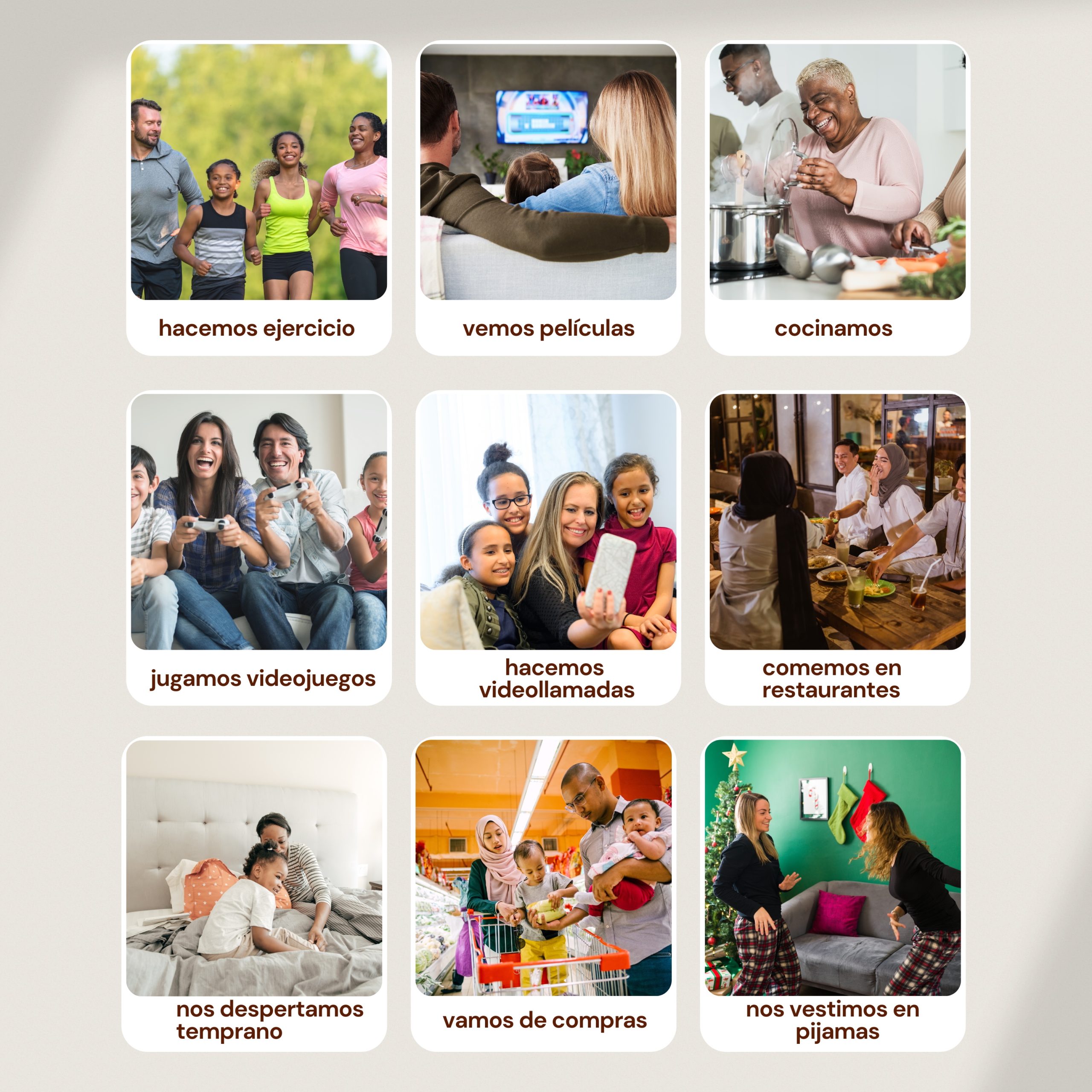
Paso 2. Write two sentences with the 4 activities you do with your family.
Modelo- Mi familia y yo cocinamos juntos (together) y hacemos ejercicio. También, desayunamos y jugamos videojuegos como familia (as a family).
Paso 3. Ask another student what they do with their family. If you are asked, you could read your two sentences.
Modelo- ¿Qué hacen tu familia y tú juntos?
Actividad K
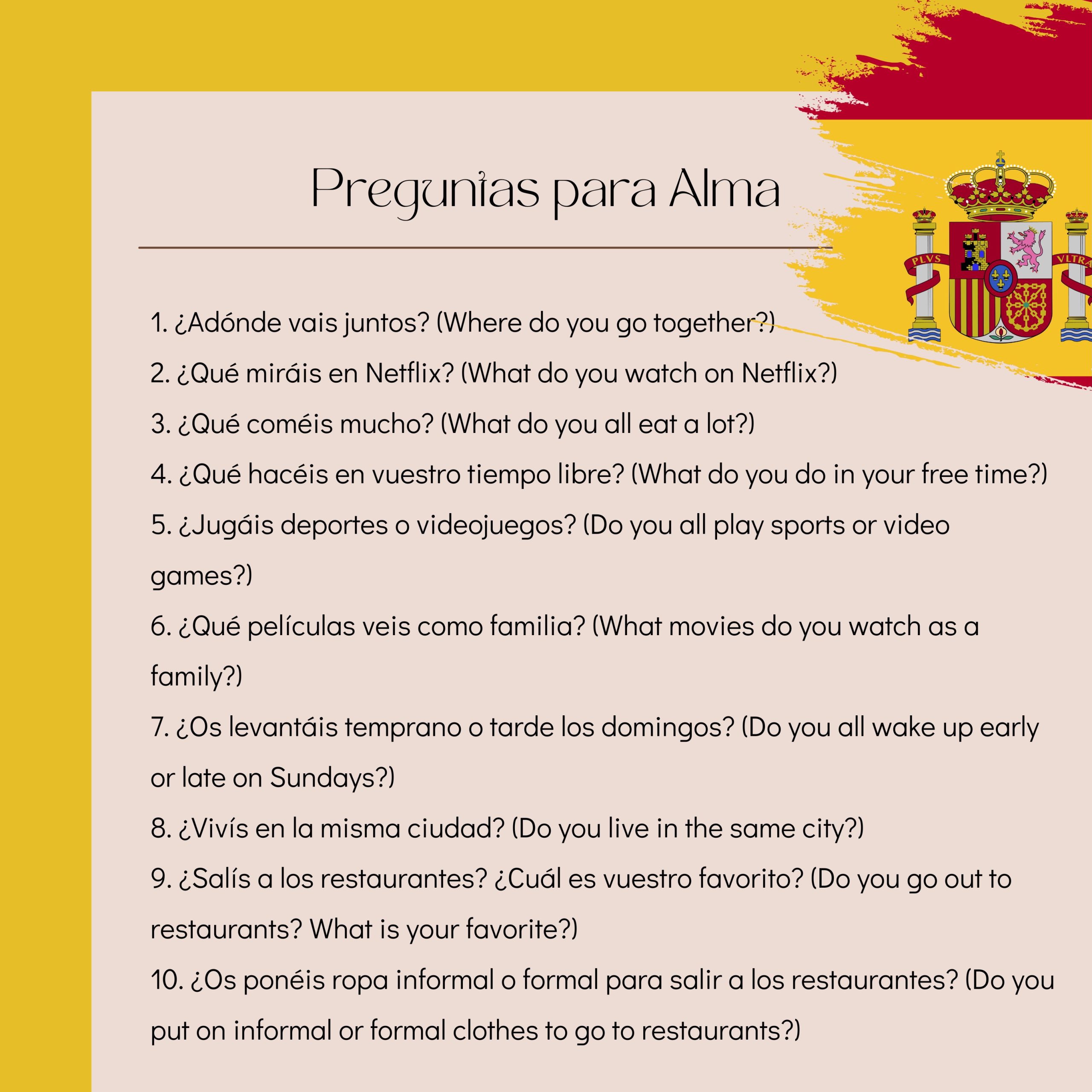
Paso 1. You will be speaking to a virtual conversation partner from Spain. Her name is Alma. You could address her in the informal tú.
The song in the background is called “Y Yo Qué Culpa Tengo” by Miguel Poveda.
Select 4 questions in the vosotros form from the following list you would like to ask Alma regarding what she and her family do. You could create your own questions as well. Write your questions for Alma in paragraph form. Follow the model.
Modelo- Hola, Alma. Tengo algunas preguntas sobre tu familia y tú. Primero, ¿qué hacéis en vuestro tiempo libre? ¿Qué miráis en Netflix en España? Etc.
*If there is a verb you would like to use, and it’s not included in the questions provided, feel free to go to Word Reference’s verb conjugator page, write your verb in the space, hit enter, and you will see the present tense vosotros/as/es form of that verb.
Paso 2. Now, Alma would like to ask questions about your family and you. Answer her questions in a recording in the nosotros form.
Modelo- Alma asks you: ¿Qué hacéis juntos los domingos? Possible answer: Vamos a la iglesia los domingos.
Alma’s questions for you:
- ¿Qué hacéis como familia (as a family) mucho?
- ¿Qué música escucháis?
- ¿Hacéis ejercicio como familia (as a family)?
- ¿Vivís juntos (together)?
- ¿Qué veis en Netflix?
IV. Más preguntas sobre tu familia
In this section of the chapter, you will be forming more questions to get to know someone else’s family using new interrogative words and possessive adjectives.
You’ve already learned how to form questions to get to know someone else and their daily routine with interrogative words from previous chapters. Let’s review them.
Notice the upside down question mark in front of each question and the accent on the interrogative words as well.
¿Cómo? (How or What) – ¿Cómo te llamas?
¿Qué? (What) – ¿Qué música te gusta?
¿Cuándo? (When) – ¿Cuándo trabajas?
¿Por qué? (Why) – ¿Por qué estudias español?
¿A qué hora? (What time)- ¿A qué hora te despiertas?
¿Dónde? (Where) – ¿Dónde vives?
¿Cuál? (Which/What) – ¿Cuál es tu apellido (last name)?
¿Cuántos? (How many) – ¿Cuántos años tienes?
Listen as StoryLearningSpanish reviews some of these interrogative words with you.
Actividad L
As a review of Chapters 1-3, see the following slides with questions you’ve asked in Lessons 1-3 to get to know someone else and their daily routine.
Choose two questions from each slide and ask 3 different students about themselves and their daily routine.
You will ask Student 1 two questions from Chapter 1.
You will ask Student 2 two questions from Chapter 2.
You will ask Student 3 two questions from Chapter 3.

Karin from Idioma Pro, discusses the interrogative words you just reviewed and introduces you to new ones for your future conversations.
Press CC for captions in the language you prefer.
In the video, Karin presents interrogative words with prepositions. See what some of them mean below and how to use them in conversation related to family.
To hear the interrogative words with prepositions pronounced, be sure to play the audio.
Actividad M
To practice using interrogative words with prepositions, select the appropriate questions to learn more about someone’s family.
Watch as a Spanish language student and her TalkAbroad conversation exchange partner discuss the topic of family.
Una conversación sobre la familia
Did you understand most of the conversation? Did you hear the questions the student and her conversation partner asked about each other’s families?
Actividad N
Begoña is a student at the university. She loves to learn about others and form connections. Begoña has questions for you about your family.

Paso 1. Listen to Begoña’s questions, and write your answers to her questions below.
1.
2.
3.
4.
5.
Paso 2. Would you like to get to know Begoña’s family better? Form 3 questions for Begoña about her family.
Modelo: Begoña, ¿a qué se dedican tus padres?
You learned that to start a conversation about family, you could say: ¿Cómo es tu familia? The “tu” in this question is a possessive adjective. Tú with an accent means you. Tu without an accent means your, which is a possessive adjective. Do you know the other possessive adjectives in Spanish?
Watch the following video by Teacher Catalina as she introduces you to possessive adjectives in Spanish and how to use them in conversation.
The following slide serves as a visual of the possessive adjectives Teacher Catalina just described.
Actividad O
Remember Begoña?
Actividad P
Look at the photos below. Circle the correct possessive adjective in each sentence. Pay close attention to adjective agreement.
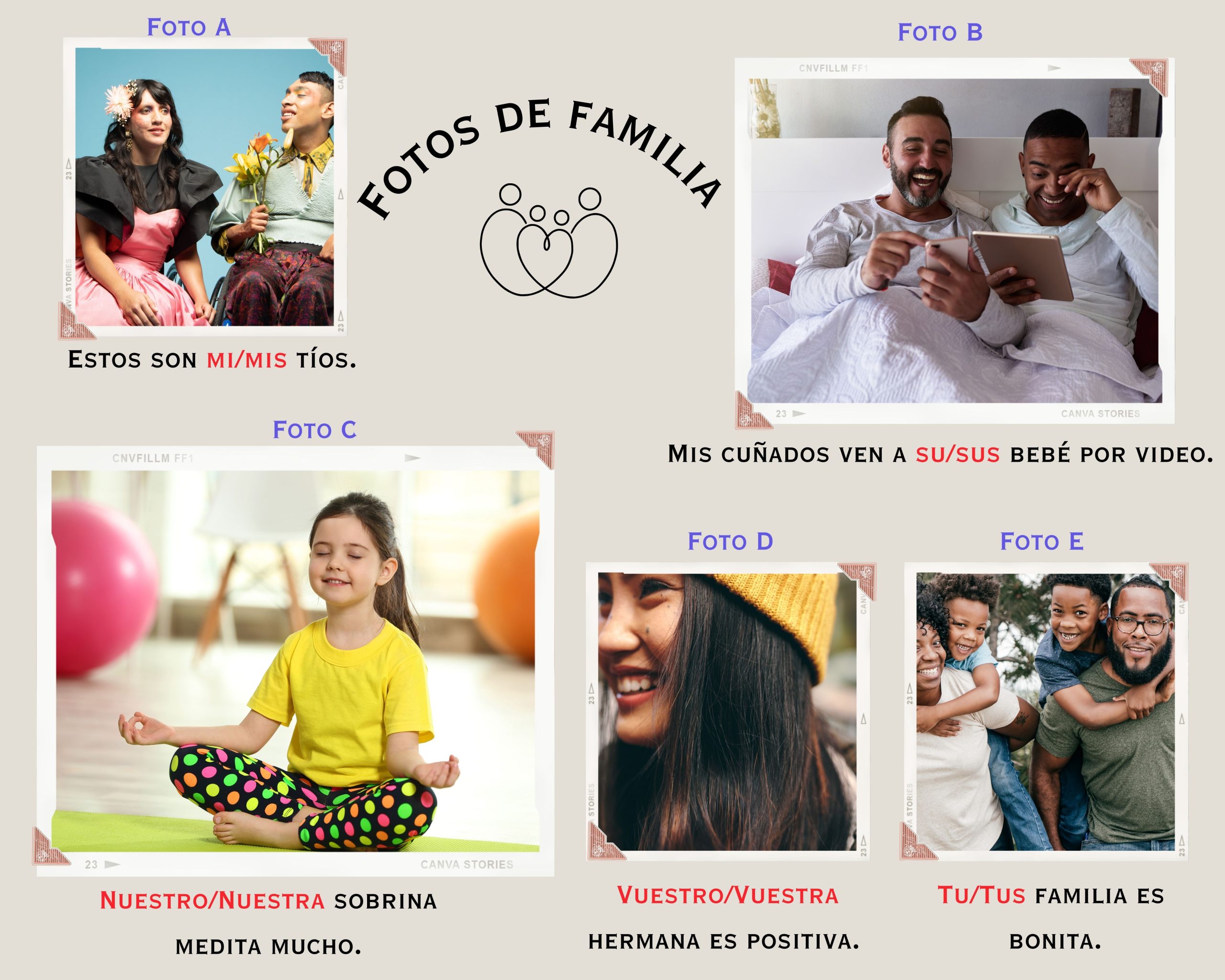
Answer key- mis, su, nuestra, vuestra, tu
¡Bien hecho! 🙂
Actividad Q
Sylvia is going to share some details about her family with you. Do you notice the possessive adjectives she uses? 🙂 Sylvia would also like to know about your family. Answer her questions below.
V. ¡Qué lindos!
The task for this chapter is to describe your family through photos or videos. You’ve learned the vocabulary for family members and how to describe them, you know how to compare friends and family, and talk about what you do with them. You’ve also learned how to ask others about their family with interrogative words and possessive adjectives.
You’ve acquired so many skills to communicate about the topic of family! Muy bien. 🙂
In this section of the chapter, you will use demonstrative adjectives and pronouns to identify and describe family members in your photos or videos. How fun! 🙂 You will also use exclamations to react to the photos your classmates or virtual conversation partner show you.
You may ask, what is a demonstrative adjective and pronoun? What is the difference between both?
Watch as StoryLearningSpanish introduces you to demonstrative adjectives in Spanish.
For a visual of the demonstrative adjectives StoryLearningSpanish just discussed in the video, see the following slide.
Actividad R
Select the correct demonstrative adjective to complete each sentence about Jonathan’s family.
The song in the background is called “Vamos a la playa” by Las Canciones De Tu Vida.
¡Bravo! 🙂
Demonstrative pronouns are different from demonstrative adjectives. How so? A demonstrative adjective requires a noun after, but a demonstrative pronoun points to a specific person or object and is used to replace the noun.
The following slide presents the demonstrative pronouns in Spanish.
Watch as BaseLang presents different demonstrative pronouns in context.
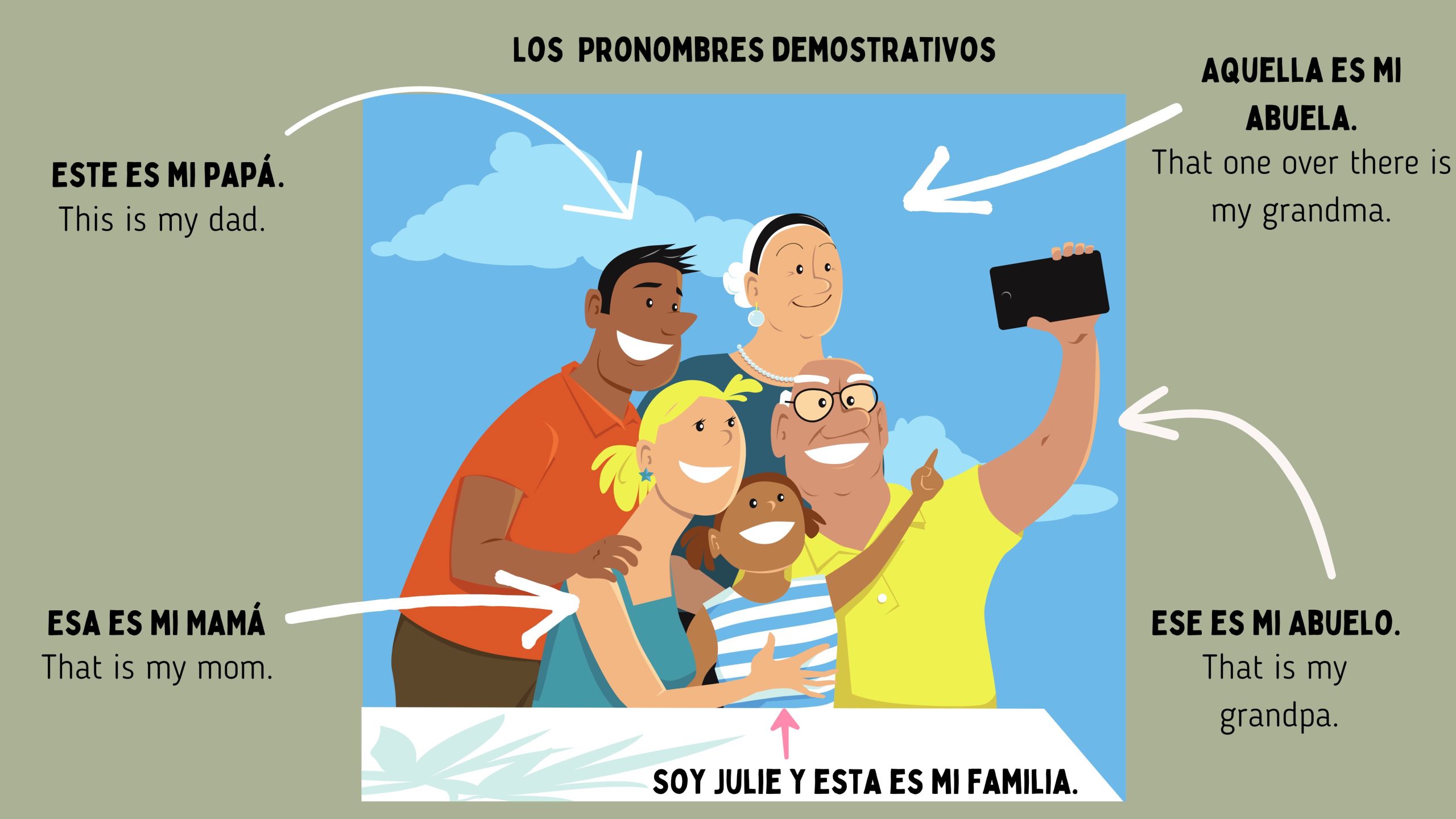
You will be using demonstrative pronouns when you introduce your family members in your photos and videos. See how Julie does this in the following slide by using different demonstrative pronouns to specify each family member in her photo.
Actividad S
You are pointing to different family members in your photos and videos. Select the correct demonstrative pronoun for each context.
For a review of the demonstrative pronouns, click here. Go to Slide 6.
Actividad T
Paso 1. Lucas from TalkAbroad is showing a photo of his family to his conversation partner. Which demonstrative pronouns does he use to point to himself and his mother in the photo?
1.
2.
Paso 2. Choose a picture of your extended family. With a partner, present each family member in your photo with demonstrative pronouns and say their name.
Modelo: Este es mi tío, Javier. Esa es mi abuela. Se llama Gloria.

Have you ever seen someone’s photo or video and wanted to comment on it in Spanish? The following exclamations could be common reactions to a photo or video, for example.
How cool! How pretty! How amazing! How scary! How beautiful! How cute!
In Spanish, these reactions would be called exclamaciones.
Caro Jara from Ecuador uses exclamations in the following video with her new baby girl.
Scroll to the last slide and click on sound
Actividad U
Put a check by all of the exclamations you heard Caro or another family member make about Caro’s baby girl. 🙂
- ¡Qué guapa!
- ¡Qué bella!
- ¡Qué bonita!
- ¡Qué hermosa!
- ¡Qué pequeña!
- ¡Qué linda!
Answers: 1, 3, 4, 6
The following video by María from WhyNotSpanish.com invites you to join her as she uses exclamations during different parts of her day.
To be able to react or express your opinion with an exclamation, use the following formula.
¡Qué + an adjective + !
You will need to make sure of the following:
- Have adjective agreement with whom or what you are describing. Example: If I am talking about my dad, I would use a masculine adjective. If I am commenting on a photo of a little sister, I would use a feminine adjective. If you are commenting on someone’s parents, then you need a plural adjective. You could also use non-binary adjectives.
- Make sure to remember your upside exclamation in front of your phrase and your exclamation mark at the end of your phrase. For example- ¡Qué interesante!
Actividad V
Paso 1. Below are a series of photos and a list of exclamations for each image. Which exclamation would you use for each photo and why?
Hint: Pay close attention to adjective agreement.
Paso 2. Create your own exclamation or reaction for each of Tío Mateo’s photos below.
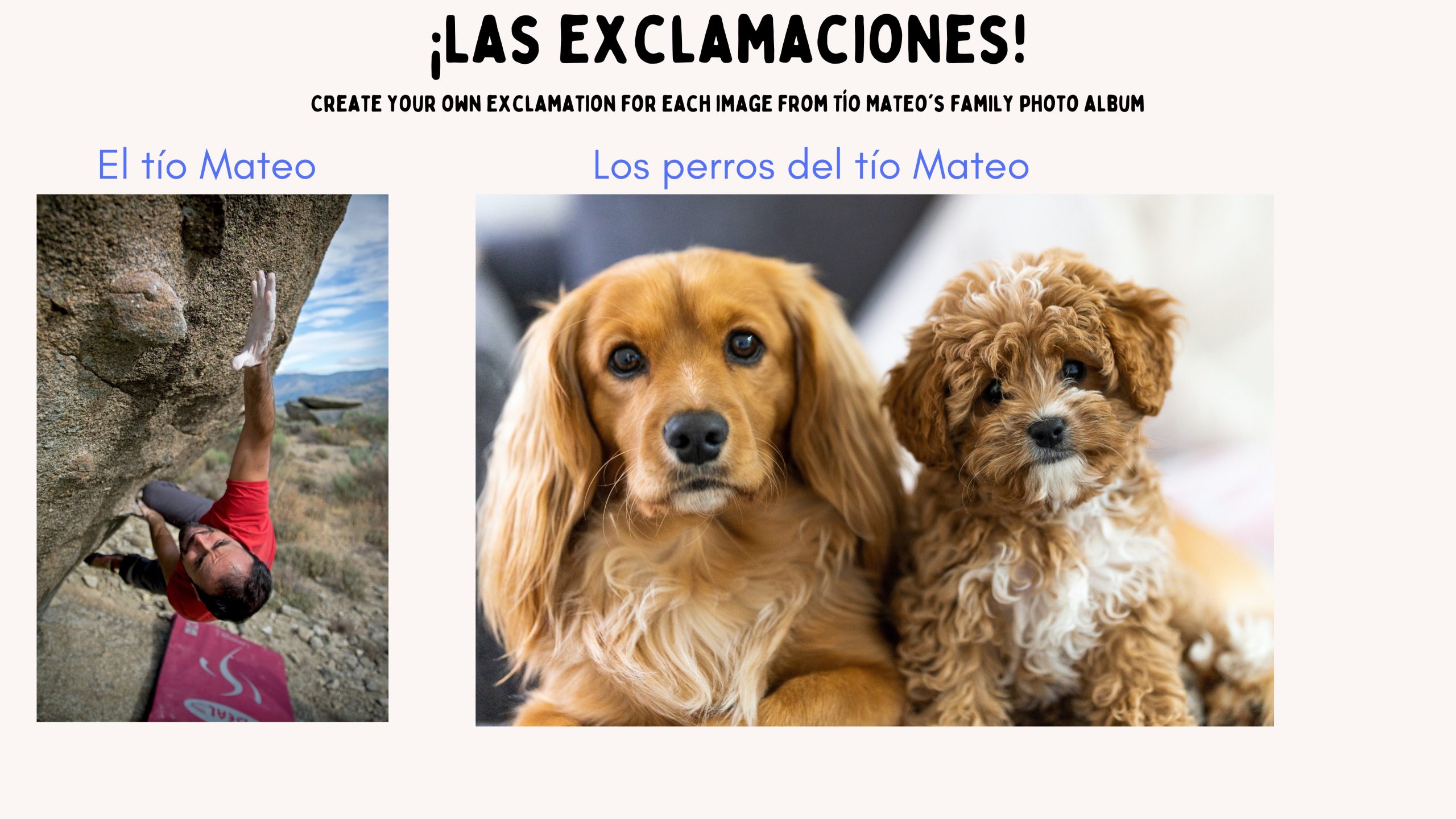
When studying abroad, some students live with host families. They often sit around the dinner table and share aspects of their lives with each other. A common way for students to connect with their host families is through photos or videos of their own family.
Students bring photos of their loved ones and share personal information about their family members such as where they live, how old they are, what their names are, what relation they have to the students, what their loved ones are like, what they like to do, and how they are.
Actividad W
Listen as Juan David is reacting to his family photos.

Circle which family member he is commenting on. Pay close attention to the adjectives used in each exclamation as clues.
1. El abuelo de Juan David/ La abuela de Juan David
2. Los perros de su tío /Las gatas de su tío
3. La sobrina de Juan David/El sobrino de Juan David
4. El hermano de Juan David/La hermana de Juan David
5. La familia de Juan David/Los padres de Juan David
Answers: la abuela, los perros, la sobrina, el hermano, los padres
Intercultural reflection 3
Earlier you heard Caro from Ecuador comment on her baby with exclamations such as ¡Qué hermosa! Caro partners with the Murph’s Life Foundation to help families across Latin America that need financial support. Murph often posts his philanthropic work on his website and social media platforms. To learn more about Murph and his mission of helping Latinos, visit the following sources.
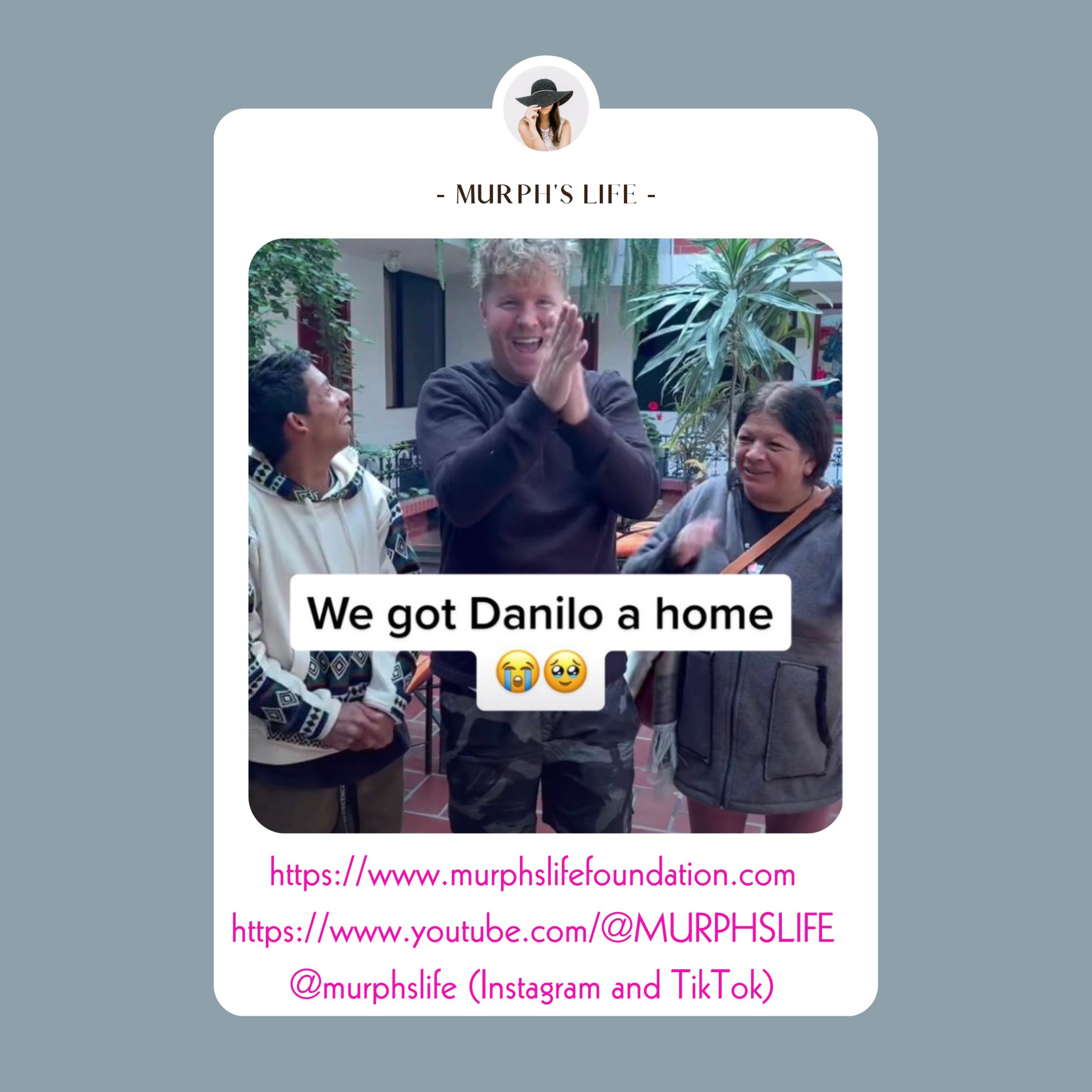
To really understand how others live around the globe, it is important to immerse yourself in the world of that person. The following video is of Murph living with a humble family in Ecuador. He puts himself in their shoes and daily life to deeply comprehend the lifestyle of a dad trying to support his three kids.
Explore more
Paso 1. After watching the video of this Ecuadorian family, what reactions do you have to the following? Use an exclamation to react to different parts of the video.
Example- Murph- ¡Qué generoso!
- Los hijos en el video
- El papá
- La comida ecuatoriana
- La casa de la familia
- El apoyo (support) de Murph’s Life
Paso 2. Compare your life now to this family’s life in Ecuador. What is similar and what is different? Could you see yourself living with a family in Latin America as Murph did? What would you hope to gain from the experience? What would be the benefits of living with a new family in Latin America? What would you like to share about your own culture with them?
Paso 3. Go to one of MurphLife’s social media platforms listed in the photo of Murph above and select a video that inspires you. Share it with a classmate and explain why you chose that video and what it means to you.
VI. Chapter 4 Final Assessment
In this chapter, you’ve learned to describe your family and ask others about theirs, compare and contrast your family members, use interrogative words and possessive adjectives to ask more questions about family, and use demonstrative adjectives and pronouns and exclamations when describing your family through photos or videos. You’ve learned so much! 🙂 ¡Muy bien!
Do you remember Luis from your Chapter 4 Intro? He would like to converse with you about your family. Before commencing the Chapter 4 Final Assessment, answer Luis’s questions from his video.
For the Chapter 4 Final Assessment, you will introduce your family to Luis via a photo and ask questions about his family. Be sure to follow the prompts below.