8 ¿Cuál fue tu último viaje y cómo era?
Your Chapter 8 task is to describe your last trip and ask someone else about theirs.
Steps to take to achieve this task:
- ¿Cuál fue tu último viaje y cómo era?– identify the preterit and imperfect tenses in a post card
- ¿Cómo preparaste para tu último viaje?– describe how you prepared for your last trip using the preterit tense and vocabulary on travel and clothing
- ¿Qué hiciste en tu viaje?– discuss what you did on your last trip and ask others what they did using the preterit tense
- ¿Cómo era tu viaje?– describe your last trip and childhood and ask others about theirs using the imperfect tense
- Los diarios de motocicleta– watch the film, Motorcycle Diaries, and complete a packet about the film using the preterit and imperfect and vocabulary on travel and clothing
- Task 8 Assessment– Ernesto would like you to write to him and answer his questions about your last trip on a postcard. He would also like you to ask him questions about his travels through Latin America.
I. ¿Cuál fue tu último viaje y cómo era?
You just met Mexican actor, Gael García Bernal, who played the role of Ernesto Che Guevara in Diarios de motocicleta. Raise your hand if you’ve seen the film.
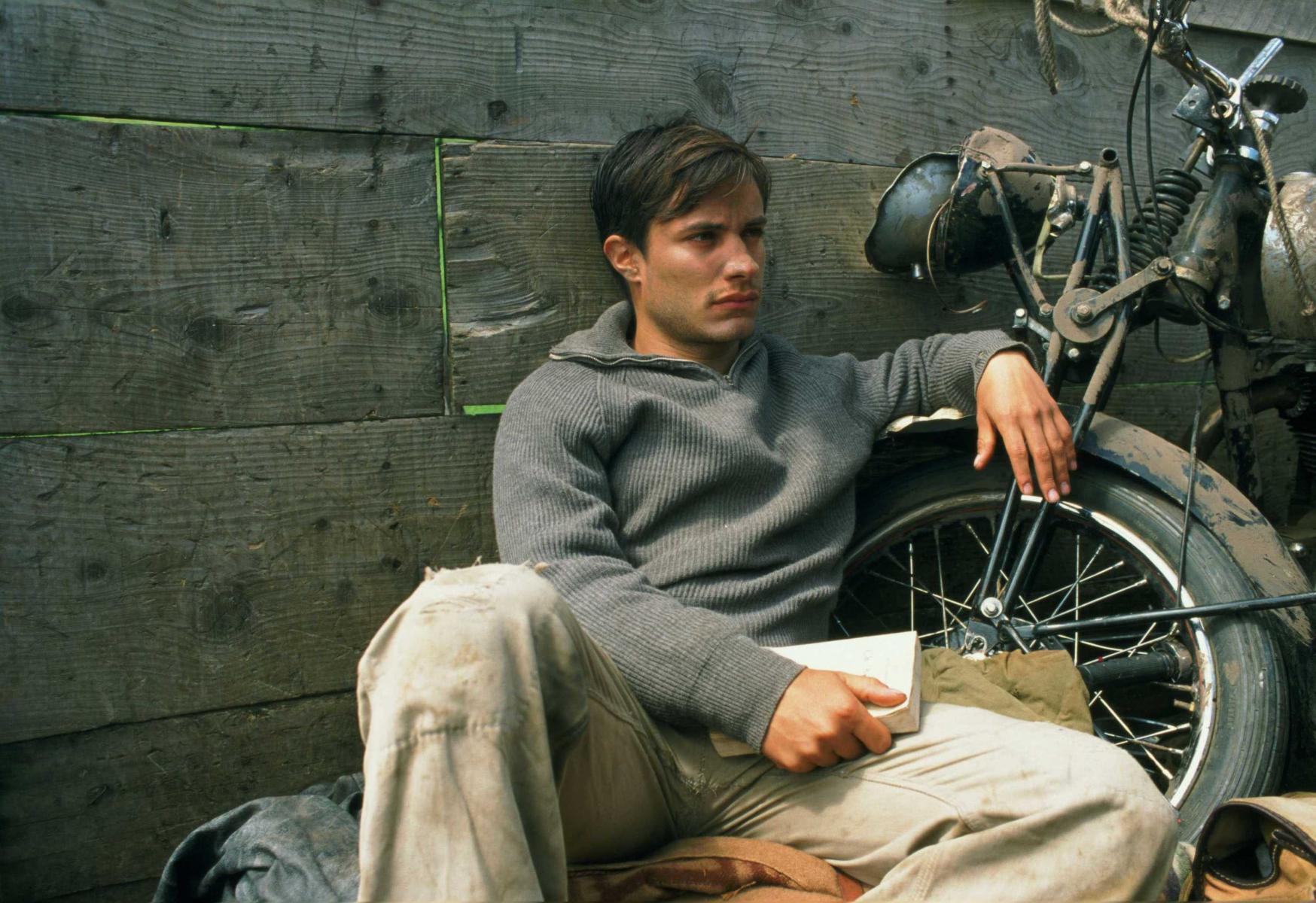
This film is based on Ernesto Che Guevara’s book,
Have you ever taken a trip by motorcycle? What is your preferred mode of travel when you vacation?
In Gael’s Chapter 8 introduction, he describes Ernesto’s infamous motorcycle trip, what he did, what countries he visited, how he prepared for the trip and how places like the Atacama Desert and Machu Picchu were fascinating and awe-inspiring.
Gael uses the preterit and imperfect in Spanish to describe Ernesto’s trip, which are both past tenses. What is the difference between the preterit and imperfect?
The preterit tense is used when there is a completed action that happened at a particular point in time and has a determined end.
For example, Rosa, a Spanish language student from New York, just visited Chicago for the first time. Listen as Rosa describes what she did yesterday at Millenium Park. Rosa uses the preterit tense because all of her actions happened yesterday. They are completed, and have a definite end.
Rosa: “Yesterday, I traveled to Chicago. I visited the Bean, took pictures and walked for 2-3 hours around Millenium Park.”
The imperfect tense describes repeated or ongoing actions in the past, things one would do in the past, or how things were or used to be. There is no exact or determined end to an action in the imperfect tense.
For example, listen as Rosa describes how the people were in Chicago and what they were wearing. Rosa is not stating what the people did in Chicago, which would mean there is a specific end point. Rather, Rosa is describing what the people were like and what she would do in their situation, using the imperfect tense.
Rosa: “The people in Chicago were so nice. They were wearing jackets and spring clothing because it was cool out. When I used to live in New York, I would dress like that too in the months of April and May.”
The goal of this section of the chapter is to introduce you to the preterit and imperfect tenses and identify how they are used to describe your last trip.
Now that you are aware of the basic concept between the preterit (completed actions) and the imperfect (ongoing or habitual actions or descriptions in the past with no specific end), see if you could identify which verbs or actions are in the preterit and which ones are in the imperfect in Ernesto’s postcard.
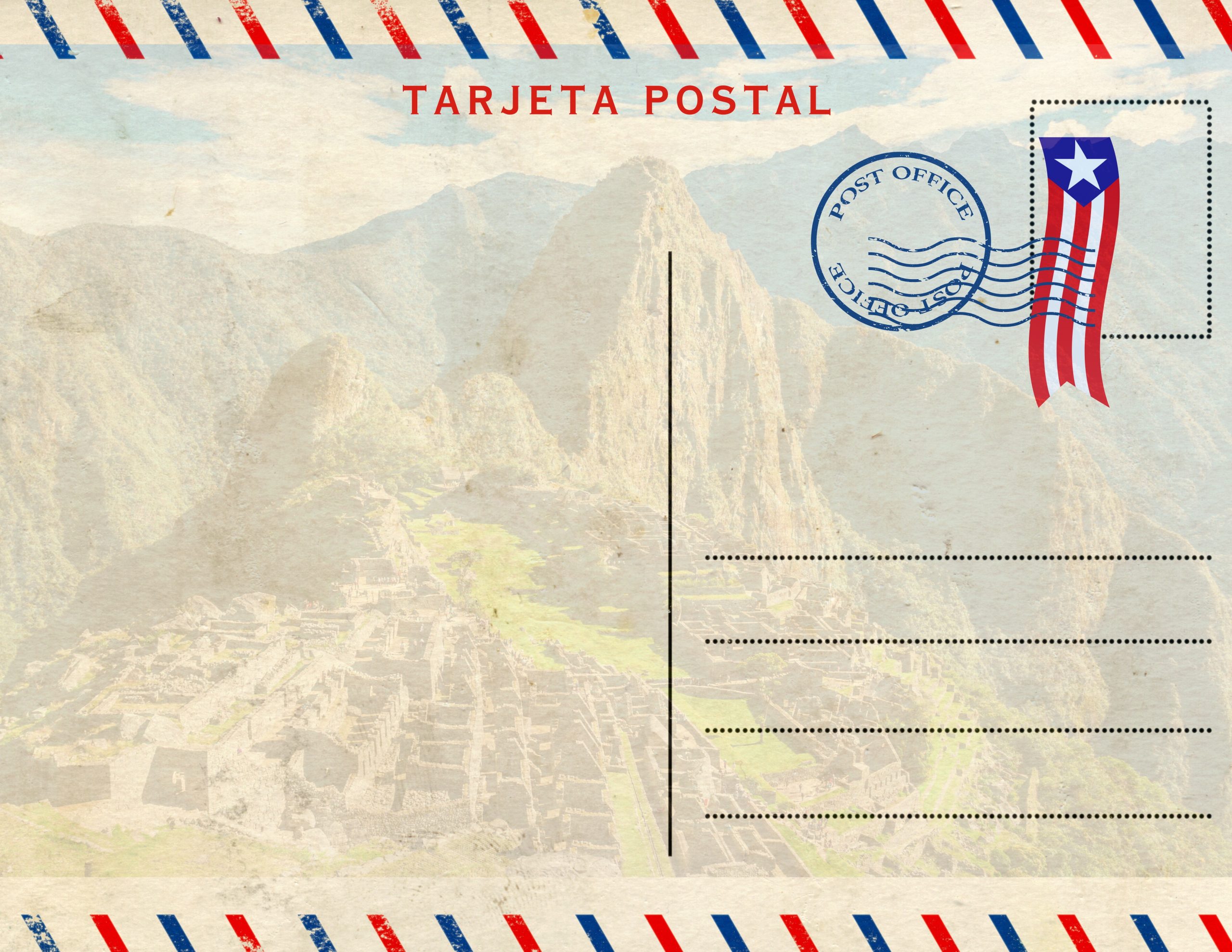
Ernesto is going to read one of his postcards that he wrote to his mom during his trip through Latin America. Ernesto includes the preterit tense, highlighted in blue, to explain what he did on his trip. These are Ernesto’s completed actions with a determined end.
Ernesto also includes verbs in the imperfect tense, highlighted in pink, to describe what the people and places were like along his travels through Peru. These are not actions that Ernesto did. Rather, Ernesto is describing how the people were and what they were doing. He uses the imperfect tense because the narration of the people in Peru represents a continuous action or description in the past.
Listen to the audio as you read Ernesto’s postcard to his vieja, another word for mom used in Argentina. The English translation is on the 2nd slide.
Actividad A
In the following activity, identify the completed actions (the preterit) and the descriptions or ongoing actions in the past (the imperfect). Use Ernesto’s postcard with the preterit verbs in blue and the imperfect ones in pink as a guide.
Spanishland School presents the major differences between the preterit and imperfect tenses in a very clear way. Watch the video until the end to answer some follow-up questions to test your comprehension.
You could press CC for captions in the language you prefer.
Actividad B
Spanishland School shares two major differences between the preterit and imperfect tenses. See if you picked up on them by answering the following questions.
¡Muy bien! 🙂
The goal for this section of the chapter was to get an overview of the preterit and imperfect and how to recognize these tenses in a postcard or in conversation.
In the next sections of this chapter, you will first learn about the preterit tense on its own when discussing how you prepared for your last trip and what you did during your travels. Then, you will learn about the imperfect tense separately to describe how your trip was. Finally, you will learn how to use both tenses when describing your last trip.
Are you ready? 🙂
II. ¿Cómo preparaste para tu último viaje?
If you decide to take a vacation, there is usually some preparation involved, such as reserving a hotel or Airbnb, buying your ticket, checking the weather in your destination, and deciding what clothes to pack.
If you travel by plane, you also have to think of how to get to the airport, check-in, go through security or customs and board your plane on time.
How did you prepare for your last trip? Did it require travel by plane, or was it a roadtrip? Did you travel by train?
Emma recently traveled through South America to practice her Spanish-speaking skills and learn about Latinx culture.
The song playing in the background is called “Gracias a la Vida” by Los Machucambos.
Listen as Emma describes how she prepared for her last trip. Each audio recording corresponds to the following slides.
Parte 1
Parte 2
Parte 3
Actividad C
Emma jotted down what she did to prepare for her last trip to South America, but her sentences are not in order.
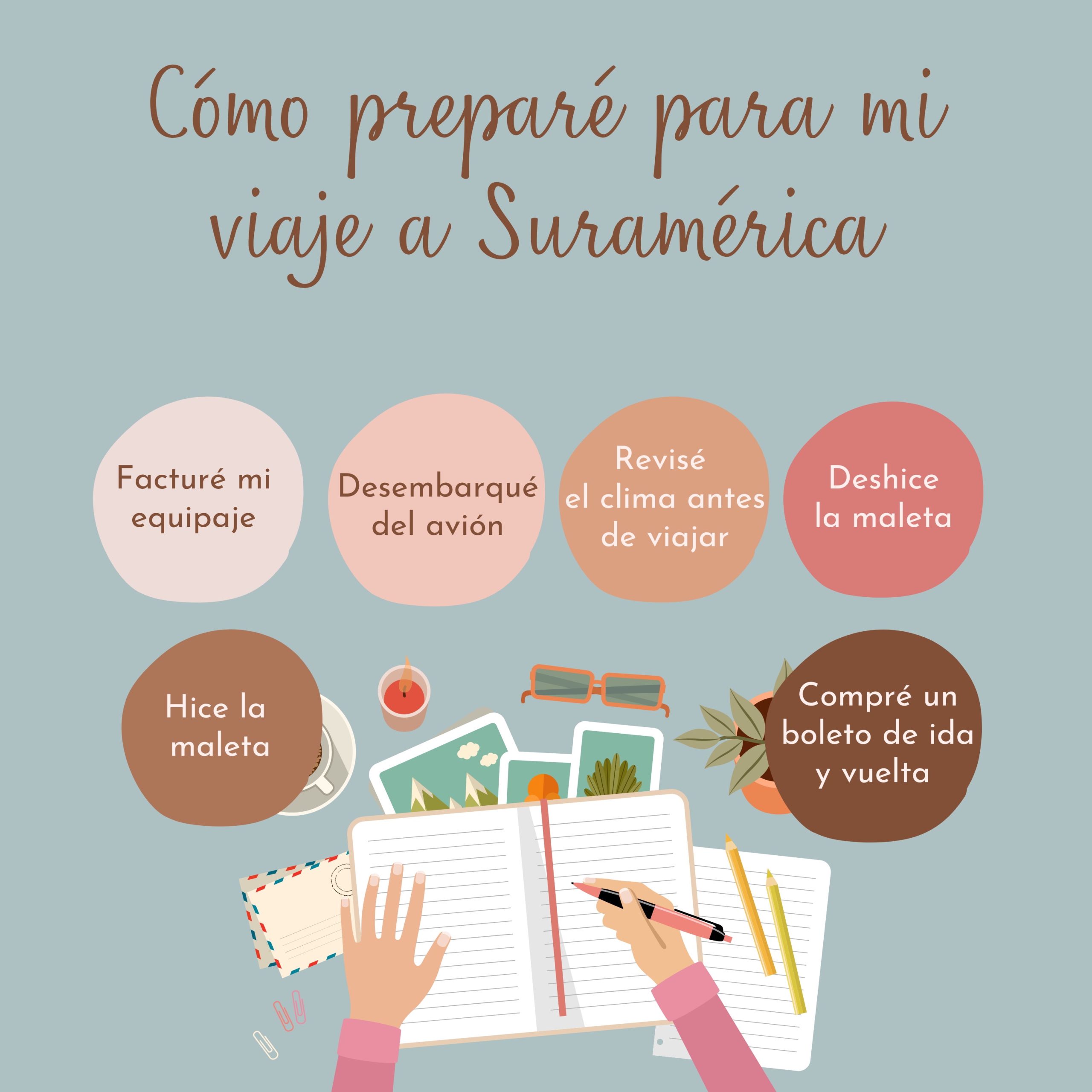
Based on the slides Emma shared with you, put her travel preparation in order of how she completed them.
¡Muy bien! 🙂
Actividad D
Review the slides Emma created that list what she did to prepare for her last trip. What do you have in common with Emma? Whether you traveled out of state, out of country or to another city, what activities did you also do to prepare for your last trip?
If you traveled by train, bus or boat, you could use the following expressions:
Compré un boleto de tren. Compré un boleto de autobús. Compré un boleto de barco.
Paso 1. Write 4-5 activities you did to prepare for your last trip. Also include where you traveled to.
Modelo- Para mi último viaje a Chicago, saqué dinero del cajero automático, compré un boleto de tren, compré meriendas, desembarqué del tren y tomé un taxi a la casa de mi amiga.
Paso 2. Ask 1-2 students what they did to prepare for their last trip. If they ask you, you could read your sentence from Paso 1.
Modelo- Hola. ¿Cómo preparaste para tu último viaje?
Did you all do similar things to prepare for your travel?
¡Excelente! 🙂
How do you think Ernesto prepared for his trip through Latin America by motorcycle? What type of clothing do you think he packed?
Watch the following film trailer by acontrafilmshome, to get an idea of what Ernesto’s journey entailed through the different South American countries and their diverse weather patterns.
You will notice that Ernesto walked through the heat of the Atacama Desert in Chile to the freezing and snowy alps of the Andes.
The trailer does not have subtitles. When you watch Diarios de motocicleta, you will have subtitles. For now, concentrate on the weather patterns Ernesto and Alberto had to endure during their trip.
Because of the extreme weather conditions between the southern and northern parts of Latin America, Ernesto had to pack clothing that would be appropriate for both warm and cold climates.
What clothing items and accessories do you think Ernesto chose to pack in his suitcase? Press audio for the pronunciation of each slide.
Ropa de primavera y verano
Accesorios
Actividad E
Place the articles of clothing Ernesto packed in their correct category. What clothing did he pack for warmer and colder weather?
¡Muy bien! 🙂
Actividad F
Nessy, who is a community college student, is about to study abroad in San José, Costa Rica in May, which is during the rainy season. Costa Rica is unique because in the capital of San José the weather is cooler. It’s in a valley and between mountains. However, the weather is very hot and humid by the coast. Nessy’s trip is 2 weeks away!
Nessy is going to read what she packed. Select the correct articles of clothing Nessy mentioned that she packed for the city and the coast.
¡Bien hecho! 🙂
Actividad G
Paso 1. Ask 4 different students what they packed during their last trip. Jot down their names and answers.
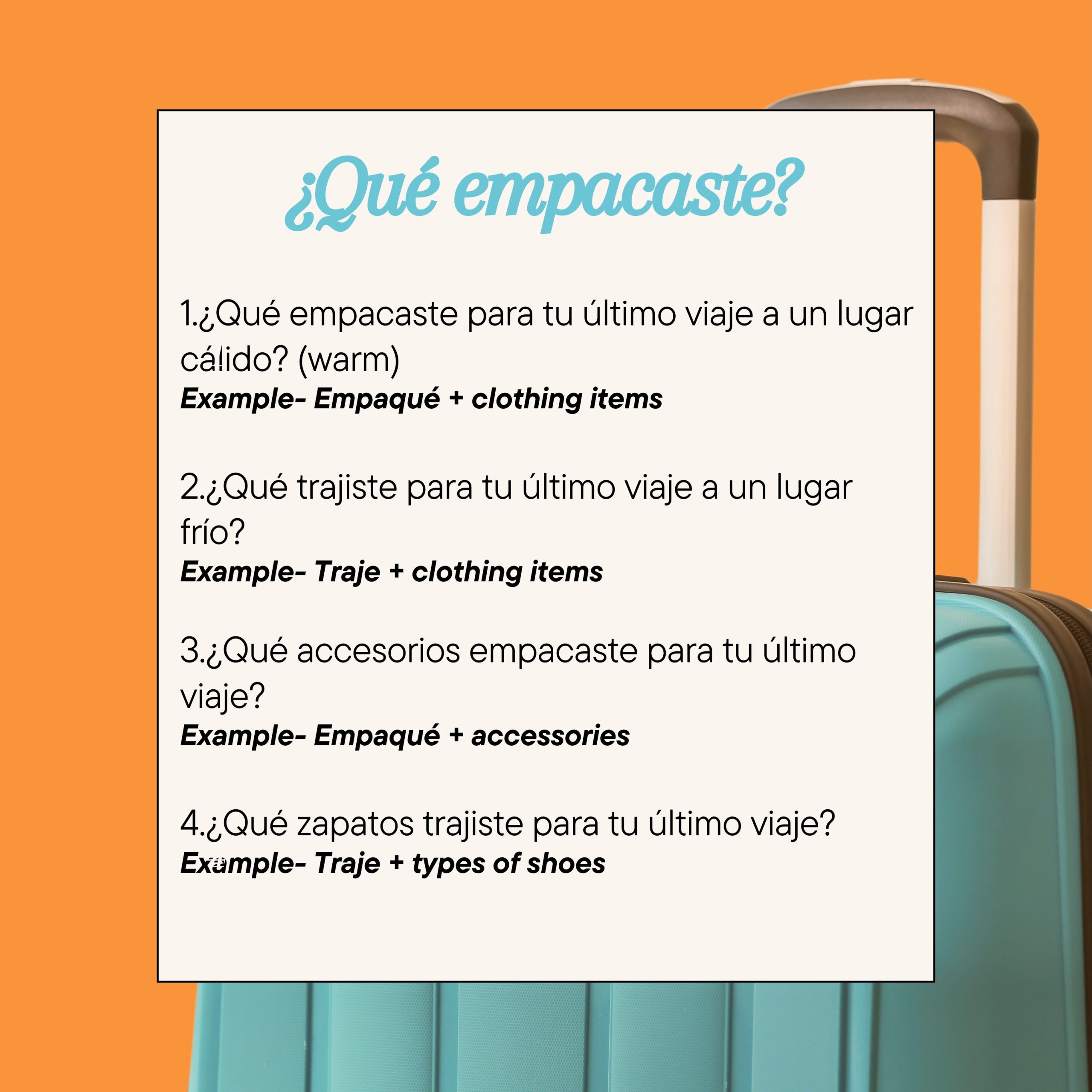
Paso 2. Did you pack similar items during your last trip? What were they?
Modelo- Tomás y yo empacamos jeans y zapatos de tenis para nuestro último viaje.
Or Jessie y yo trajimos nuestro reloj y cinturón para nuestro último viaje.
III. ¿Qué hiciste en tu viaje?
Do you remember your last trip? If you’ve never traveled out of state or country, do you remember your last trip to a city outside of your own?
Listen as YouTuber, Jen Dimas, details her last trip to Taxco, Guerrero in Spanish. She uses the preterit tense to list the activities she did.
Actividad H
Do you remember what Jen did in Taxco? 🙂 Jen is going to state what she did during her trip again. Select whether each statement is true or false, based on Jen’s video.
How did you do? Is Taxco somewhere you would like to visit in the future?
In Jen’s video, she uses the preterit tense to list what she did during her trip. You used the preterit tense in the last section of this chapter when you described what you packed or brought in your suitcase for your last trip.
You learned that the preterit tense describes completed actions in the past with a definite end. In this section of the chapter, you will be introduced to how to form the preterit tense, different conjugations for regular and irregular verbs, and other situations where you use the preterit tense to discuss past events.
Watch as Speak Spanish with Paula introduces you to the preterit tense and its conjugations and uses.
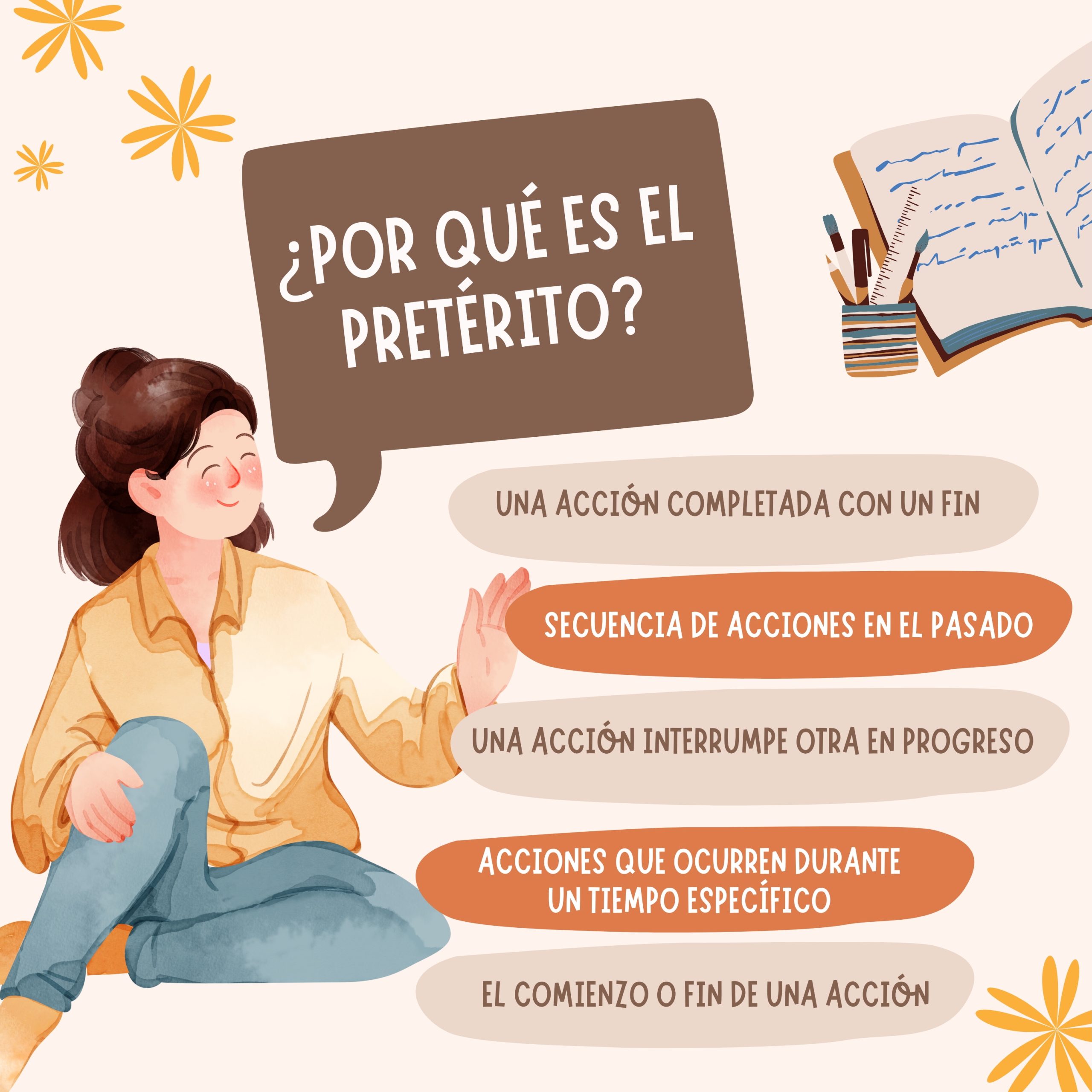
For a summary of the preterit tense, see the following slide.
Actividad I
Based on the video by Paula and the slide you just reviewed, select the reason each of the sentences would require the preterit tense.
¡Excelente! 🙂
The title of this chapter is ¿Cómo fue tu último viaje?
To start a conversation about someone’s last trip, you could ask the questions in the following slide. The slide also includes ways to answer each question.
Actividad J
Select a partner. Ask them the first 4 questions in the conversation slide and then switch roles.
Modelo-
Estudiante 1- Hola. ¿Cuál fue tu último viaje?
Estudiante 2- Buenas. Mi último viaje fue a Florida.
You asked the first 4 questions in the slide because to answer the 5th question and beyond, you will need to know how to express what you did using different verbs in the preterit yo form.
To answer the question, ¿Qué hiciste en tu último viaje?, see the following slides, which provide snapshots of activities from a recent trip.
The snapshots are separated into AR, ER/IR and Irregular verbs that are in the preterit yo form. Feel free to press the audio to hear how these verbs are pronounced.
Verbos AR en el pretérito forma yo
Verbos ER/IR en el pretérito forma yo
Verbos irregulares en el pretérito forma yo
Actividad K
Recently, Fede traveled to Buenos Aires, Argentina, with his girlfriend. At his job, someone asked Fede, ¿Cómo fue tu viaje? Select the activities Fede said he did during his trip, based on the cues provided. Refer to the slides with yo form preterit verbs as needed.
¿Y tú? ¿Qué hiciste en tu último viaje?
Actividad L
Paso 1. Have you ever played, This or That? Complete the following questionnaire about your last trip. What did you do?
Paso 2. Share your answers with a partner.
Modelo- Hola. En mi último viaje, fui en avión. Me divertí y me quedé en un Airbnb. Etc.
Paso 3. Count how many activities you did on the left versus the right side of the game, ¿Este o ese? If you did more activities on the left, this means you are a more adventurous traveler. If you did more activities on the right, this means you are a more reserved traveler.
Which one are you?
Left side: If you are female: Soy viajera aventurera. If you are male: Soy viajero aventurero. If you are non-binary: Soy viajere aventurere.
Right side: If you are female: Soy viajera reservada. If you are male: Soy viajero reservado. If you are non-binary: Soy viajere reservade.
Share your findings with your partner. 🙂
¡Muy bien! 🙂
Actividad M
Paso 1. Go through all 3 slides. Click here. Select 5 activities you did on your last trip or visit to a new city. Then, select 5 things you didn’t do on your last trip or visit to a new city.
Modelo- En mi último viaje, _____, ______, _____, ____ y ______. No _____, ______, _____, _____ y ______.
Paso 2. Ask another student what they did during their last trip and what they didn’t do. Then switch roles.
Modelo- ¿Qué hiciste en tu último viaje? ¿Qué no hiciste? (The student will read their lists.)
Do you have any activities in common?
¡Muy bien! 🙂
You are ready to ask the rest of the conversation questions about someone’s last trip to your fellow classmates. 🙂
Actividad N
Go around the room and find 7 different students. Each student will be asked one of the questions from the following list. Greet the student, select a question to ask them from the list, and say thank you after they answer.
To review how to answer each of these questions, click here and go to the orange slide.
Modelo- Buenas tardes. ¿Te divertiste en tu último viaje? Student answers: Sí, me divertí mucho. You say: Gracias. Go to the next student.
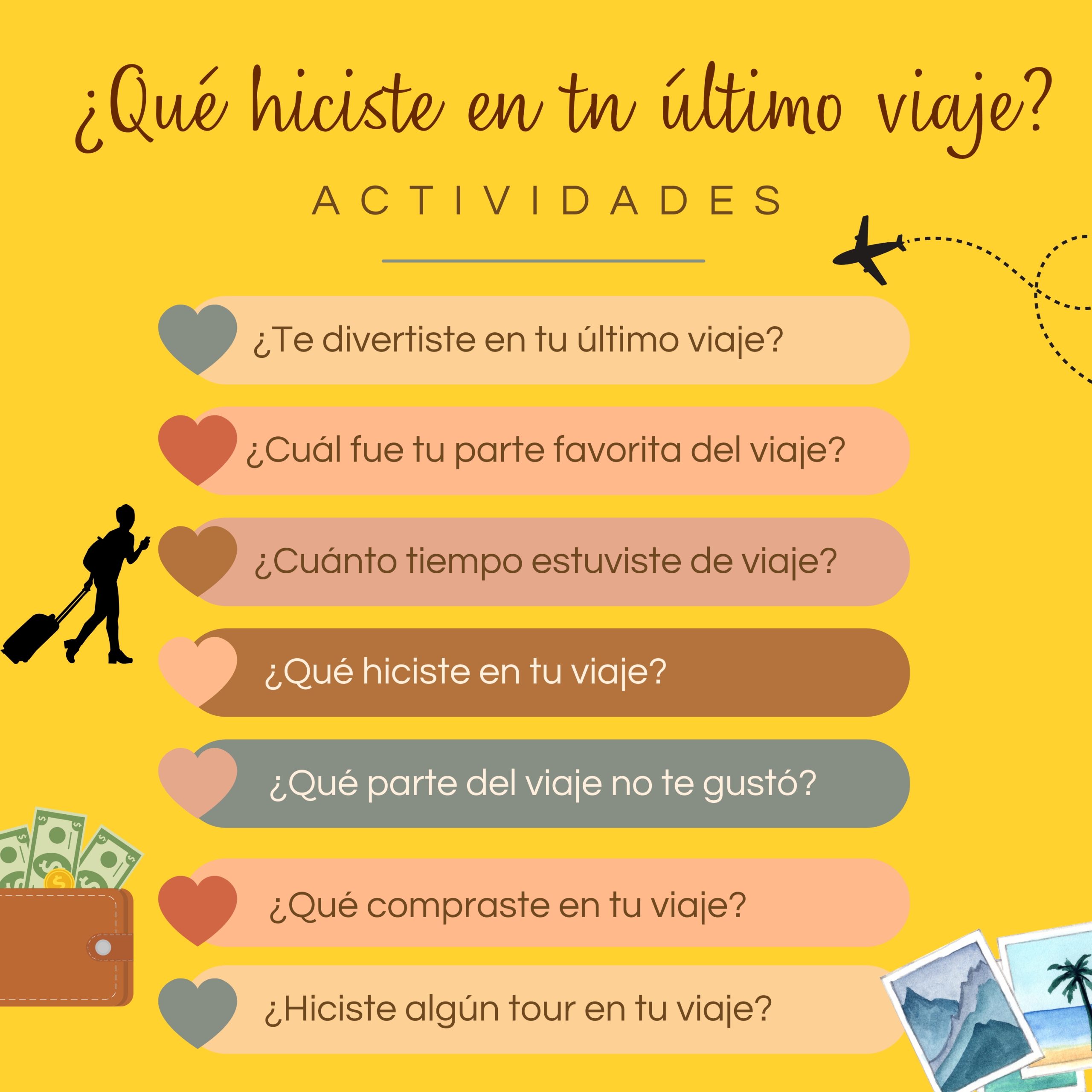
You did very well. You learned about the preterit tense, how to use it in conversation to ask someone about their last vacation, and how to describe what you did during your last trip. ¡Magnífico! 🙂
IV. ¿Cómo era tu viaje?
Have you ever traveled somewhere that moved you and then later showed friends or family pictures or videos of this place? How would you describe it? Was it beautiful? Was it majestic? How was the weather there? How were you feeling when you were there? What was it like?
Watch the following clip by CineClips of Ernesto as he arrives to Machu Picchu for the first time. What do you think he was feeling?
Actividad O
Based on the video you just saw of Ernesto visiting Machu Picchu for the first time, select the most appropriate answer for each question.
Did you notice that the questions and answers were in the imperfect tense versus the preterit? Because you were answering questions about how Ernesto was feeling, what he was wearing, what the weather was like and how he was describing Machu Picchu, this would require the verbs to be in the imperfect tense since they do not have a specific end point.
Watch as Tell Me in Spanish introduces you to the imperfect, discusses when and how it is used in conversation and presents the verb conjugations for the tense.
Actividad P
Based on what you just learned about the imperfect tense from Tell Me in Spanish, select the correct answer for each question.
For a summary of the imperfect tense, review the following slide.
Listen as Ernesto Guevara reflects on his motorcycle trip through Latin America with his best friend, Granado. Ernesto describes the places and people he encountered during his trip using the imperfect tense.
Actividad Q
You listened to Ernesto share memories of his voyage through Latin America with Alberto.
Did you hear all of the verbs Ernesto used in the imperfect tense when describing the geography of Chile, the clothing of the women in Peru, the age and intelligence of their young tour guide, and the weather while on the road?
How did you do? 🙂
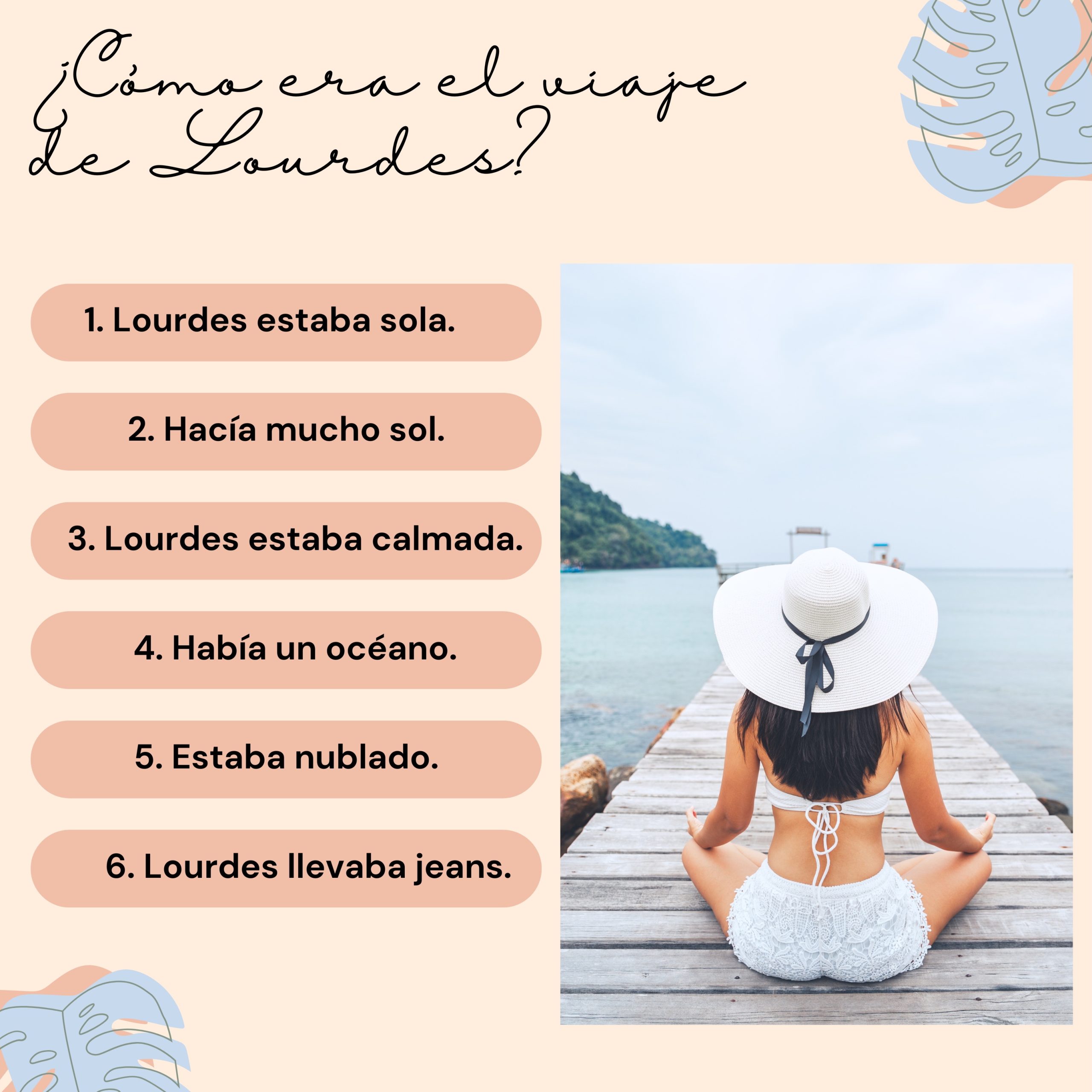
Lourdes is taking a much needed vacation.
Actividad R
Paso 1. Lourdes is sharing a photo with a friend and discussing how her trip was. Select whether the following statements that are true or false, based on Lourdes’s vacation photo.
Paso 2. Discuss your last vacation with a classmate. Ask your partner the following questions, and then switch roles.
- ¿Estabas solo/a/e o con familia o amigos en tu último viaje? Answer: Estaba ______.
- ¿Qué tiempo hacía? Answer: Hacía _____. or Estaba _____. (weather)
- ¿Cómo te sentías o cómo estabas durante tus vacaciones? Answer: Me sentía ____ (emotion). or Estaba ____. (emotion)
- ¿Qué ropa llevabas en tu viaje? Answer: Llevaba _____. (list some of the clothing items)
- ¿Cómo era el lugar (the place)? Answer: Era ______. (adjective to describe the place you visited)
You just learned how to use the imperfect tense to describe your last vacation experience. The imperfect is also used to describe habitual actions you used to do in the past.
Listen as Armando describes his childhood in Panamá.
For a transcript of Armando’s video, click here. Scroll to Armando.
Actividad S
Armando shared a lot about his childhood in Panama. ¡Qué interesante! 🙂

When learning about the imperfect in the pink slide you reviewed earlier, you were presented with key words that are associated with the imperfect because they denote habit or a repeated actions in the past.
Paso 1. In the following transcript, with a partner, find the key words that convey repetition or habitual actions in the past.
Hola. Me llamo Armando y soy de Panamá. Voy a hablar un poco de mi pasado. De niño, jugaba al fútbol con mis amigos casi todos los días. Siempre estaba afuera porque me gustaba estar en la naturaleza. Tenía pelo más rubio en mi niñez y me vestía en pantalones cortos y camisetas con frecuencia. ¡Hacía mucho sol en Panamá! También, leía libros de ciencia ficción cada semana. Por la tarde, comía empanadas y tostones con mi familia. ¡Eran deliciosos! ¿Y tú? ¿Qué hacías de niño? ¿Cómo era tu niñez?
For the answer key, click here.
Paso 2. With your same partner, answer the following questions together.
- ¿Qué deporte jugaba Armando de niño?
- ¿Por qué Armando estaba afuera siempre?
- ¿Qué color era el pelo de Armando de niño?
- ¿Qué ropa llevaba Armando en su niñez?
- ¿Qué tiempo hacía en Panamá?
- ¿Qué tipo de libros leía Armando de niño?
- ¿Qué comida panameña comía Armando con su familia?
For the answer key, click here and go to the 2nd page.
¡Excelente! 🙂
To ask someone else how things were during their last trip using the imperfect and what they used to do as a child, please see the following slide. Play the audio to hear the questions pronounced.
Actividad T
Paso 1. In groups of 2 or 3, take turns conjugating the verbs under each photo in the imperfect tense to describe what each person used to do as a child. You could check your answers in the second slide.
Paso 2. Put a check by the activities you used to do as a child as well.
Paso 3. Write a sentence with an activity you have in common with one of the kids from the slide.
Modelo- Como Gigi, yo también me levantaba temprano cada mañana. (Like Gigi, I also used to get up early each morning.)
Paso 4. Read your sentence to your group. 🙂
Do any of you have activities in common you used to do as children?
It’s time to converse with the class using the imperfect tense! 🙂
Actividad U
Choose any 5 questions from the following image, and ask 5 different students what they used to do as children.
*If you are talking to a male student, you could say: Hola. De niño, ¿qué películas veías? (as a child)
*If you are talking to a female student, you could say: Buenas. De niña, ¿jugabas deportes? ¿Cuáles?
*If you are talking to a student who uses non-binary pronouns, you could say: Hola. De niñe, ¿qué música escuchabas?
To hear the questions pronounced, click on the audio.
¡Bravo!
You are now going to ask your conversation partner about their childhood to learn what they used to do as a child. Was their childhood similar or different than your own? What did you learn about them?
V. Los diaros de motocicleta
During this chapter, you learned about Ernesto Guevara and his motorcycle trip through Latin America. In this section of the chapter, you will be watching the film, Los diarios de motocicleta.
Your instructor will give you access to the film. If you are not taking a course through the College of DuPage, you could check your local library or streaming services for access to Motorcycle Diaries.
While watching the film, you will answer questions using the preterit and imperfect tenses and the vocabulary on clothing and travel. The questions from the film will serve as a review of the chapter goals.
Preguntas sobre Diarios de motocicleta
After watching the film, watch this video about Motorcycle Diaries and ethical travel by A Moonlighting English Teacher.
After watching The Motorcycle Diaries Ethical Travel, go back to your answers in your document and see if you would like to change or alter any.
¡Muy bien! :).
VI. Chapter 8 Final Assessment
In Chapter 8, you learned how to describe your last trip and ask others about theirs with the preterit and imperfect tenses and vocabulary on travel and clothing. You also described your childhood using the imperfect tense and asked others about theirs.
For your Chapter 8 Final Assessment, you will converse with Ernesto about your last trip and ask him questions about his childhood to get to know him better. Be sure to address the questions he includes below.